
Touching Virtuality: How to Say Goodbye to the Real World

Virtual reality surrounds us. For now, it’s confined to our phones and computers, yet soon digital worlds will feel far more tangible. As early as 2021, Mark Zuckerberg grasped the trajectory of humanity’s future and founded Meta, a company with an ambitious mission: nothing less than the creation of a true matrix. A metaverse in which people can work, communicate, and live, all through augmented and virtual reality technologies.
— Do not try to bend the spoon — that’s impossible. Instead, only try to realize the truth.
— The truth?
— There is no spoon.
At the time, this announcement sparked a wave of criticism. Many felt Zuckerberg was rushing things. Indeed, for most people, VR headsets and other tools for interacting with virtual worlds were little more than novelties rather than essential devices. But what has changed since then?
First and foremost, virtuality itself has evolved. Thanks to the efforts of software developers, there are now far more reasons to invest in VR and AR devices. In addition, a variety of options, including more affordable ones, have emerged for those eager to experience virtual worlds. Let’s explore some of them in detail.
Headsets remain the primary gateway into unreal realities. In recent years, numerous new models have been released, yet the leading names in the field remain Valve, HTC, Meta, and Pimax. Recently, a new contender has joined this elite group: Apple, with its Vision Pro.

VR headsets generally fall into two categories: standalone and those requiring connection to another device. Standalone headsets are convenient because they function as complete computers in themselves, allowing users to enter virtual spaces from anywhere. Within this category, devices from Meta and Apple are particularly impressive.
The second type connects to a computer or gaming console and caters to more dedicated, game-oriented users. Connections may be wired or wireless. Among these, the best headsets are produced by Valve, HTC, and Pimax. Heres a small comparison of current headsets for your convenience:
| Model | Price | Pros | Cons |
|---|---|---|---|
| Meta Quest 3S | $299-$400 | Budget and balanced choice | Short autonomy, grainy pass-through |
| Meta Quest 3 | ~$499 | Best standalone VR | Price, battery, less usable for MR |
| PSVR2 | ~$400 | Console games | Needs PS5, cable connection |
| Apple Vision Pro | $3,499 | Professionals, MR/productivity | High price, weight, limited content |
| Valve Index | ~$999 | PC VR enthusiasts | Difficult installation, needs PC |
| HTC Vive XR Elite | ~$1,099 | Hybrid VR/AR, MR | High price, less developed ecosystem |
| Pico 4 Ultra | 549 € | Quest alternative in Europe/Asia | Unavailable in the US, weaker ecosystem |
| Pimax Crystal | $1,599 | Simulators and visual accuracy | Needs PC, build quality, price |
Gloves are arguably the most important accessory after the headset. Today, most users rely on simple controllers to interact with virtual environments. These typically come with the headset and are not hugely different from the joysticks used for Xbox or PlayStation.
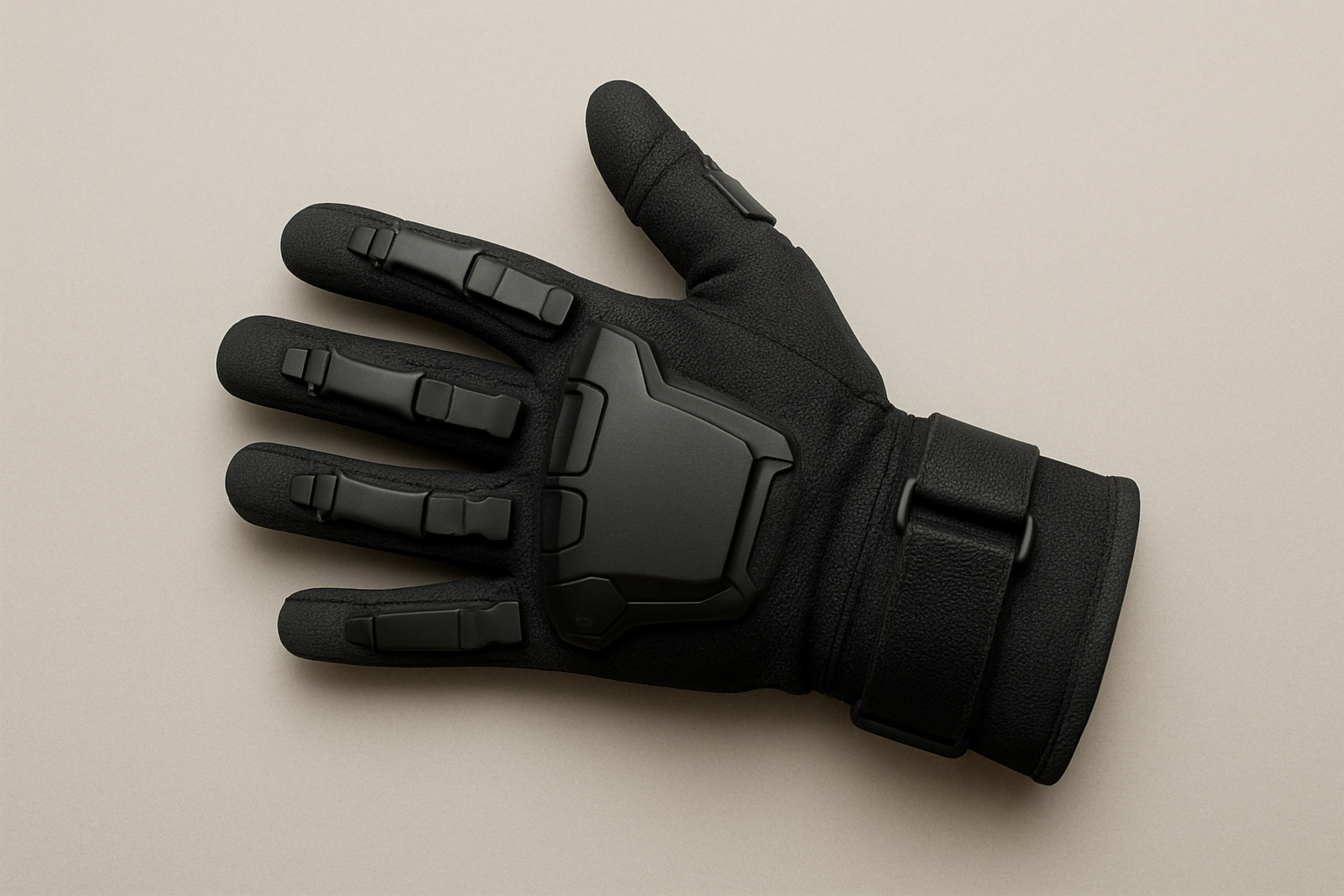
But what if we truly want to feel virtual objects—experience their weight, texture, temperature, and density? It sounds like science fiction, yet the technology is beginning to exist. Many promising prototypes have emerged, but the most intriguing is a glove from Sharp. Tiny vibromotors embedded in the finger phalanges allow users to sense the texture of virtual objects, whether stone, hair, or even liquid. The prototype’s design, however, looks fragile. Quick, sweeping motions might easily send it flying. Nevertheless, as the saying goes, “we shall see.” Its expected price is around $700, which is relatively reasonable for such technology.
Meanwhile, another project has long since reached its Kickstarter goal: the CaptoGlove. While it won’t make virtual objects physically tangible, it offers far greater comfort than any joystick.
Boots and movement platforms address one of VR’s greatest challenges: avoiding collisions with walls. No matter how spacious a room may be, reality inevitably imposes its limits. Special systems allow users to move freely while remaining in one place.
For budget-conscious users, Cybershoes offer a solution. Paired with a mat and a chair, these $300 boots let you “run” in every direction while seated. It’s a compromise, but an effective one.
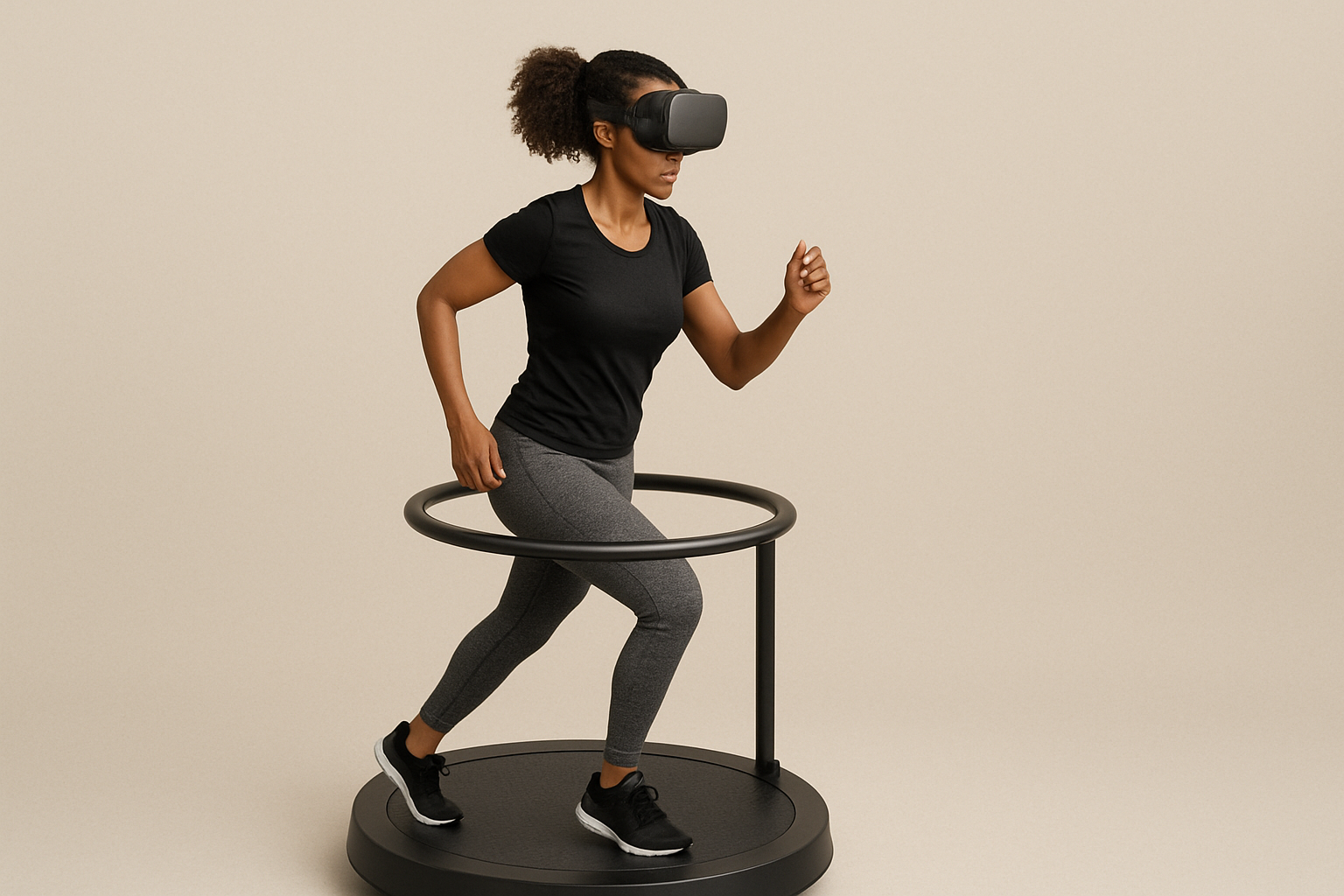
More advanced movement systems also exist. Remember Ready Player One? The protagonist navigates a fully omnidirectional treadmill. That technology is real, available for around $3,000 for home use. Called Virtuix OmniOne, it functions similarly to Cybershoes, but allows standing, squatting, jumping, and even rolling. Due to the price, such platforms are mostly found in VR clubs. Yet there’s no need to despair—personal computers were once similarly exclusive.
Full-body suits are the ultimate dream for advanced VR enthusiasts. These attach trackers to all moving parts of the body. Trackers themselves are inexpensive, but the challenge lies in securing and calibrating them correctly. Curious how it looks? It’s fascinating to watch.
Finally, software is the cornerstone of virtual reality. Without it, there is nothing to immerse oneself in. Yet developing this software requires funding, which ideally comes from hardware sales—a tricky circular problem. It is no wonder VR still seems a speculative investment to many.
Today, there is already a respectable selection of useful programs, games, and virtual platforms. These include graphic editors, fitness apps, virtual shops, museums, cinemas, and collaborative workspaces. Most function much like websites: click a link and you are transported elsewhere. The best example of this boundless virtuality is VRChat. Excluding Zuckerberg’s still-underdeveloped metaverse, VRChat most closely resembles a limitless virtual reality—a sort of internet for VR headset users. Even without a headset, it is accessible via a standard computer.
***
As we can see, technology continues to advance, and it seems Zuckerberg’s vision of a virtual age was not misplaced. Devices are becoming more affordable and diverse, while the metaverse expands daily. At the same time, many highly desired features remain out of reach for the general public. Prices and the lack of necessity mean VR has yet to move beyond the realm of entertainment. Yes, there are more practical applications, such as in defence or industry, but that is a story for another time.