Lyuda Kalinichenko: “I represented Britain at the Balkan Textile Biennale in Serbia”

I wouldn’t call it fate, but in London it was almost impossible for me not to meet the artist Lyuda Kalinichenko,. In 2023 I was working on a piece about the current state of the UK punk-rock scene and looking for someone to come to a concert. The only person who said yes immediately was Lyuda — though at that point we had barely been in touch. The concert turned out to be frankly awful, but thanks to it I learned that you can pitch any outlandish idea to Lyuda and she’ll go for it. She is, in a sense, that kind of outlandish idea herself.
We have since unrolled her ten‑metre artwork across the lawn of Victoria Park and belted out karaoke on New Year’s night on the Bridge to Nowhere in Peckham. From that bridge you can see a quintessential Soviet “ship” residential block, the kind found everywhere in St. Petersburg and, I imagine, in Lyuda’s hometown of Yekaterinburg. It’s pretty much the only spot in London that looks like Russia.
The Bridge to Nowhere holds some kind of sacred meaning for Kalinichenko. She once dreamed of mounting an exhibition beneath it, and she mentions the bridge again in the text she asked me to edit for publication. It’s a story about her trip to Textinnale in Serbia. From the tone she chose, it’s not entirely clear how outlandish that trip really was. But knowing Lyuda, I’m almost certain it was exactly that…
“One day you find yourself here: in a vast world, surrounded by the unknown. Did you choose this place, or did you end up here by chance, like a piece of polystyrene carried by the current and left on an unfamiliar shore?” So begins the text by Saška Kremenec and Katerina Ablamskaya, organisers of the Balkan Textinnale in Serbia.
For me, the image of a drifting piece of polystyrene turned out to be unexpectedly precise. It’s a strange material: repellent, alien, nearly indestructible, always in sight, irritating by its very presence; somehow more honest than the rubbish that sinks to the bottom. And yet, in extreme conditions, polystyrene is indispensable: it keeps warmth in and keeps you afloat. In these contradictions I recognised my own state over the past few years.
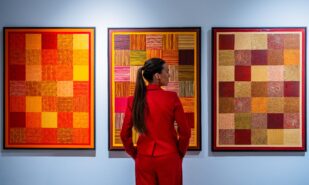
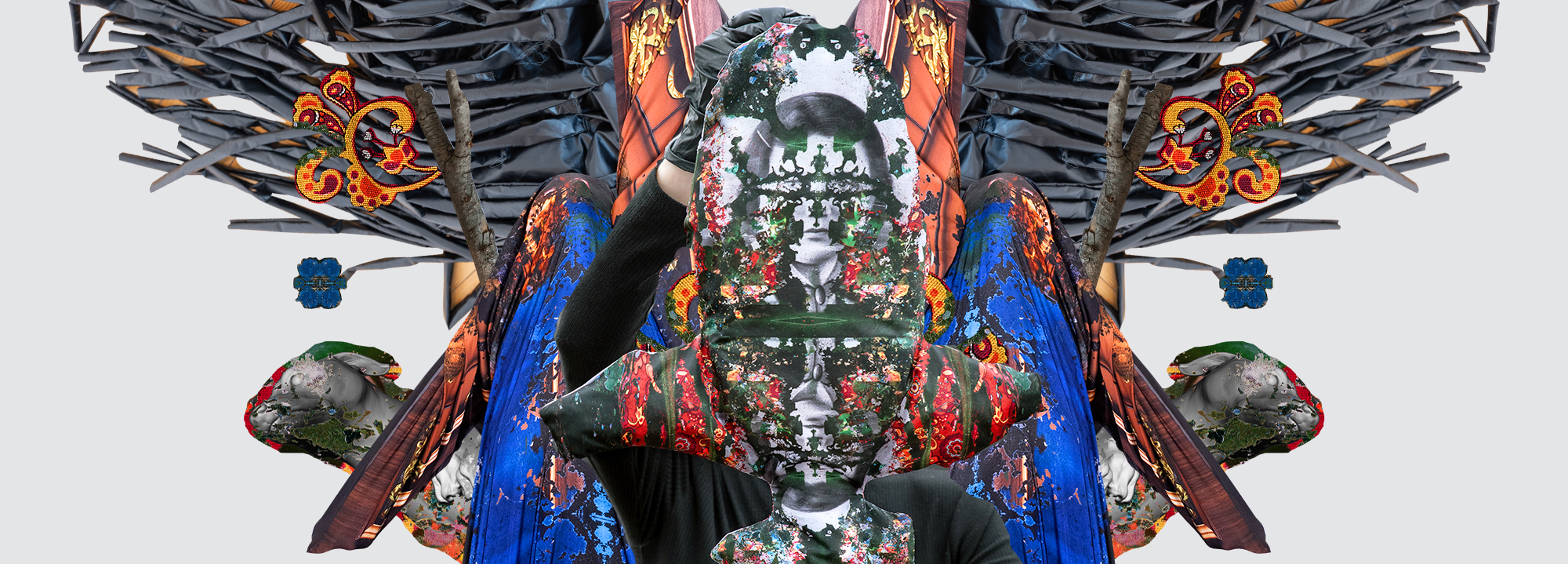
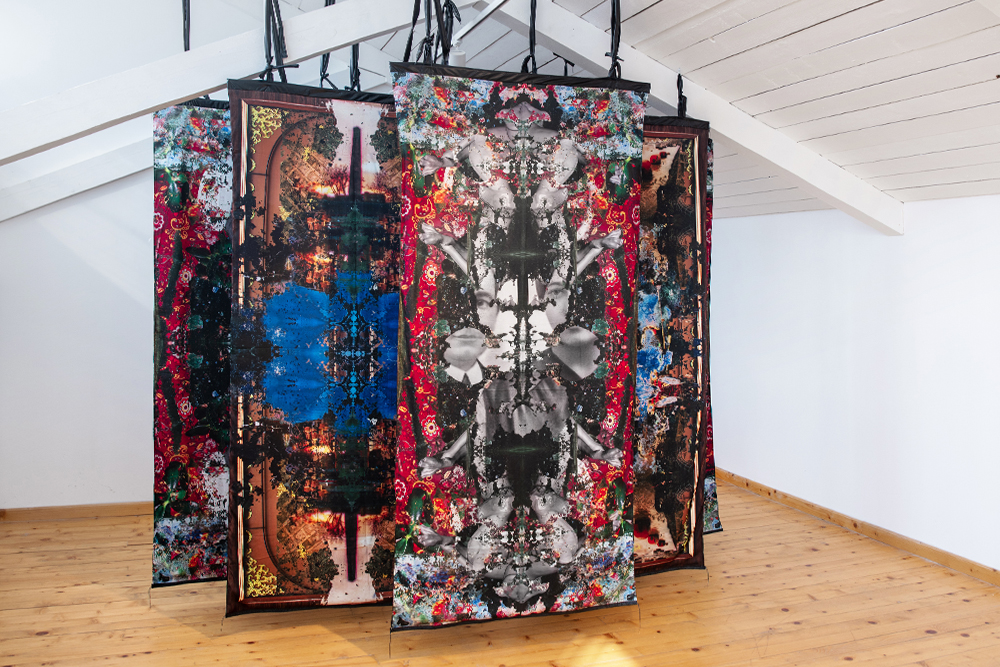
I am on my way to Luton Airport, from where I will fly to Belgrade in three hours. This morning, London is wrapped in fog, and I especially love it like this; I have no desire to leave. Half of my suitcase is taken up by Loop Poetry, the installation taking part in Textinnale. Since emigrating, fabric has become my main medium, partly because it is simply practical: it is mobile and easy to store. Five panels, each over two metres high, fit easily into hand luggage. Alongside them, my suitcase carries two stories that have unfolded over several years.
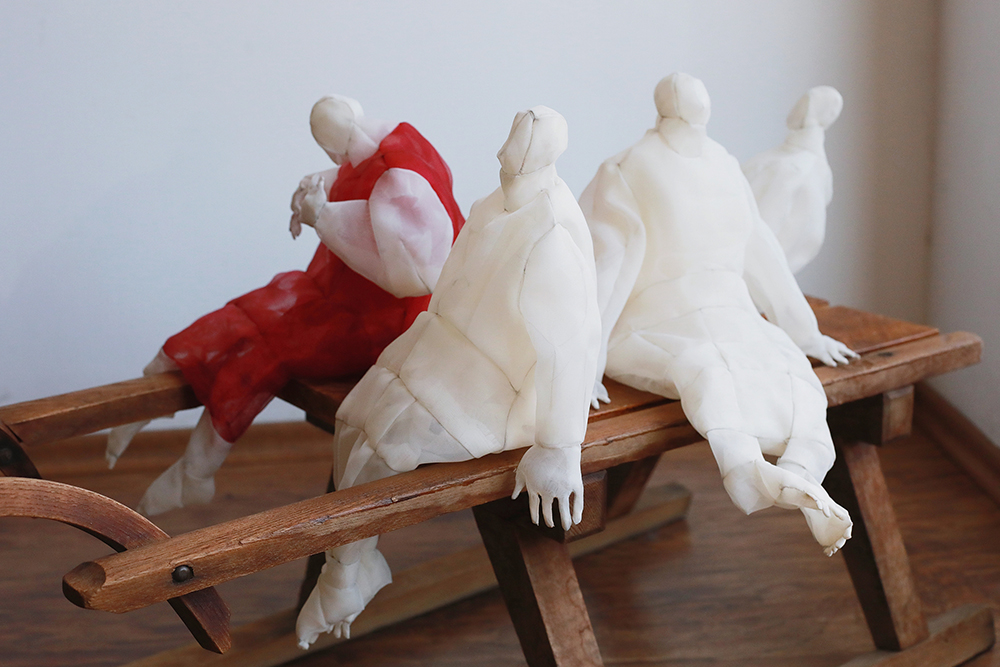
The first, about the loss of memory, began in 2016. Our entire family photo archive, containing photographs dating back to the 1930s, many of them retouched by hand, was accidentally thrown away with the rubbish. For several years, I worked to reconstruct it by collecting images from relatives. Many had survived thanks to the old tradition of sending photographic prints instead of postcards. In 2022, this project became a book.
The second story is about memories found by chance. In 2023, walking through Burgess Park in London, I came across photographs scattered across a bridge. The bridge was called “Bridge to Nowhere”, and the photographs, wet from the rain and partly damaged, looked like fish scales. I took them home. This is how Loop Poetry was born, becoming my own journey through time.
The theme of this year’s Textinnale is DRIFTLANDS. Its three venues drift like islands, those same pieces of polystyrene washed up on an unfamiliar shore. Yet each has its own character, its own atmosphere.
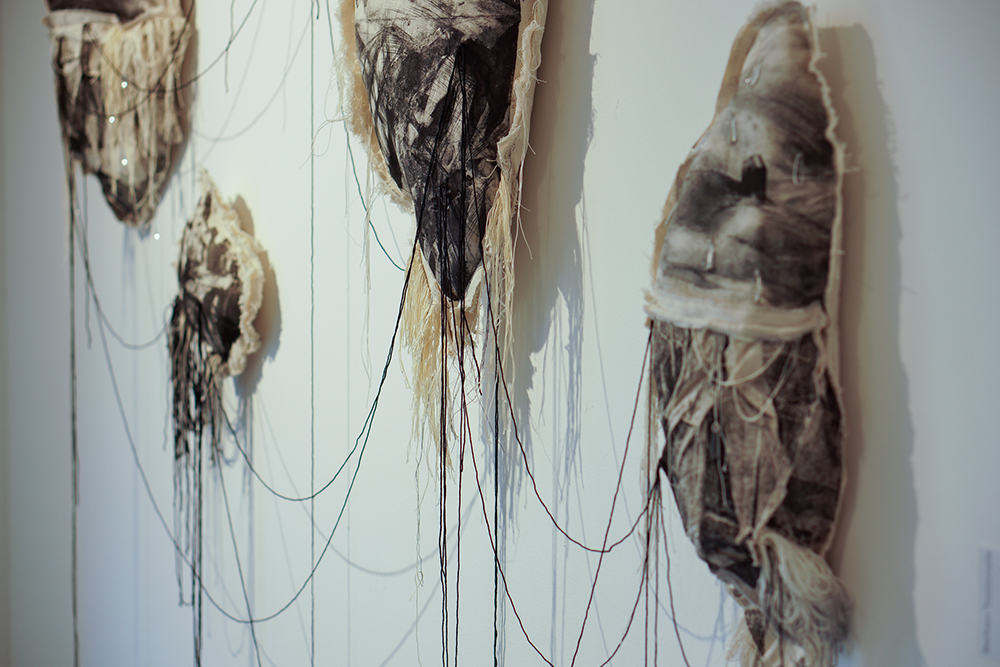
Woonder Studio carries a sense of fragility, pain and tenderness. There I had the chance to hold A Speechless Diary — a book of white fabric, in which hand-embroidered abstract patterns stand in for text — by my London-based fellow artist Olga Klimovitskaia. The black thread patterns remind me of a morning when I spotted a centipede on my white bedsheet and leaped up screaming, trying to shake it off as it darted around in search of escape. At some point, our fears, mine and hers, seemed to merge. I sense that same tension through the patterns of A Speechless Diary.
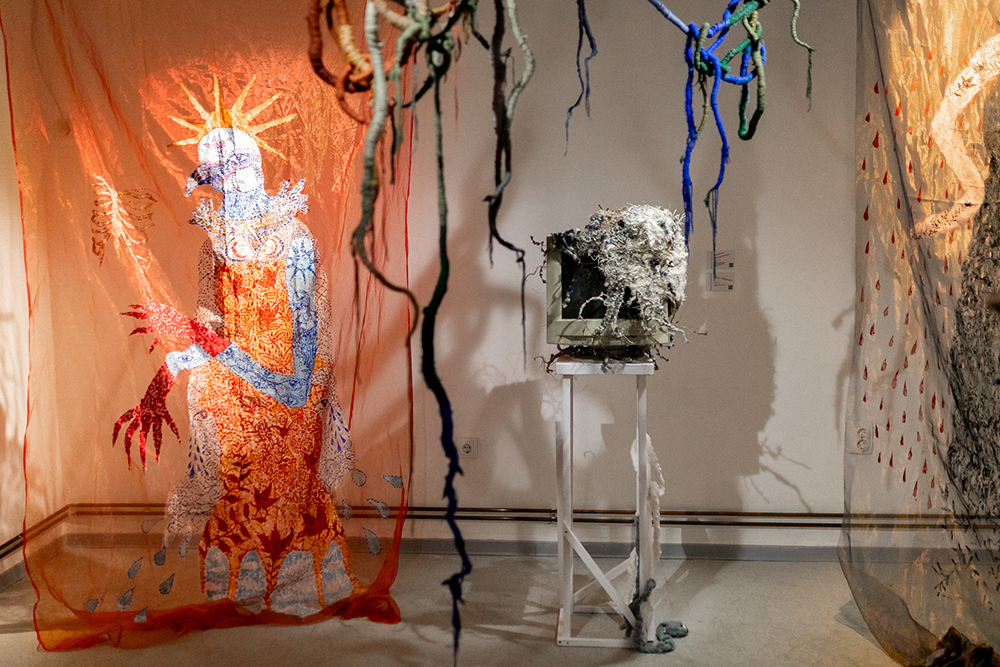
At Nordistica Gallery, something closer to fairy-tale is taking place. The atmosphere is set by mythical creatures on organza (a fine transparent fabric) created by the Serbian artist Teodora Nešković. At the entrance I am greeted by a black-and-white photograph by Sveta Sher, printed on fabric, whose sensibility feels close to my own. Trees grow through a rubbish dump; roots intertwine with torn pieces of cloth in an apocalyptic landscape. The wind moves the fabric, and the work comes alive.
The enchantment deepens when I unexpectedly join an evening choir in the gallery. We sit in a circle, yarn roots hanging above us, masks looking down from the walls. We sing in many languages. At one moment, I begin to cry, remembering my childhood, when my family used to gather in the evenings in much the same way and sing.
The exhibition at Distrikt Atelje 61 in Novi Sad is divided into two spaces that feel unrelated to one another. The ground floor has been transformed into a collective game. Its rhythm set by Hopscotch, a carpet by the artist Milica Dukić, laid at the centre of the room like a dare.
Upstairs, the video work Even if I sow a stone, a flower will grow by Nelli Akchurina is on show. I watch her make her “seed-stones”: first dyeing white fabric with natural materials — ash, horse manure and grass — then sewing it into oval shapes stuffed with sheep’s wool, resembling pebbles. Finally, Nelli scatters them across ploughed earth, in the hope that art will begin to grow.
My own installation takes no part in this collective game. It occupies a separate space: heavy, seemingly naive at first glance, unwilling to share its secrets. But the secrets are there.
Those who looked behind the work discovered its reverse, made of blackout fabric, from which black ribbons hang. Woven into them are objects gathered by chance in the street. The search for such objects is central to my artistic practice. Whenever I arrive somewhere new, I enter into an alliance with the place through the ritual of collecting. Setting out on a kind of expedition, I walk through the city or its outskirts and gather stones, branches, fragments of ceramic or glass — things already marked by time. Eventually, they enter my installations.
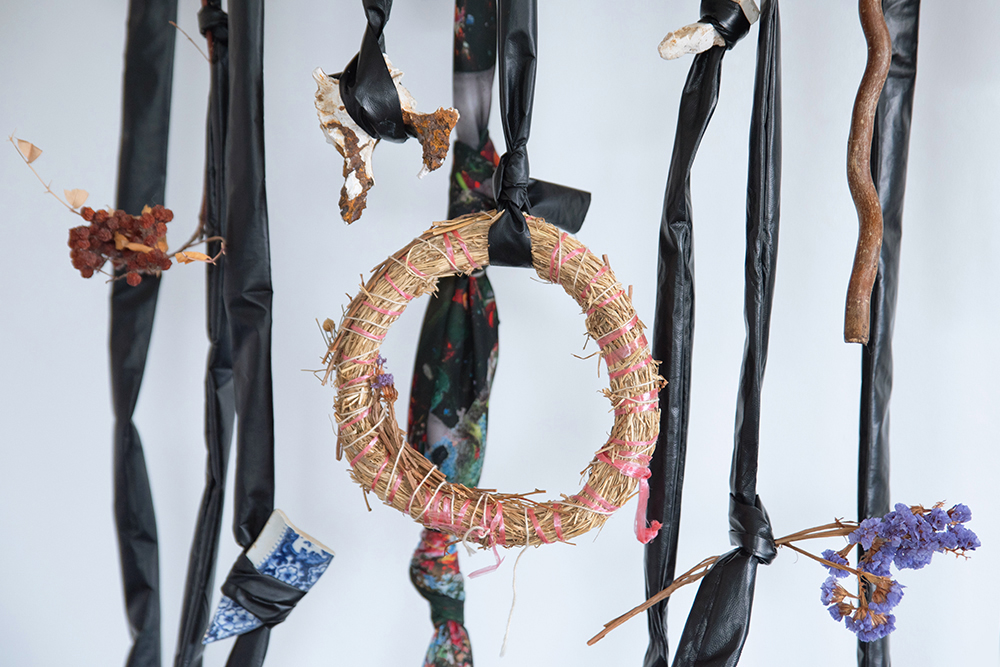
In Novi Sad, I had hoped to find pieces of polystyrene, since that image had become my key to Textinnale. But something else happened instead. In the courtyard of a residential building I found a wreath resembling those woven from dandelions. Local residents later explained that it was a čuvar kuće — a “guardian of the home”, a traditional protective symbol made from wildflowers and herbs in Serbia.
The circular form of the čuvar kuće echoed the logic of my work, its theme of repetition and the cyclical nature of time.
This wreath, which became the symbol of my trip to Textinnale, is travelling back with me to London, where it will guard my new home.