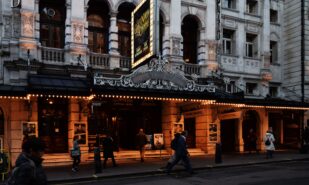
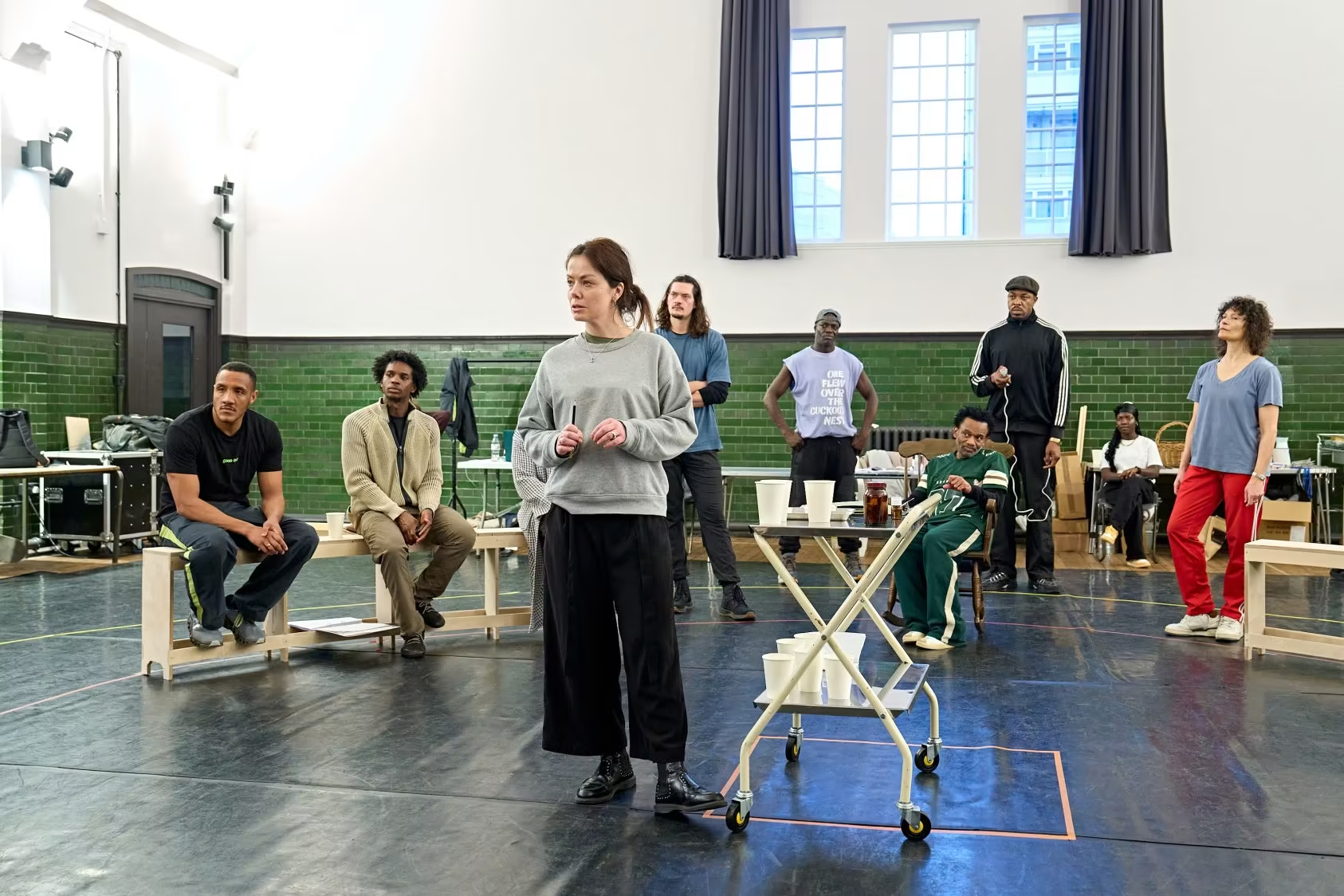
The Player: One Flew Over the Cuckoo’s Nest at The Old Vic

A countercultural icon, One Flew Over the Cuckoo’s Nest by Ken Kesey became popular almost immediately after its publication, while the film starring Jack Nicholson gained an independent life of its own, adding even more fame to the novel.
But comparing this premiere at The Old Vic to the film is both pointless and unfair. The production elevates the story of the confrontation between patient McMurphy and Nurse Ratched to a new level of philosophical reflection.
First of all, it should be said that this is an adaptation by Dale Wasserman — and a magnificent directorial work by Clint Dyer, who has assembled on stage a world equal in power to an ancient tragedy, with a pure, distilled catharsis in the finale. While the narrative line is fully preserved, this is an entirely new work, with completely different emphases.
Writing about this production is pure pleasure — it is layered with meanings, nuances, and ideas.
The audience is greeted by a circular arena and two screens bearing the words Congo Square, New Orleans. This place is considered one of the most important cultural sites in the history of African American music and culture. In the 18th and 19th centuries, Africans — both enslaved and free — gathered here on Sundays. They danced, played drums, sang — and so the performance begins with Congo dances.
At first glance, this reference frames the production as a story about the confrontation between Black patients and a white medical staff (incidentally, the male nurses are Black as well). But with each scene, the action — and its meaning — grows far beyond this tragic conflict.
Of course, it is also about punitive medicine in general, and psychiatry in particular. I don’t know, dear reader, whether you’ve ever encountered punitive dentistry — but I can tell you, it is unforgettable. Not happy about having a nerve removed without anesthesia? Oh, we’ll punish you for that.
Naturally, Nurse Ratched awakens memories in the audience: neat, controlled, ruling over the men’s ward, dismissing the ridiculous, almost caricature-like doctor. And in her precise mouth, the word punishment hisses like a snake. A merciless performance by Olivia Williams — she plays shades of embodied evil that shimmer and ripple like an oxide film on overheated metal.
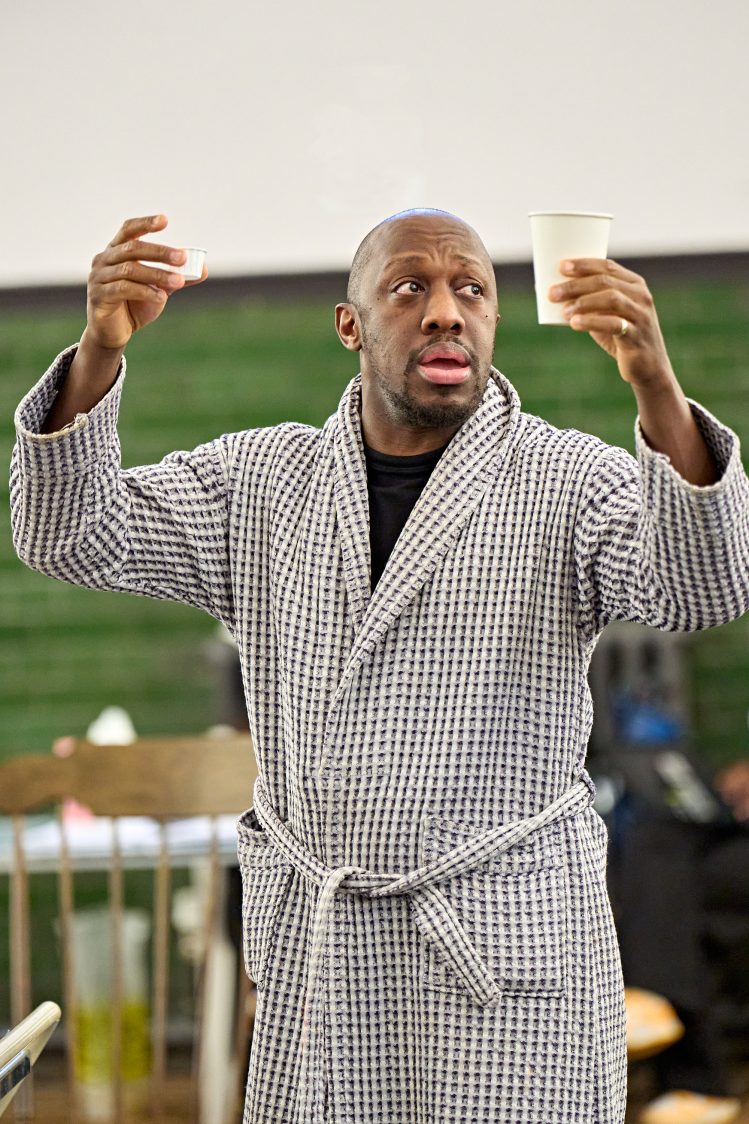
The Doctor (Matthew Steer, recently seen in Arcadia at The Old Vic): disheveled, mustachioed, bespectacled, hopping about the stage with a kind of chicken-like jitter, wagging his finger — but who listens to him? Any male nurse (dressed here, by the way, in dapper white suits with black bow ties) matters more than this laughable little doctor.
The audience sits around the stage — its mosaic pattern echoing Congo Square — like around an almost ancient arena, looming over it, becoming both witness and participant, as if in a religious rite.
And indeed, this Cuckoo’s Nest resembles the enactment of an unseen ritual — perhaps an ecumenical one. There are fluid shamanic dances to the beat of the djembe, a silent spirit of an Indigenous tribe holding the skull of a horned animal, and a blissful figure with arms outstretched in crucifixion.
You will, of course, remember that the protagonist enters the psychiatric ward to avoid trouble with the law.
This McMurphy has nothing demonic, truly criminal, or even revolutionary about him. There is something childlike in his manner, boyish, genuinely clownish, fairground-like, alive. His element is play. A play that cannot be justified in the black-and-white circular world of Nurse Ratched. For her, play is destructive; life itself is destructive simply by existing. What, by the way, would be the antonym of the word play?
Aaron Pierre plays McMurphy so vividly it feels as if he’s painted in fluorescent acrylic. The audience responds with delighted laughter that swells into something like a stadium roar — he draws not only the patients but all of us into his game, pulling us into a whirl of mischievous revelry.
Petrushka, Punch, Hanswurst — it’s impossible not to recall these truly folk characters in the context of this Cuckoo’s Nest. And all the more terrifying, then, is the Hero’s Journey, the arc that leads him to a tragic end.
There is also another central figure here — the Chief, the complete opposite of McMurphy.
Let us return to the geography of the production: Congo Square lies near land used by the Houma tribe for harvest celebrations and considered sacred ground. Thus the Chief and the Spirit of his ancestors are shaped by the very genius loci.
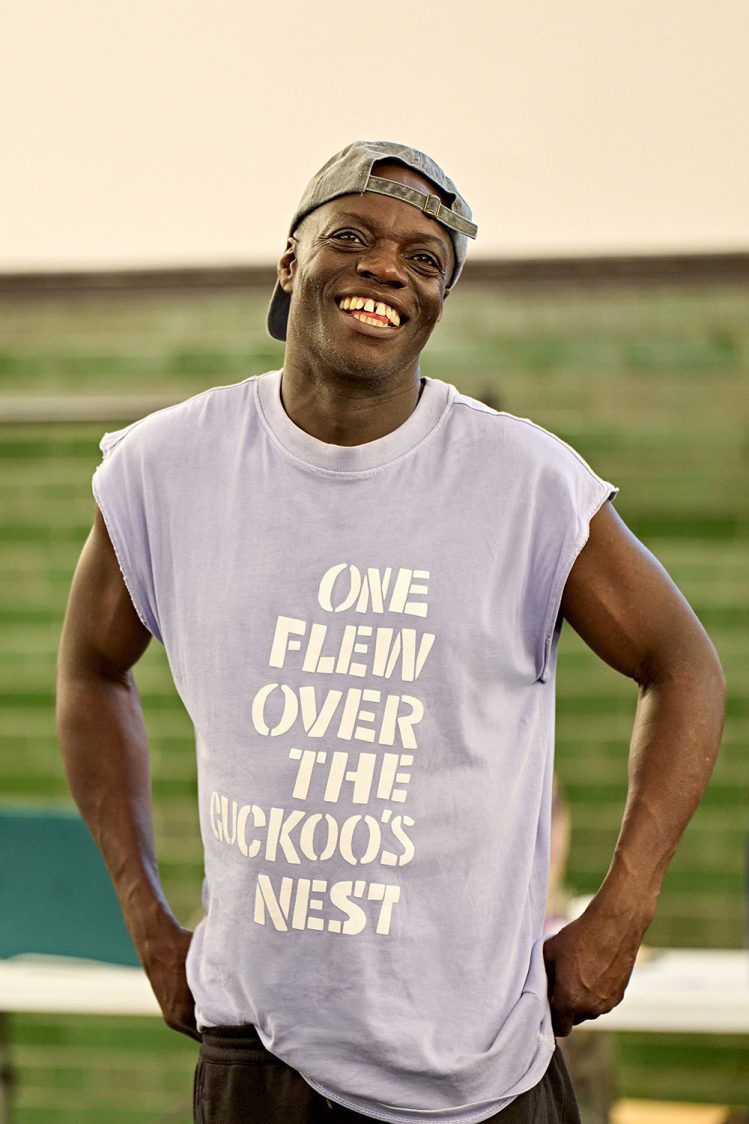
We promised not to compare the production with the film, but here it is hard not to mention the work of Miloš Forman. This Chief (Arthur Boan) is entirely different. There is no copper profile, no bronze-like monumentality. He is a man — powerful, very young, patient, and submissive — yet within that submission lies a great deal of will. The centurions of the white-coated hegemon push him around as they please, but he only gently extends his massive hand for the mop. And in the way he scrubs an already clean floor, there is not a trace of madness, but a conscious, deliberate choice.
He is silent, completely absent from conversation — until suddenly he appears at the top of the staircase set, like on a church pulpit. And then his speech flows freely, vividly; he becomes not just a narrator, but something greater — a chronicler and a preacher.
Gradually, McMurphy’s playful energy draws the Chief into speech, and he seems to break through a transparent, invisible cocoon he himself created to survive the surrounding violence and the impossible opposition to Nurse Ratched.
There is a scene where McMurphy and the Chief sit in the very center of the mosaic arena, gripping each other’s shoulders, when suddenly a bright beam descends from above, forming a circle of light on the floor — and within it drift the silhouettes of wondrous birds. Free, playful, carried by the wind. Alive.
The other patients are performed with such care, almost clinical precision — and without the slightest caricature, God forbid.
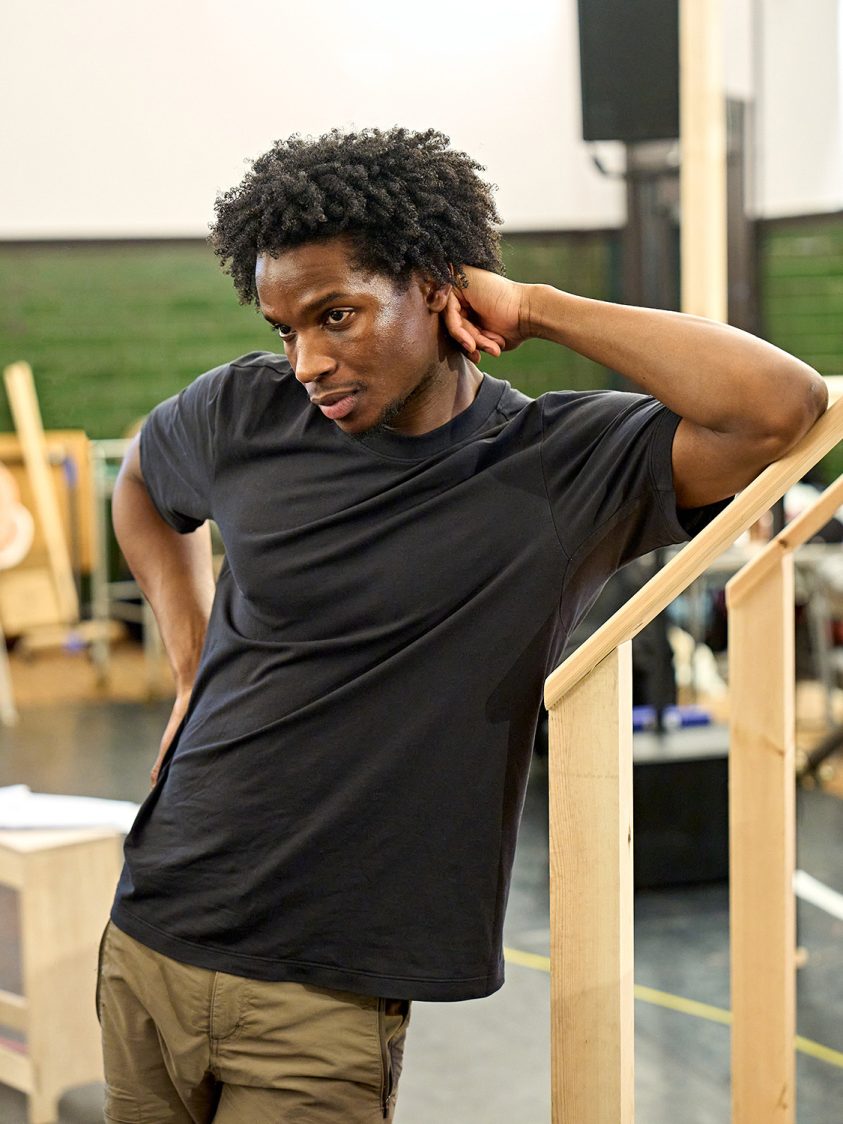
The catalytic character here is Billy Bibbit (Kedar Williams-Stirling), a poor boy twisted by the combined cruelty of his mother and Nurse Ratched — powerless, dreamy, anxious. And his tragedy in this Cuckoo’s Nest lies precisely in the fact that these two women have deprived him of that essential element necessary for life — play. Betraying McMurphy, he sits at Nurse Ratched’s feet, running trembling fingers along her calf — like along the marble leg of a divine idol.
The tragic finale here becomes unmistakably liberating: freeing McMurphy from a semblance of life, the Chief dismantles the slabs of the square, between which flickers not fire, but a clear, radiant light.