Final Stop: Family Toxicity — Who’s Afraid of Virginia Woolf? at @sohoplace

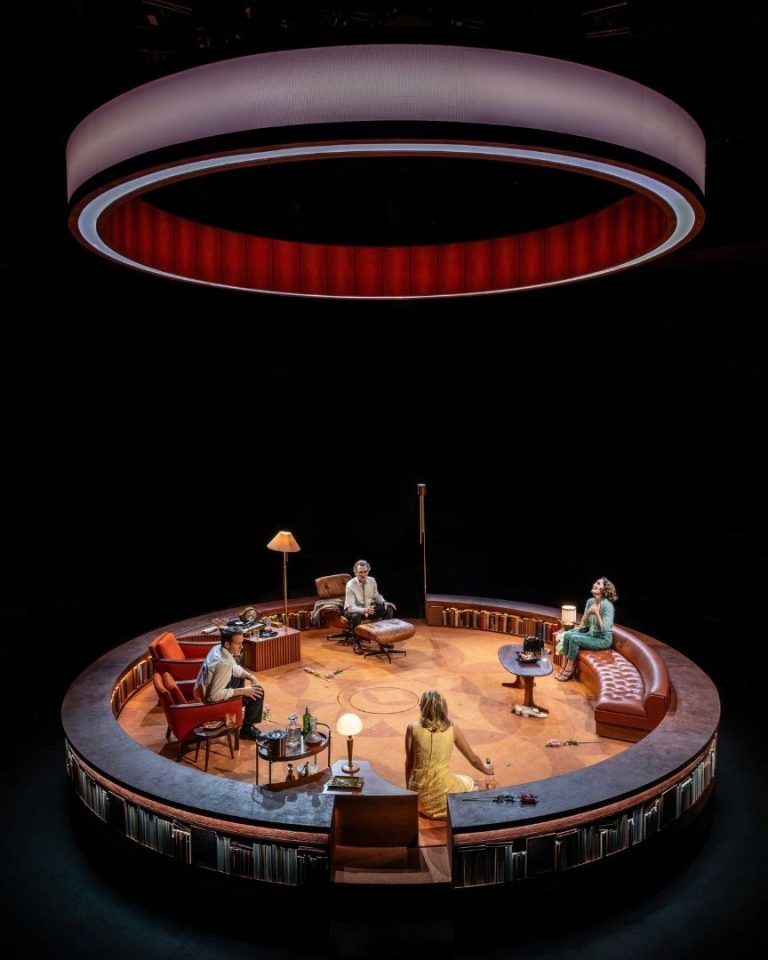
The set is exquisite. There is something extraordinarily beautiful about it — not glossy, showroom beauty, but something warm, intimate and unmistakably domestic. The vintage furnishings, chosen with impeccable taste and an evident knowledge of their period, form an ensemble that is about to give its own performance to a full house. The stage revolves almost imperceptibly, allowing us to inspect everything: every lamp and vase, and, if your eyesight is good enough, even the titles on the spines of the books. It is, after all, a professor’s home. Stylish, meticulously kept, warm, bathed in shades of orange. The lamps spill their golden light across the room. You could live here happily, having clever conversations and enjoying life. But no.
Edward Albee wrote Who’s Afraid of Virginia Woolf? at the very beginning of the 1960s. Naturally, it has nothing to do with the English novelist herself. The title is a playful variation on the song from Disney’s Three Little Pigs: instead of the Big Bad Wolf, we have the great Virginia Woolf. But the joke, of course, has a deeper meaning. In Albee’s hands, the question becomes something like this: who is afraid of facing reality without the protection of comforting illusions? Virginia Woolf herself, who spent much of her life struggling with her own inner grey wolves, seems not entirely out of place here. Albee spotted the phrase in a bar in New York’s Greenwich Village, where some tipsy intellectual had scrawled it in soap on a mirror. The joke lodged in his memory, and he eventually used it as the title of his famous play. (I wonder whether the person who wrote it ever found out. They might have tried to claim the copyright!)
The play premiered on Broadway in 1962, at the Billy Rose Theatre. It was Albee’s first full-length play, and it immediately provoked an enormous scandal. Critics described the whole thing as a “cesspool” and were outraged by its assault on the institution of marriage. Meanwhile, audiences flocked to see it, and the production won several Tony Awards. Then Who’s Afraid of Virginia Woolf? set off an explosion within the Pulitzer Prize committee. To cut a long story short, at the time the rules required a dramatic work to demonstrate the theatre’s educational value. Albee’s play was considered insufficiently elevated, excessively indecent and decidedly lacking in educational merit. That year, no Pulitzer Prize for Drama was awarded at all. Two members of the jury resigned in protest, and the criteria for the drama prize were subsequently changed. In short, as it turned out, the play was critically necessary.
Mike Nichols’s film adaptation, starring Elizabeth Taylor and Richard Burton, appeared in 1966 and shook not merely the relatively small world of theatre-goers and sophisticated literary critics, but a much wider public. Verbal abuse, psychological violence, passive aggression, toxicity — this cocktail was helping to create a new theatre for the world. Perhaps without this play there would have been no new dramatic language: in 1962, Albee forced audiences to reconsider their ideas about what could be permitted in art.
But in 2026, theatre and cinema no longer have to fight for the right to portray a toxic marriage. That right was claimed long ago — partly thanks to Albee himself. Of course, Albee did not invent the depiction of the hideous side of family life. Strindberg, O’Neill and Tennessee Williams had all been there before him. But it was Albee who triumphantly wheeled this domestic horror, duly decorated with academic titles, onto the commercial Broadway stage, and did so with extraordinary audacity.
What Albee does in his plays is precisely what playwrights and directors would increasingly do afterwards: he drags into the merciless glare of the footlights everything sordid, rotten and repellent in ordinary life — everything people usually prefer to keep hidden. No Greek tragedy, no elevated rhetoric, no desperate twists of plot. Domestic life, decay, night, humanity, grotesque behaviour, poison. That sort of thing. Ugly. And if, in the 1960s, the very act of bringing this golem onto the stage was enough to justify a production, more than sixty years later a staging of Albee demands something else. Some new meaning, perhaps.
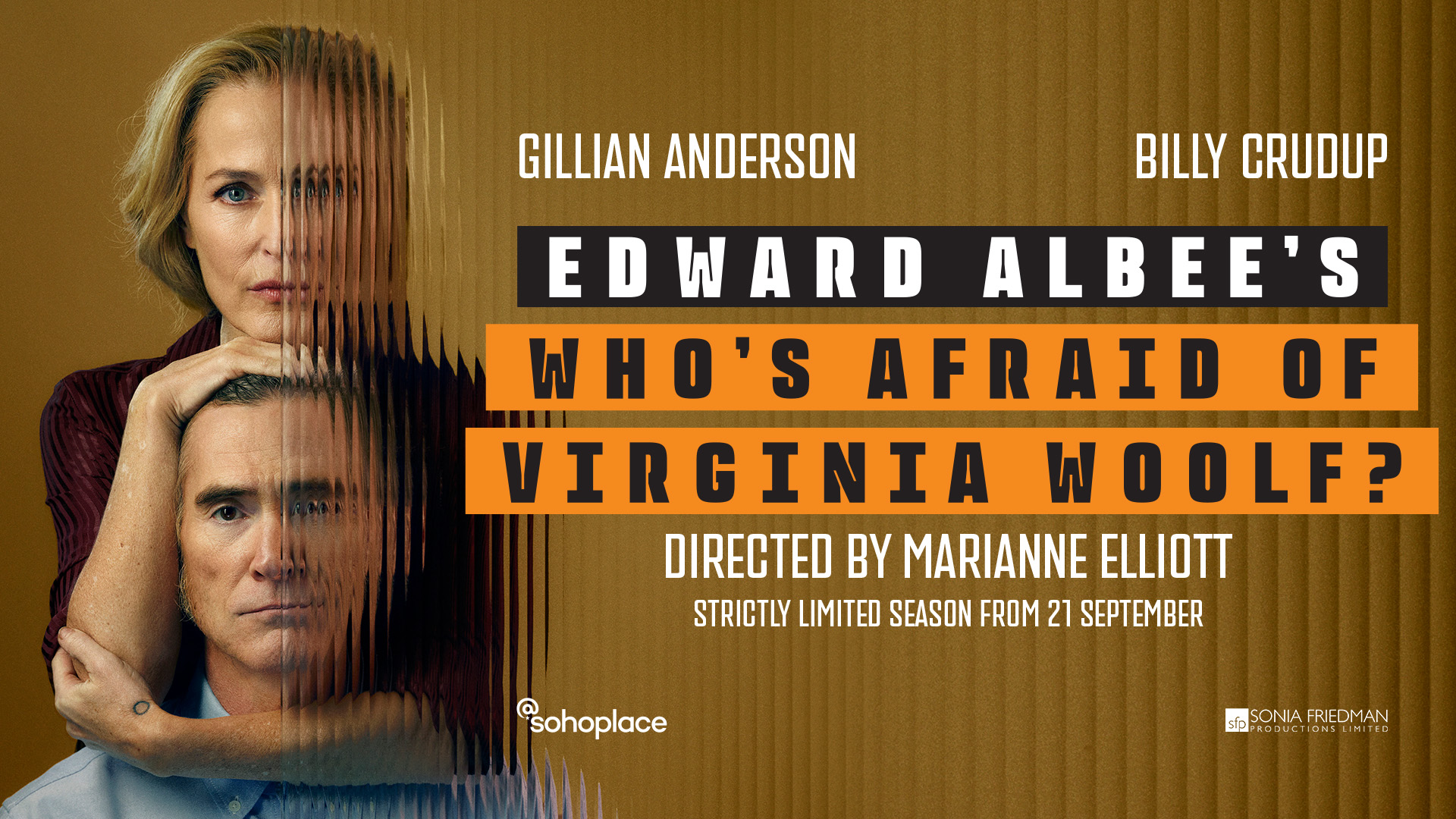
And so here we are: 2026, London, Soho. Two stars — Billy Crudup and Gillian Anderson — are performing this marital drama under the direction of another star, Marianne Elliott. She has two Tony Awards for directing, three Olivier Awards and an extensive list of productions to her name. And here we have it: a difficult, demanding play, performed by two famous actors. It seems that not a single word has been cut. The play remains as long, as three-act, as unwieldy as ever. Its characters still destroy one another with mockery, words, lies and truths.
The same text. The same act titles, from Walpurgisnacht to The Exorcism. The stage revolves slowly and heavily, creating the sensation of intoxication gradually descending into dark delirium. (The set designer is Miriam Buether). Everyone spars, drinks and indulges in toxic behaviour. They drink in close-up, tossing ice lavishly into their glasses (neat drinks? Absolutely not!). But where is the element that might give us an experience as socially significant as the one audiences had when the play was genuinely revolutionary? The acting, presumably.
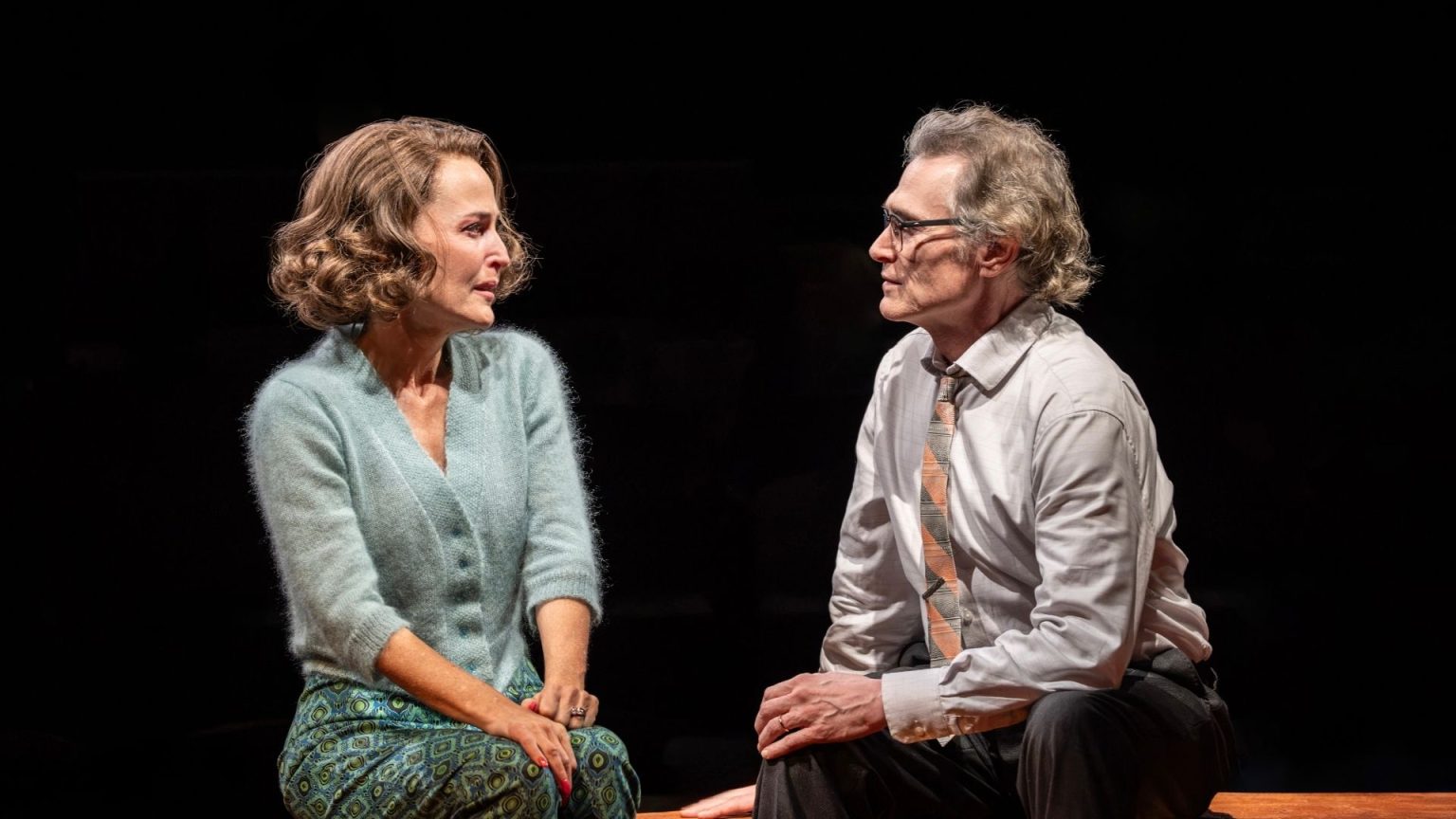
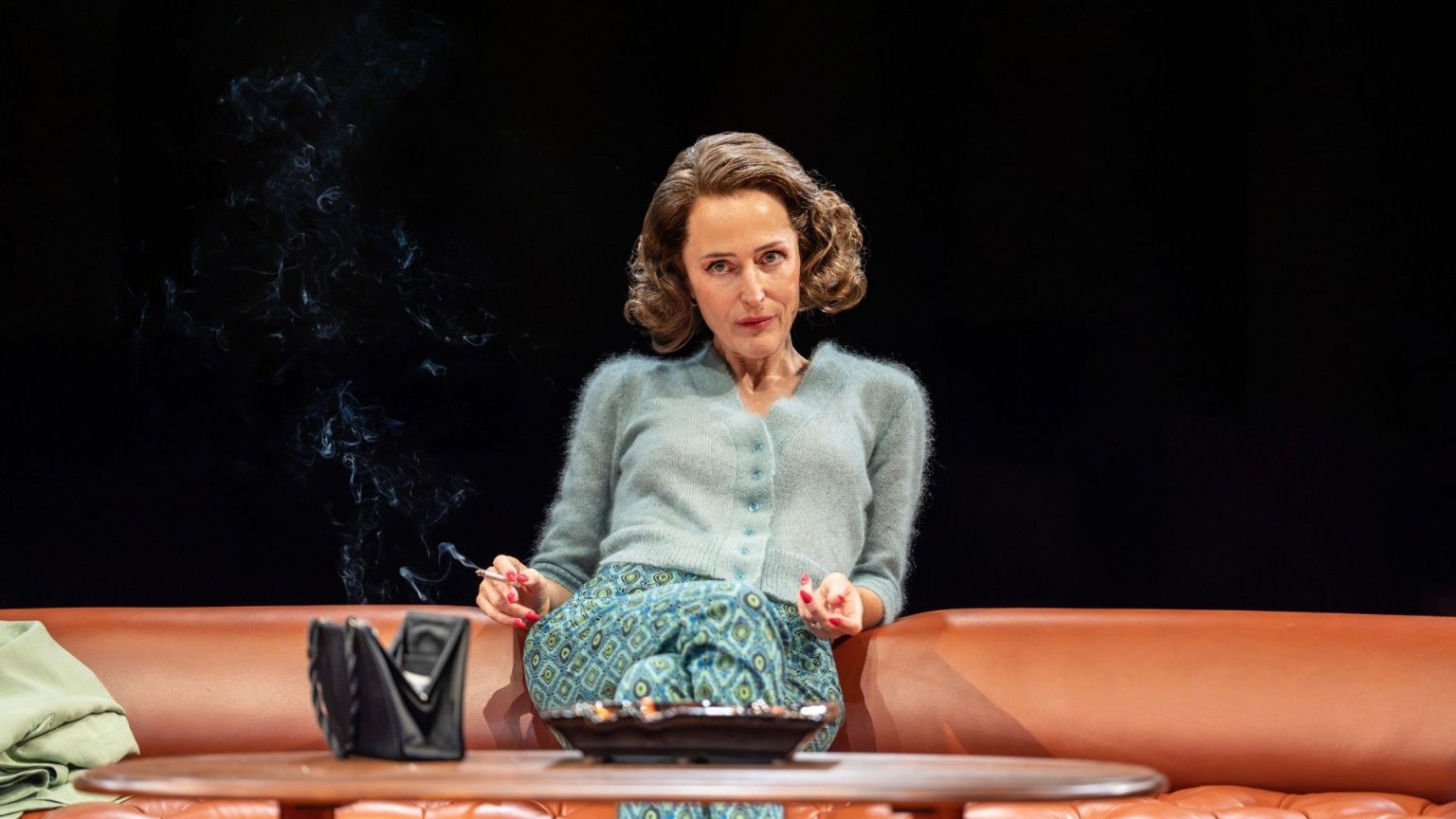
And here we encounter an unexpected interpretation. From the moment they appear within the circular stage, it is clear that this Martha and George have hated each other for a very long time. They are already irritated, and their irritation is ancient, hardened, encrusted. Martha, played by Gillian Anderson, resembles a lean, powerful bird of prey — a kite that has lost all its chicks and is searching for any poor, stray little creature it can find. Why? To eat it, apparently. Perhaps that is precisely why she is so delighted when the guests arrive. The heels, the cleavage, the tight trousers do nothing to conceal this Martha’s hardness. On the contrary, they emphasise it. Sharp, predatory movements. Birdlike fingers — now talons, now wings. And then she laughs, opening her beautifully painted mouth wide, like a witch from a children’s nightmare. This is the final frontier of a beautiful actress’s fearlessness: allowing herself to look like a demon in trousers.
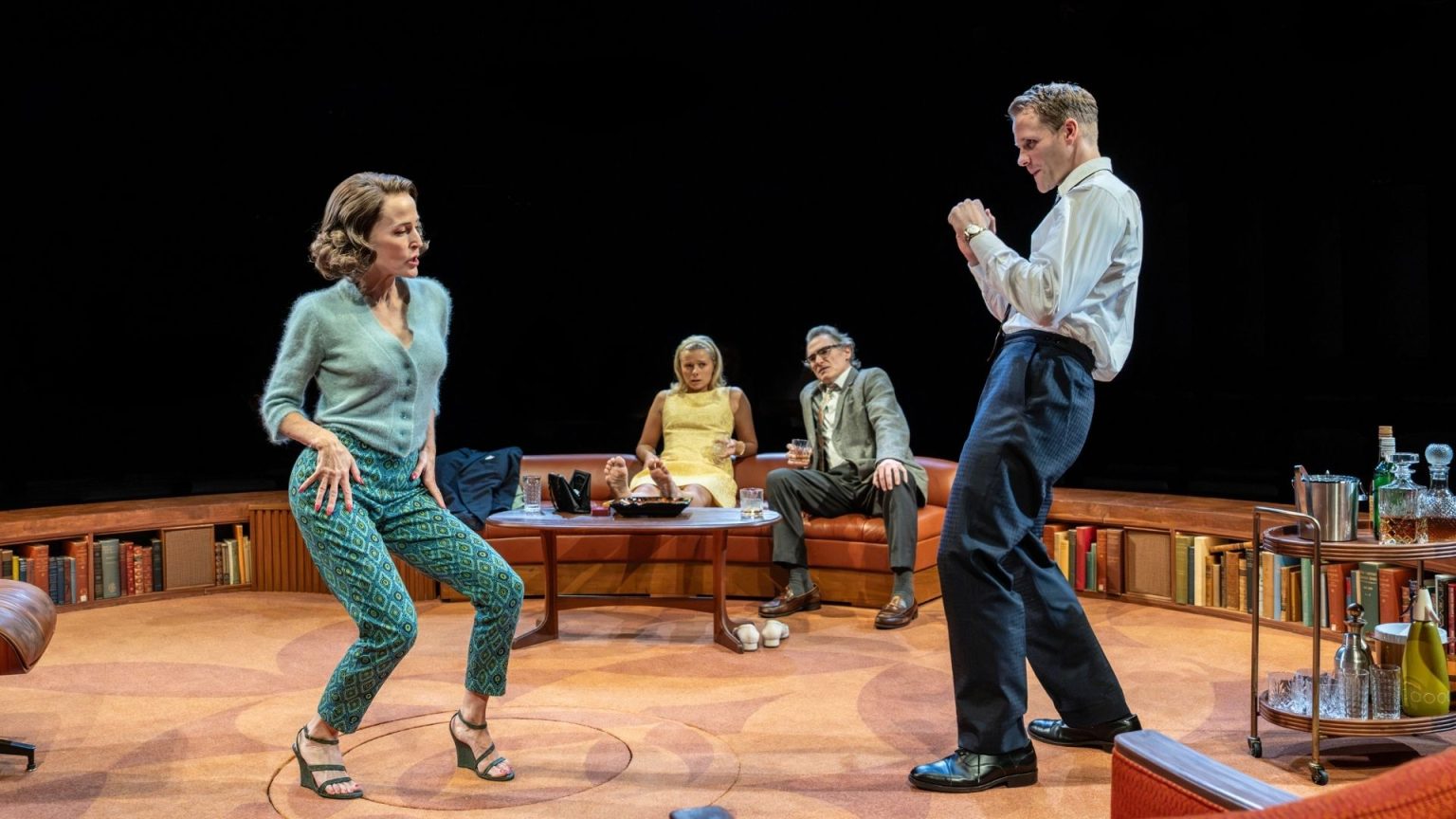
Her husband George, played by Billy Crudup, appears to be a perfectly conventional university professor. And yet there is something strange about him, something pernicious. As though he were concealing, skilfully and habitually, some rather indecent passion. At one moment he is lethargic, profoundly exhausted, a man of weary distaste; at the next, a full-blown hysteric. It is in these two states — zero and live — that his danger seems to lie. There is no telling when his patience will run out. He explodes without warning, then goes dark again until the next time. And God knows when he will flare up. So you think: ah, now something is going to happen! Is it?
Let us remember that the actors are performing in a magnificently designed arena — circular, beautifully illuminated, separated from the audience. An arena for gladiatorial combat, perhaps. Or, even worse, a circus ring? So there we have it: an arena, four people, three acts of verbal bloodshed, the audience seated all around. The metaphor is so literal that it adds almost nothing to the play. Yet it sharpens one question: what happens to Albee’s play when love disappears from it and only the machinery of mutual destruction remains? And now… Now what?
The train goes no further: all change, please! All change! Except that this train keeps travelling in circles, and the platform outside the window is always the same. The same dreadful station. Its name is Family Toxicity. Even the arrival of the guests, the young and beautiful Nick and Honey, changes nothing. The atmosphere remains exactly as it was — except that fresh meat has arrived for the two grown-up Jabberwocks, who have grown tired of devouring each other and fancy something new. Three acts of merciless, monotonously performed, vile, stifling, repulsive rows. Insults and alcohol. Alcohol and cruelty. Everything is as Albee wrote it, only somehow different. The gags are performed selfishly, for the actors themselves rather than for one another. At times it seems that with every insult the characters are attempting to fight their way towards each other, to find each other, like a button searching for its buttonhole. But no. Both the button and the buttonhole are hermetically sealed inside glossy, mass-produced plastic. There is conflict. There is no intimacy between the characters.
We have already mentioned the famous 1966 film of Who’s Afraid of Virginia Woolf?, starring Elizabeth Taylor and Richard Burton. One need only look at their close-ups to see genuine tenderness. And it is not simply because they were husband and wife in real life. It is because of the immense love conveyed beneath the surface of their performances, which made the rows shaking that little New England house so much more terrifying.
This is why, in the @sohoplace production, Martha’s cries of “Oh, where is my George? Oh, how many years he has understood me and held me in his arms at night!” sound so peculiar. As though this were not the truth at all, but merely another trump card in her toxic, narcissistic deck — a card she draws with the habitual movement of her beautifully manicured fingers. Only it fails to impress Nick. Drunk and dishevelled, he looks at this woman in bewilderment, but that is as far as it goes. He is neither shaken nor impressed by their great, if deeply damaged, love. Because he cannot see it.
And what about the young guests, Nick (Josh Dylan) and Honey (Phoebe Horn)? So young, so fresh. A pleasure just to look at them! But there is no attraction between them either.
There are mutual expectations, there are deeply buried resentments, but there is no marital partnership. They roll around the carpet like billiard balls: smooth, perfectly shaped, exquisitely beautiful, occasionally colliding. At one point, Nick nods to Honey after she has called out to him for the third time, drunk, miserable and hiccupping. And that is all. For one brief moment, she has managed to make herself heard. Here, too, there is lovelessness; here, too, a human component sealed in plastic. These guests could have been almost anybody. Martha and George do not much care whom they devour — the younger, the tastier, and the less experienced. The finale, in which everyone weeps, inconsolably and desperately, even the imposing George — and in which George himself switches from zero to a full 360 volts — brings relief to no one. It ought to. But it does not. The house spits out the exhausted, sick, battered, chewed-up, still-drunken young guests. (Why on earth they did not leave at the first insult or the first sign of their hosts’ bizarre behaviour is entirely incomprehensible today, in 2026.) The hosts remain alone together, tear-stained, neither victorious nor defeated. They instantly forget Nick and Honey, to whom they have caused so much pain, although the young couple had absolutely nothing to do with any of it.
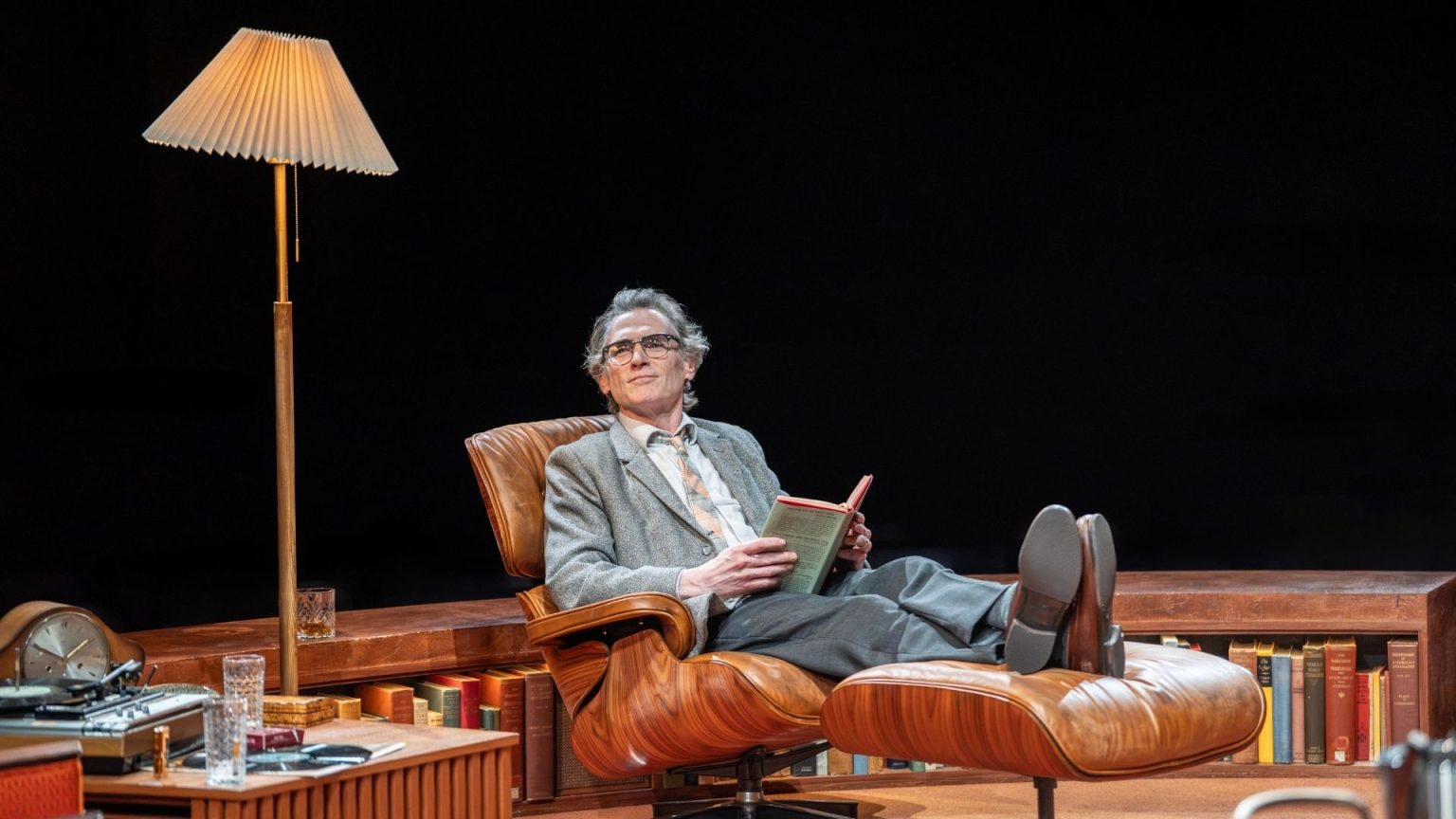
They are simply resting after their draw. But there is one more character we have not yet mentioned – the audience. The audience laughs almost constantly. The auditorium erupts at every sharp retort, and it seems that this is not so much laughter at a joke as laughter of relief. Ah, this is not happening to me! Thank God, nobody is saying these things to me! I am merely watching. I am only a witness. At moments of particular tragedy, the audience falls silent. Then it starts laughing again. But for Albee, it seems, the status of witness is not far removed from that of the accused. If you laugh, it means you understand. You recognise something. You know what you are looking at. You are implicated. We are all, as it were, tarred with the same brush. And this alternation between laughter and silence is not about nostalgia for the days when theatre knew how to shock its audience. It is about the strength of our psychological defences.
About our ability to recognise horror, to sympathise with it when the occasion demands, and a minute later to laugh at precisely the same horror, merely presented in the form of a joke.
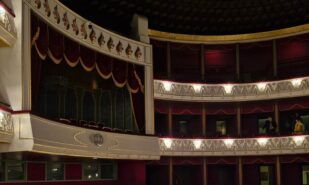
But in the @sohoplace production, the boundary between the audience and the stage is extraordinarily reassuring. The spectators surround the stage on all sides. The physical distance between audience and actors has all but disappeared, yet the safe distance between other people’s lives and our own remains entirely intact. We can sit comfortably and watch other people suffer, then get up and step out, with a sigh of relief, into the evening dusk of Oxford Street.