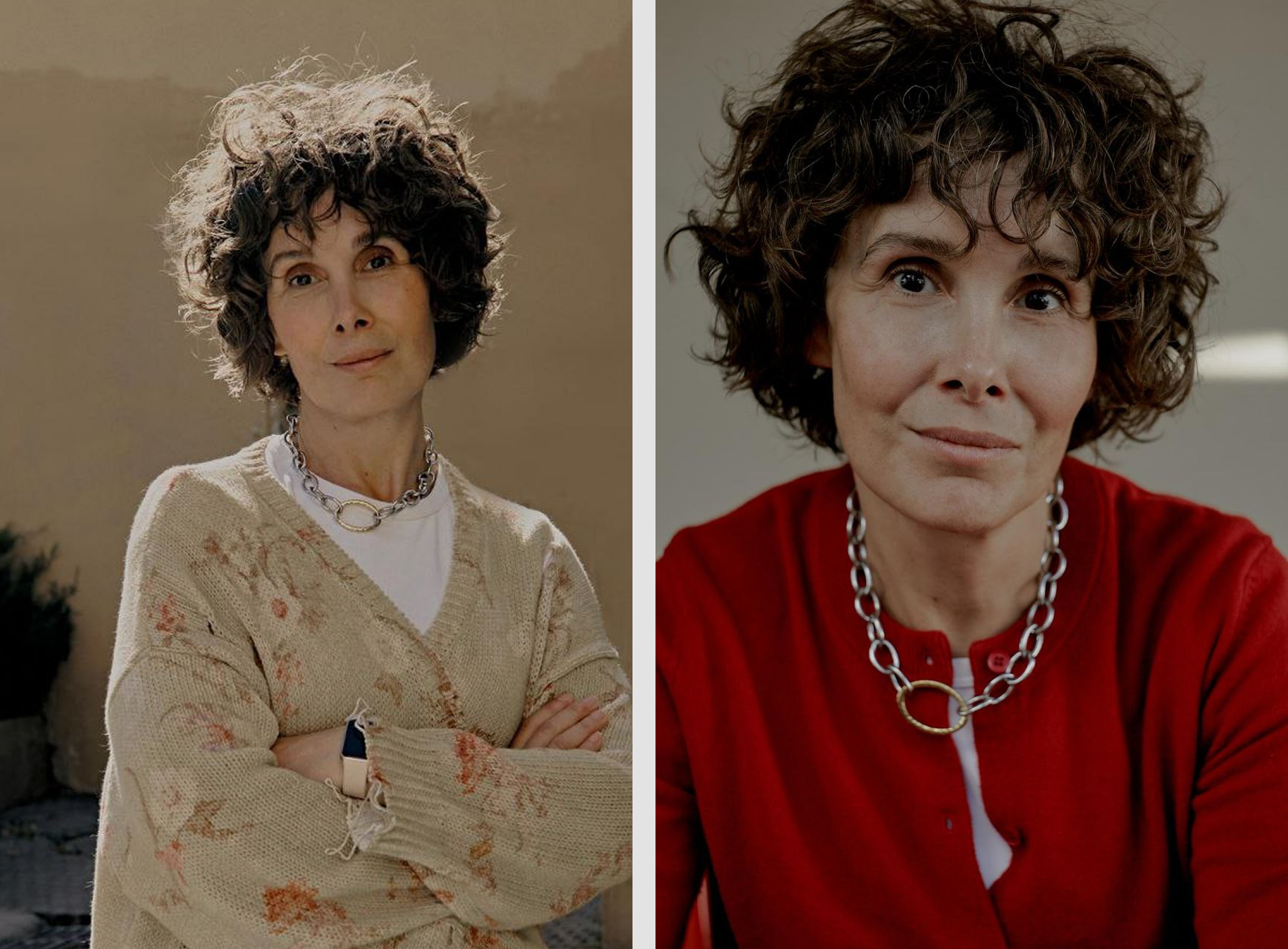
Galina Yuzefovich: “Talking about reading is a kind of comforting refuge”

Galina Yuzefovich knows how to turn a conversation about literature into a conversation about time, generations, and collective illusions. Why did Harry Potter turn out to be not just a fairy tale but a sociological tuning fork? Can the Mockingjay become an antidote to injustice? And did there ever exist a “whole world” that read the same thing? We talked about mass myths, émigré shadows, university brotherhoods, and why a child who reaches for a book should not be stopped.
May we start our conversation with your book “The Keys to Hogwarts”, which you recently presented in London at the Idiot Books bookshop? Why did you turn your attention to Rowling’s seven-book “Harry Potter” series?
There are many reasons. In 2024 I taught a course on the world of Harry Potter on the Stradarium platform, and I gathered an enormous amount of material for it. To be honest, I had been accumulating it actively long before that: I’d been watching the Harry Potter phenomenon since the early 2010s, though with goals that weren’t entirely clear even to me. Then that material turned into a course, the course ended, but new information just wouldn’t stop arriving—one thing you read, another catches your eye… At some point it became clear that everything I’d amassed either had to be formalized, organized, and poured into some stable form, or else I had to simply stop doing it. And I chose to formalize it—this is how the book came into being.
That’s the first explanation, the practical one: I really wanted to put all that collected material to use somehow, to generalize it, and to put, if not a full stop, then at least a semicolon. But if we step one level higher, the point is this. I’ve always been tremendously interested in large-scale mass phenomena in literature, because for me literature is not only art but also a kind of media—something that communicates, among other things, about its readers. If huge numbers of people begin reading a book, passing it hand to hand, speaking in images and quotations borrowed from it, then obviously this characterizes first and foremost not the book but its readers.
Once I grasped the scale of the “Harry Potter” phenomenon, I realized I was desperately curious to understand how it is built, which buttons it presses in the reader, why it was this—this exact thing—and why at this exact moment. In short, Harry Potter became interesting to me not only as an artistic phenomenon but to a great extent as a social one, located at the intersection of the public and the literary.
In general, I’m very surprised by people who aren’t interested in such mass phenomena. There’s an idea: if everyone reads it, then it must be something lowbrow. I take the exact opposite position: if everyone reads it, that means I need to read it too.
This object doesn’t necessarily have to make me fall in love with it, but at least I’ll understand what my contemporaries are interested in, what they live and breathe, and I’ll be able to form some hypothesis about their desires, moods, and values. In the case of “Harry Potter”, my almost sociological curiosity aligned perfectly with my sincere love and fascination with the book itself—and that’s the third reason to turn to Rowling’s universe. I think it’s an outstanding monument of literature which also tells us about the period when the current generation of adults was forming. It tells us far more than many sociological studies. If you want to understand where modernity came from, turn to Harry Potter.
Today’s teenagers also grew up on Harry Potter, to be fair, because we shoved it at them with frightening force. But now they say it’s not very fashionable; they have “The Hunger Games” instead.
“The Hunger Games”, frankly, is already grey-haired retro too—the first Hunger Games book came out in 2008. It’s wonderful, more than worthy reading, and I love it very much. But of course it’s a phenomenon of a different scale: in quantitative terms, Harry Potter is much larger. Roughly every third inhabitant of the Earth knows the key plot points from Harry Potter. Maybe not everyone has read it or even watched it, but the number of people familiar with the Potter mythology is about a third of the world’s population.
“The Hunger Games” can’t really boast that: at best, one in ten—and more likely one in twenty—people on Earth knows about the Mockingjay. And I personally would read with enormous pleasure a book about the universe of “The Hunger Games”, its mythology, its cultural references—Suzanne Collins has plenty of those. Still, I’d venture the guess that it will be a much less long-lasting mass phenomenon. I’m not sure today’s teenagers will as unequivocally stuff “The Hunger Games” into their children as an older generation stuffs “Harry Potter” into theirs.
I read somewhere that today’s teenagers feel the Mockingjay is their hero. Adults betrayed them, and suddenly it turned out that the ideals that were being sold to them when they were three no longer work.
In that case I have bad news for these kids. In my view, “The Hunger Games” is an outstanding book precisely because it is ethically complex. It’s not about the sacred Red Banner of the Revolution, but about much more complicated things. Essentially, it’s the eternal story that when you kill the Dragon, you become the Dragon yourself. And in order not to become it, you have to make some almost abnormal effort. But to understand that, you need to read the whole cycle—and to read it fairly attentively—whereas the romance of revolutionary transformation lies right on the surface.
Of course I understand what inner need this book answers: suddenly it becomes clear that the world is unjust and has no intention of becoming just. That is a very painful, tormenting realization, especially for a teenager. And of course you look for a hero who will help you cope with that realization. As Chesterton wrote: “The saint is a medicine: he cures because he is an antidote. That is why the saint often becomes a martyr: an antidote is painful as poison.” In that sense, yes—the Mockingjay is a good antidote for a time when it suddenly turns out that there is no justice and, in principle, none was ever planned.
If we turn back and look at world literature before Harry Potter—were there books whose love swept the whole planet and gave it the happiness of shared reading and shared emotions?
In the phenomenal success of J. K. Rowling’s epic, the factor of timing played no small role. The first “Harry Potter” comes out in 1997. It’s an astonishing moment when, for the first time — and, as it turned out, for a short time only — the concept of “the whole world” took shape. Today we see that there is no “whole world” again — there are territories fenced off from the outside and fencing themselves off from within, segments with different forms of censorship.
But 1997 is the moment when the internet already exists, covering and in some sense leveling the whole world, yet it has not turned into a space of propaganda, censorship, and fake news. It already creates the possibilities we know today, but it does not yet create the problems we live with today. Rowling’s books come out precisely at the moment when a spark can ignite a flame of truly global scale.
Today we live in a world where the number of cultural and literary objects available to us increases by an order of magnitude every month, while time and inner capacity do not. A big phenomenon today always exists inside a small bubble. Let me give an example. When the Russian rapper Pasha Technik died, a significant part of the Russian-language information space filled with immense grief. And I heard that name for the first time on the day of his death. This doesn’t devalue his work in any way, nor does it position me as some unpleasant snob. The fact of my ignorance says only how fragmented the information space has become: big phenomena (and Pasha Technik is certainly a big phenomenon) can form large support communities that do not intersect at all with other similar communities formed around other centers.
Earlier—before the end of the 1990s—big cultural phenomena embraced large communities of people. For instance, a community—let’s call it “Soviet children”—people born between the 1960s and the 1980s—understand each other perfectly and pick up every little quote from, say, the Strugatskys’ “Hard to Be a God”. We have a shared code formed by the fact that the number of cultural objects available to a Soviet child was limited. “The Three Musketeers” with Boyarsky and Dumas’s “Three Musketeers” are stitched into each of us simply for historical reasons.
There are similarly important objects inside other cultures. In London I went to a show called Ballet Shoes, staged from Noel Streatfeild’s book of the same name—absolutely iconic in the UK. “I am regarded as something of a dangerous intellectual,” as they say in Jeeves and Wooster, because I read that book, while no one around me had—it’s not part of our cultural canon. Believe me, the French or the Germans haven’t heard of Ballet Shoes either. But in England it’s an absolutely cult object!
That’s their “The Road Goes On Into the Distance…”
Or like “We Children of Bullerby Village” for Swedes. In Russia Astrid Lindgren is anomalously popular. But what do we read? Karlsson-on-the-Roof and, a bit less often, “Pippi Longstocking”. In Sweden, however, Lindgren’s main book is undoubtedly Pippi, while Karlsson is rather marginal. After Pippi come Lotta on Troublemaker Street, Emil of Lönneberga, “We Children of Bullerby Village”, and “Kalle Blomkvist” — about children’s adventures in Sweden in the 1920s–1930s. In short: a different canon.
My children and I also loved Emil very much, and once we made a point of going all the way to that Lönneberga, where we met—who do you think?—a large number of Swedish families walking around hugging copies of the Emil books. And they looked at us as if we were crazy: we were the only foreigners who had come to kneel at the roots. Because a little place in the Småland province is a truly local phenomenon.
But let’s return to “Harry Potter”. Rowling and her books broke through all these boundaries of local cults and cultures and created an entirely new, special space. Thanks to the emergence of a new carrier of information — precisely that internet which was already global but not yet corrupted — wizard boys and wizard girls spilled across almost the whole world. Of course, there are significant exceptions to this rule. As a rule, those are countries living in relative isolation and not included in the sphere of British colonial influence. In my book I write about Nepal, where practically nobody reads Harry Potter, except for an urban hipster stratum. But that is still a smaller part of the globe.
Inside each culture you can find a phenomenon comparable to Harry Potter. But there is no international phenomenon comparable to Harry Potter. Before Harry Potter there were no books that could unite, sustain, and warm all of humanity at once and simultaneously. But, I repeat, the point is not only the virtues of the book itself, but also the moment when it was published.
So in some sense it was also authorial luck?
Absolutely.
What is authorial luck?
Well, I’m exclusively a researcher, not a writer, and I can’t teach anyone to write prose. I can tell a potential writer what is happening around them so that they don’t reinvent the wheel, so that they don’t feel tragically alone, so that they don’t bang their head against a concrete wall. I can create context for them, show how the literary environment around them is structured and lives. But only a sensitive and experienced practitioner can teach a writer the craft of writing itself. And even then they can only suggest certain techniques, methods, tools. Everything else is a combination of motivation, work capacity — and, yes, something that doesn’t translate well into rational terms.
Did growing up with writer-parents shape your context? Did it bring you into the profession?
Well, to begin with, when I was little, my parents were not writers at all. My father taught history at school, my mother worked at a newspaper in Perm. In any case, it’s hard to answer this question. Of course, the general “literariness” of the family influenced me in some way. Yes, there were always many books in our house; yes, my father read aloud to me a lot in childhood; yes, my parents’ friends would sit late into the night in our kitchen and talk about books breathlessly. But I know other people who had all the same things and happily became IT specialists, working and earning normal money, not… all of this.
I began very early — abnormally early, as I now understand — to identify myself through books. When I was about five, A. A. Milne’s “Winnie-the-Pooh” was important to me—important in a grown-up, intellectual way. In the kindergarten I attended for a very short time, I couldn’t make friends with anyone. And I remember: I’m riding a carousel with a new girl, Natasha, and Natasha says: “And I really love Winnie-the-Pooh!” I ask gloomily: “The cartoon?” She answers: “Nooo! The book!!” And I realize that I’ve finally met my own. A person who loves the Winnie-the-Pooh book is my secret handshake. And my parents definitely didn’t teach me that.
On the other hand, can you imagine how much entertainment was available to a child in the early 1980s in the city of Perm? If you don’t want to run around outside and play football with the boys — and I was never good at that genre — then what do you do? You sit at home. And what do you do at home?
You read.
Right — exactly. But everyone read; many people in Soviet times had books at home, but not all of them tied their lives to literature. So I’m inclined to think that in addition to family and social factors, there is also a certain natural predisposition.
Do you think there are books “for a certain age”? Can parents advise a child not to read something? Forbid them to take a certain book from the shelf?
I think you can read anything at any age. The probability of getting hurt by a book is extremely small. Only domestic law enforcement believes that if a child reads an unpatriotic book, that’s it, game over. Of course not. I’m absolutely sure that at any age anyone can read whatever interests them.
Another matter is that sometimes that first reading experience is inaccurate. I’ve been in that skin many times. For example, I read Tolstoy’s Resurrection at ten years old and remembered perfectly all the plot twists, the characters, even the dialogues. But already at university I discovered with enormous interest that the emphases, shades, nuances, context — everything — had been formed by me in childhood catastrophically wrongly.
And let’s face the truth: how often does today’s child pull Madame Bovary or The Decameron off the shelf the way we did in childhood, trying to partake of forbidden joys of love? They don’t. So today, if a child wants to read something — if it catches them — let it be “the bald devil in a mortar,” anything at all: any self-respecting parent should whisper thanks to the heavens and in no case take the book away. Don’t try to over-censor, correct, or steer a process which is already, frankly, not going smoothly. And then those very parents come and ask in a dreadful voice: “And how did you make your children read?”
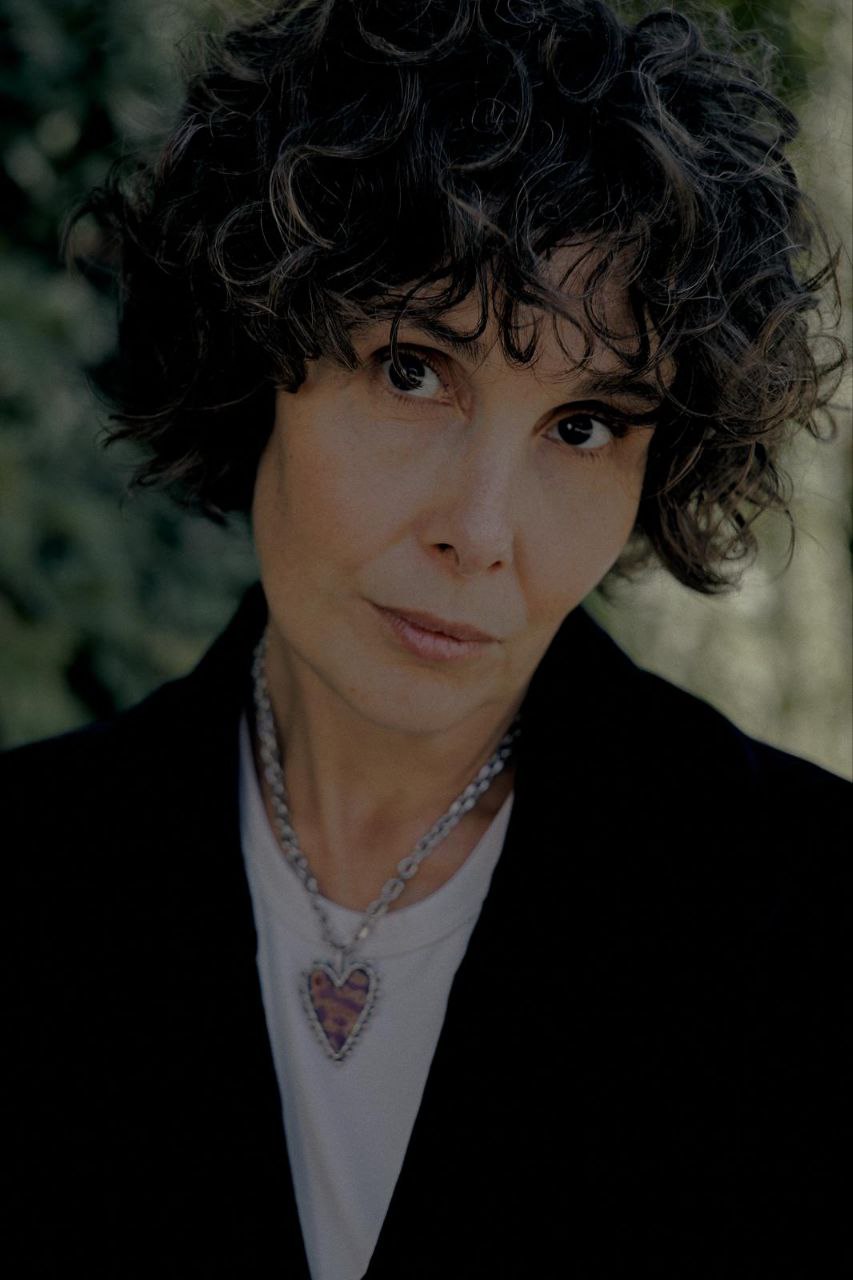
“The club of famous radio nannies” — your programme with Ekaterina Shulman, Zakladka. Why have conversations about literature become so important today? I can answer this from my perspective as a listener, but how do you interpret this audience interest?
Your answer will certainly be no worse — and perhaps better — than mine. My version of the answer seems rather trivial. It’s all because Ekaterina Mikhailovna and I are cute little cats: two pleasant, intelligent, adult women sitting and speaking in an intelligent language, with great enthusiasm and interest, about literature. The one thing you absolutely can’t suspect Ekaterina Mikhailovna and me of is that we are discussing a Flaubert novel while heroically enduring disgust and boredom. In fact, the idea of Zakladka was born at the moment we realized we couldn’t stop talking: we talk before the recording, and when we’re leaving, we keep talking about the same things.
You can’t call us friends in the sense that we raise children together or go on vacation together, but we have this secret garden — plants in which we love to discuss with each other. You know, I have a favourite cooking show where people don’t so much cook as talk about traditional Chinese cuisine, which I don’t really eat and never cook, but they talk about it with such interest, enthusiasm, and involvement that it’s incredibly compelling. I suspect in our case people respond to sincerity, involvement, and genuine interest.
And our audience, broadly speaking, resembles us. People who watch and listen to us are intelligent women 30+ who read now, read before, or simply would like to read more—and our conversations about reading are a kind of comforting refuge, not politicized, not charged with hostility and hatred. It’s a live conversation in which each listener can try on the role of a third interlocutor.
I literally feel like I’m back at my own university — at RSUH, at Zverev’s lecture. I’m eighteen again, and tomorrow at seven in the morning I have to go and take a place in line at the Historical Library.
And then they hugged and cried.
Do you remember RSUH?
Of course — it’s the foundation of my life. I have a slightly special RSUH, because I studied in the Classical Philology department. Tatyana Nikitichna Tolstaya called it a “brotherhood of esoteric sadomasochism”: we had six classes of Ancient Greek and five classes of Latin a week, and everything else — like everyone.
We lived, of course, in a special world and in a special state of consciousness, slightly altered by perpetual overwork. My favourite teachers were also largely concentrated in our department and rarely appeared beyond it. The great poet, translator, critic, thinker, and teacher Grigory Mikhailovich Dashevsky — I believe the chance to study with him is one of the greatest pieces of luck in my life. Nikolai Pavlovich Grintser, head of our department, teacher of Greek and Ancient Greek literature, one of the world’s best specialists in ancient epic.
If you step outside the department, then of course I was very influenced by Andrei Leonidovich Zorin, whose course on eighteenth-century Russian literature I had the chance to attend. And overall RSUH is a space flooded with light; I remember it with an almost unbelievable gratitude. All my closest friends somehow come from there. Last year my closest friend, the anthropologist Alexandra Arkhipova, and I celebrated thirty years of friendship — we met in our second year, in 1995.
Lately we’ve often been turning to the literature of the émigré wave after the Revolution — Sasha Chyorny, Vladimir Nabokov, that pool of authors. It feels like with their lives, their texts, they are speaking to us… In short, is it legitimate to feel a certain kinship with them?
You know, I have a terrible secret that I periodically reveal, but luckily it’s quickly pushed out of public memory: in fact I’m not a philologist — my diploma says I’m a historian. I graduated from the Faculty of History and Philology with a degree in “history.”
And if historical education teaches you anything, it is that all historical parallels are unreliable. More than that: they often get in the way. We always love to discuss what year it is in Russia right now — is it 1937 or already 1945, or 1953, or 1985?
2026?
Yes, 2026. Fair enough. We try to see in the past a reliable parallel that would allow us to build strategies of behaviour. But that is an absolute kingdom built on sand. Such an approach doesn’t help; it harms.
Not long ago I happened upon a lecture by Ilya Zdanevich, posted on the Arzamas portal. There’s a wonderful idea there: the dead are also part of our society; they participate in our lives. Yes, in a certain way the dead live among us, and we can look to them for emotional support. Why do z-poets constantly try to forcibly recruit someone famous: “Brodsky would be with us!” And the same happens on the opposite side: “Brodsky? Is he with them? He’s with us! And Pushkin is with us!” — “No he isn’t, Pushkin is with us!” It’s both terribly stupid and very understandable. Everyone wants to lean on the reliable shoulder of Alexander Sergeyevich; it calms us down.
If we are looking for emotional supports — if we find something that opens some cherished little door in our heart, gives warmth and support — then thank God, why not. But it’s important not to overplay it. Pushkin died almost two hundred years ago; we don’t know whose side he would be on. And would he be Pushkin at all if he had been born in a different time?..
The same applies to emigration. To build your identity on “I am like Tsvetaeva” is foolish. I am not Tsvetaeva, thank God, and I don’t write poems — what a blessing! And even Vera Polozkova is not Tsvetaeva, despite some resemblance. But if Tsvetaeva helps — then that’s good. In general, I think literature should be treated like a healing herb. If it helps — wonderful. If it doesn’t — spit it out quickly. There’s no need to torment yourself with that too.