
Jump over the stream! At the National Theatre they have staged Gorky’s Summerfolk

Director Robert Hastie, Deputy Artistic Director at the National Theatre, seems to have only just finished Hamlet with Hiran Abeysekera before taking on the incredibly difficult play Summerfolk by Maxim Gorky. One might well ask—what has Hecuba to do with him (forgive the inappropriate joke), what devil drove him onto these galley benches? And yet it suddenly turns out that, strangely enough, this is in fact a continuation of the very same Hamlet theme—and there is even a Hamlet of its own here.
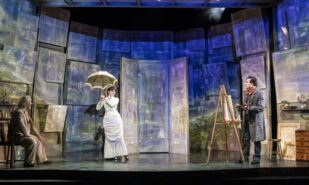
The entire world of Summerfolk revolves around the married couple Varvara (Rebecca Banatvala) and Sergei (Paul Ready) Basov. Their house is the centre of gravity, the light and warmth in this slightly sinister forest: a small white house, the lattice of a dacha veranda, mismatched white chairs, a piano, golden kerosene lamps.
Paul Ready performs a breathtaking volte-face in Summerfolk: endowed with an essentially sympathetic charm, through tiny details he gradually transforms his Sergei—an imposing bearded man in a cream suit—into a dreadful monster, not merely a toxic and boorish drunken husband, but something closer to Koschei the Deathless, or even a dragon (greetings to the readers of Propp!), who has locked the washerwoman’s beautiful daughter in his luxurious dacha castle.
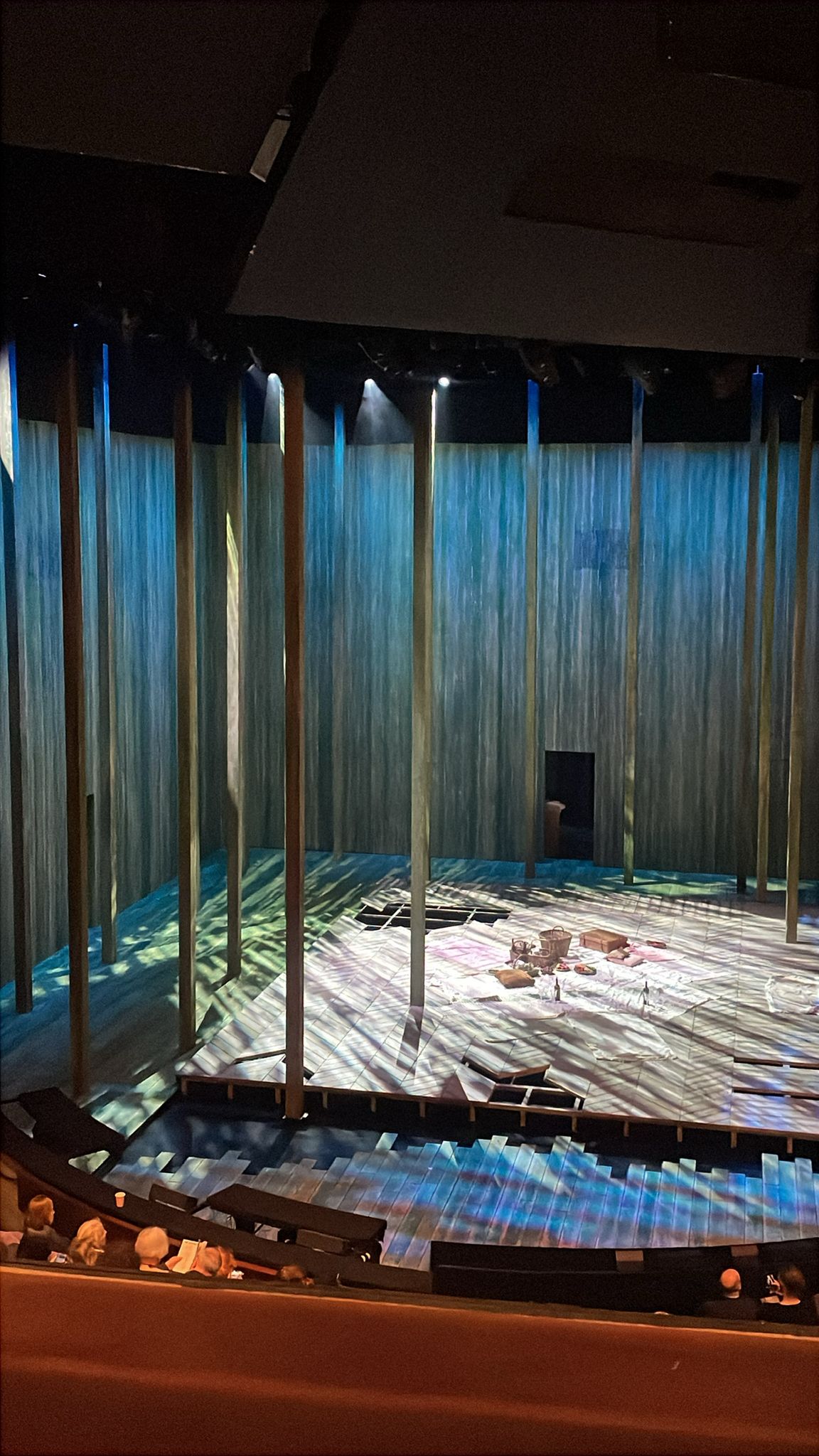
The house is surrounded by a forest—apparently pine, though in fact it is simply wooden beams stretching up into the flies, and it is impossible to tell whether they end somewhere or whether they simply break through the theatre roof and continue upwards, bare, branchless, meaningless.
People move between the trees—sometimes an invisible tide pushes them toward the Basovs’ doorstep, sometimes it carries them away again. The movement is painful, chaotic, yet it is also proof that somewhere out there, beyond this place, life is happening.
Varvara is a tired beauty akin to Chekhov’s Elena: everyone falls in love with her, yet she needs none of them in particular. What she truly wants is to find herself—and not even freedom, really. Sitting inside this familial confinement, she flows in her beautiful dress from dialogue to dialogue, from scene to scene, visibly accumulating an inner charge of irritation. And, as you may recall, she has a brother. And he—he is the quintessential Hamlet.
Yes indeed: he darts about the stage, tormenting himself with philosophical questions, small, defenseless, tousle-haired like a sparrow, desperate, and clearly gnawed by a spiritual malady—just like Hamlet. Like Hamlet, he writes poetry; and like Hamlet, the poems are terrible, meant only to deliver a sting. With precisely this Hamlet-like aura Alex Lawtherplays Vlas.
He moves like quicksilver—sometimes wearily melting onto the floor, sometimes gathering himself again, gesticulating nervously, dropping words as if by accident. One fears for him more than for anyone else: he has no foundation within him at all, only wind and melancholy. Unexpected, isn’t it?
Yet in general these are, of course, highly unexpected Summerfolk. Most of all they resemble a geological cross-section: here we have fluffy comedy, here sharp drama, here a little sex compressed together with the “woman question”, and here something heavy, thick and black as oil… What is it? Existential despair? Cosmic horror? Cthulhu lurking beneath the stage in that black mirrored water? You are free to choose any layer—or all of them at once.
Nina Raine and Moses Raine have rewritten the play so that one cannot quite tell where Gorky ends and British humour begins—humour balancing delicately between university wit and riotous vulgarity, without falling entirely into either. This tightrope act keeps the audience constantly on edge, just like the actors leaping across the narrow stream where thick black water flows—oh, surely someone will slip!—yet no: everyone reaches the other bank.
For Robert Hastie, this is his first encounter not only with Gorky but with Russian-language drama altogether. The Russian flavour is certainly retained, though it seems mostly decorative. Let us run through the checklist: there is a balalaika (though slung on a guitar strap), carpets are present (a sofa, a chair, and the piano stool are upholstered in carpet-patterned fabric), and a samovar is ceremoniously brought out twice at the beginning of the performance. But once this obligatory programme has been completed, the production turns to the most fascinating thing of all: human character.
Summerfolk is often compared with Chekhov’s plays, but in this version the characters somehow feel closer to Tolstoy—so philosophically rich and many-layered are they. And let us say in advance: even when, in the finale, a thunderous scandal erupts—generously seasoned with dancing on tables, poetry and a fistfight—there are neither right nor wrong here. There is only transition, choice, and the relief that follows the bursting of a festering abscess of endless lies and half-spoken truths.
One can imagine such a scandal—some drunk, some despairing, someone filled with love—happening almost anywhere. Do you remember Thomas Vinterberg’s terrifying and beautiful The Celebration, the first film of Dogme-95? Exactly so.
The acting here is uniformly extraordinary. Perfectly constructed characters, reactions played with astonishing precision—and that is why the performance runs for three hours: cutting anything would feel unbearably wasteful.
The most tender, tragic and vulnerable thread belongs to Maria Lvovna, played by Justine Mitchell (who, incidentally, played Elena in The Children of the Sun here at the NT in 2013). This is an extraordinary new performance: her heroine is utterly fearless, and it is impossible not to fall in love with this Maria Lvovna.
As we recall, Maria Lvovna passionately reciprocates Vlas’s declarations of love. There is a twenty-year age difference between them, and the way Mitchell plays fear, distrust, despair, shame—and then finally blazing love—is mesmerizing. She is slender as a cherry tree, and she might be fifteen or a hundred years old—oh magic, oh wondrous feminine witchcraft! Her wrists are like twigs, and the costume that at first constrains her like rusted armour suddenly begins to wrap her graceful figure like rustling expensive paper. Her neat little shoes step uncertainly along the planks—as though she might at any moment lift off and fly.
She blushes crimson, cries, squeezes her eyes shut—and suddenly becomes astonishingly like her own young, playful daughter (Tamika Bennett). The girl bounds about on her silver heels like a rosy elf: very physical, fiercely young and earthly, yet somehow otherworldly—not of this crude, vulgar story where men drink vodka, roar with laughter and crack obscene jokes. No, she does not belong here. And suddenly it becomes clear who she takes after—her mother, of course. She too does not belong here.
Gradually, line by line, scene by scene, the characters begin to divide into “these” and “those”. But this is not the same division, not the social indictment with which Gorky’s play is filled. Hastie has magically shifted the vectors of Gorky’s drama, turning Vlas into Hamlet and Maria into a grown, intelligent, delicate Ophelia—one who has enough soul and heart for them both, and warmth as well.
The gallery of characters whirls past the audience like a furious carousel, and it becomes clear why the play they try to stage within the story is A Midsummer Night’s Dream: there is the enchanted forest of wooden beams, desire, love, confusion—and no wonder the second act becomes a picnic in the woods, where the abscess begins to swell: adultery, flirtation, tragic love, youthful longing, all generously seasoned with summer heat and alcohol.
The audience laughs constantly—sometimes sympathetically, sometimes maliciously, sometimes in recognition. These people who cannot quite change their lives, cannot properly leave their partners, cannot write poems, cannot even shoot themselves—such incompetents, and yet so close and recognizable that sometimes the laughter bursts out almost with relief: this is not me, this is not about me, my life is surely in order…
And perhaps this is the main difference between Gorky’s Summerfolk and Hastie’s Summerfolk: in Hastie’s version none of them are “condemned”. Instead, they evoke compassion. Inept, otherworldly, awkward, young and not so young, kind and not so kind, drunk and not so drunk—above all, living, real human beings.