From Stucco to AI: Inside the Royal Academy Summer Exhibition 2025 Opening

What makes a British summer truly British — strawberries from Wimbledon, traffic jams en route to Cornwall, or the Chelsea Flower Show? In our view, the season officially begins with the Royal Academy of Arts’ annual Summer Exhibition, nestled in the grand enfilade of Burlington House in central London. This year’s edition opens to the public on June 17 and runs through August 17.
Marble, gilded stucco, wide staircases — the kind Pre-Raphaelites may once have tripped on — all of it sets not just the mood but the ritual of the show. Yet this loud, vibrant, visually explosive celebration of contemporary art is now taking place for the 257th time in a row. Not a single interruption — not war, not pandemic, not monarchic succession, not even existential disillusionment has managed to halt this annual spectacle.

In 2025, the exhibition is curated by architect Farshid Moussavi, who didn’t just line a few scale models against the wall (as is often the fate of architecture in museums). She insisted — and succeeded! — in making architecture a full participant in the artistic dialogue. And that’s fitting, since dialogue is the overarching theme of the 2025 show. Designs, blueprints, even an urban mock-up carved from a fallen sequoia are given equal voice.

All in all, the show features — wait for it — over 1,700 works. If you’re hoping to see it all in 30 minutes, abandon hope now: you’ll get lost, and the artworks will blur together like a smoothie — a whirl of colour and texture. It spans every imaginable medium: painting, sculpture, video art, installation, photography, architecture, textiles, digital art, even AI. All genres, all moods, all styles. More formats than the BBC!


Prices range from the modest to the outrageous — from “expensive postcard” to “better sell your flat.” But that’s what the Summer Exhibition is about: half of London shows up dreaming of buying art on instalment, and the other half hoping to sell. Proceeds go not only to the artists, but also to funding the Royal Academy’s educational program — the only free three-year fine arts postgraduate course in Europe. So no one can claim contemporary art doesn’t serve a practical purpose.
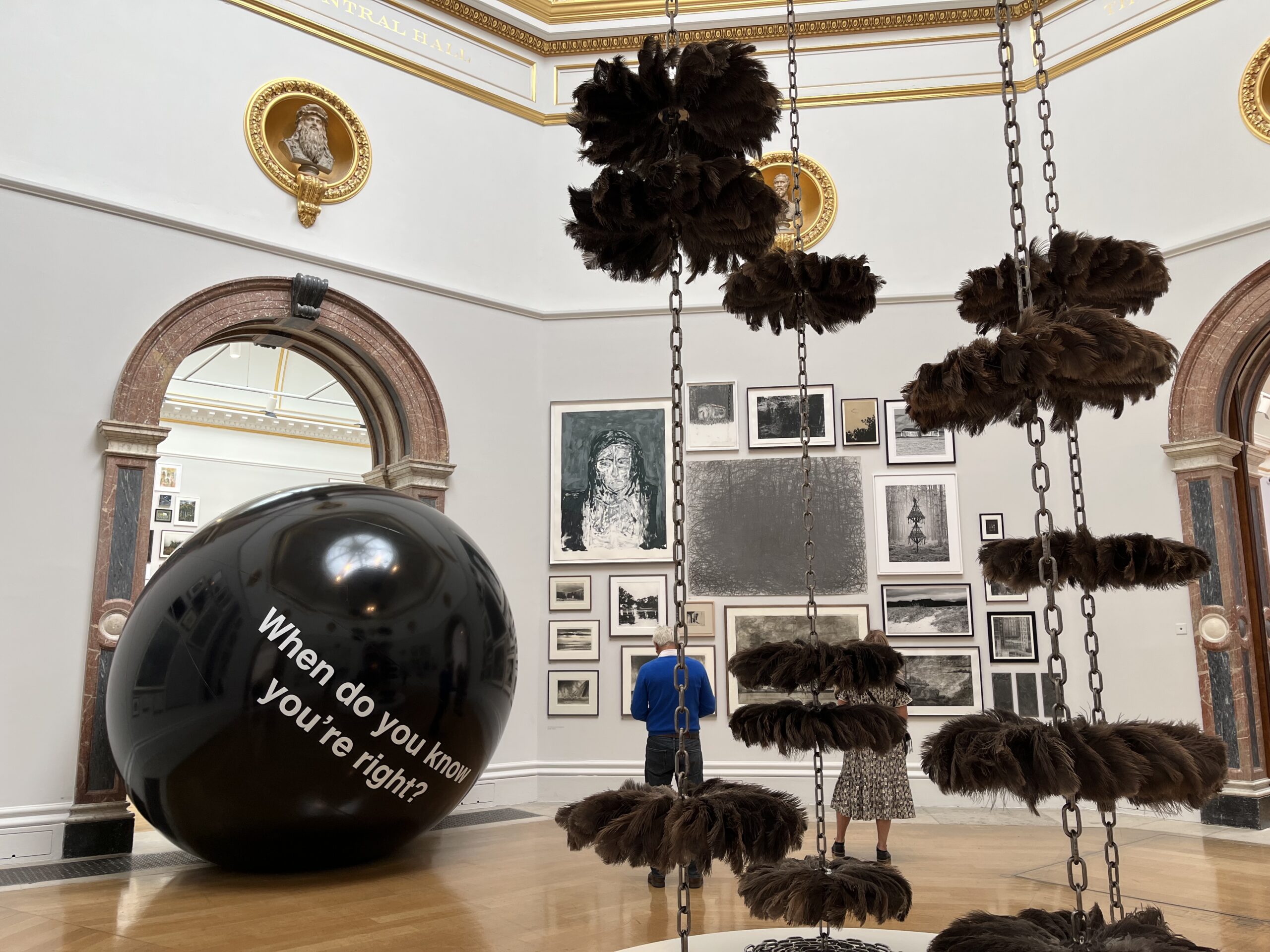
The curatorial work with space deserves special mention. With so many works, the result could’ve easily resembled a chaotic garage sale. But no — the rooms are meticulously curated. Themes unfold like chapters in a visual album: colour-based groupings here, thematic threads there, textile animal silhouettes above your head, and around the corner — architectural blueprints for future cities that don’t destroy the present. Even the endless rows of postcard-sized paintings — often hung like stamp collections — don’t tire the eye. The space breathes, despite its density.

Perhaps the most surprising star of the show is artificial intelligence. At least one work, according to its label, was created with AI involvement. Normally, galleries shy away from such things — as if machines don’t belong in the temple of art. But apparently, the time has come. AI has not only snuck into the elite world of art — it’s starting to make itself comfortable.

This entire art extravaganza is sponsored by Insight Investment, a major financial firm that has been supporting the Summer Exhibition for 19 years. Noble indeed — although slightly ironic to see one of the pillars of capitalist stability proudly backing an exhibition centred on “survival and coexistence.” But hey — that’s the dialogue.

On your way out, you’ll encounter five giant inflatable balls, each bearing a strange question written by the artist in collaboration with children — things like “Does abstraction have rules?” or “When do you know you’re right?” It’s a final nod to the logic of childhood and the beauty of absurdity. After all, sometimes kids are the only ones asking the questions that really matter.

The Royal Academy does the impossible: it turns what could be a dry yearly report on the state of the arts into a cultural bacchanalia. Yes, there are filler works. Yes, some of it’s “too much” and some “not enough.” But that’s the point. The Summer Exhibition is a mirror shattered into 1,700 shards — and every piece tells its own story. Don’t try to take it all in. Choose a room, a theme, a medium — or simply a work that stirs something in you. Because art, in the end, isn’t about whether you liked it. It’s about whether it got to you.
You must be logged in to post a comment.