Jeff Shankley: “Theatre is the bedtime story business”

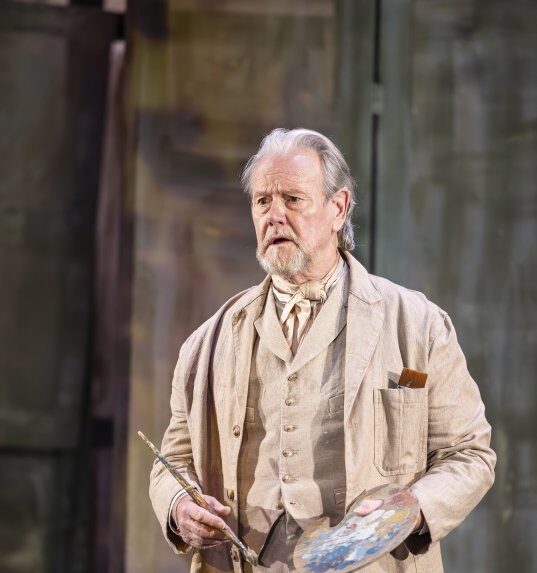
Jeff Shankley, a legend of British musical theatre and the original performer of Munkustrap in Cats and Pilate in Jesus Christ Superstar, has never confined himself to the mirror of the stage. He writes books and composes music. Today, the owner of an unforgettable baritone takes to the stage at Charing Cross Theatre as Claude Monet in the musical A Mirrored Monet — and it is theatre that became the focus of our conversation.
Shankley speaks not about a genius, but about a human being — complex, vulnerable, and driven by his craft. In this interview, he reflects on the nature of creativity, its fleetingness, fear and freedom, and on how a role is born — and why it is essential not to judge a character, but to try to understand him.

Claude Monet is a real person, a historical figure. How did you find your own Claude?
I always begin with the text: when you’ve got the helicopter view of the whole play, not just your role within it, then you can understand why the writer wrote the story. I started with the assumption that Monet wasn’t a genius, that he was simply an artist with a particular perspective on life. Ask any genius whether they think they are a genius and they would probably say no. So I approached him as an ordinary man with obvious complications. I used some ideas in rehearsal, of course, but it was important to me to play what the writer wanted. Because we have a saying: the writer is always top of the table. I worked through the simple, basic things: where is he going, what is he doing, what are the stakes? And one little niche I always love to find in a character is: what would he prefer to hide?
That shows the vulnerability, and as I’ve grown older I’ve realised that it’s precisely the vulnerabilities that make a character far more complex and much more interesting. Claude was a difficult man, there’s no doubt about it. The amount of human debris he left around him… And for some reason it was always women. Perhaps because it is women who dedicate their lives to such men. And the structure of society then was such that women were always, in some sense, subservient to men. Thankfully, that has changed now.
Before this production, did you feel close to Monet as an artist?
I knew the pictures, of course, and I loved them, but I did not know Monet the man. Unlike the painters before him, who would say, “I know what a cathedral looks like, I’m going to paint that,” Monet would say, “No, I’m not going to paint the cathedral. I’m going to paint the effect of light upon it, and the effect of air and the environment around it.” His work was never really about haystacks, cathedrals, water lilies, or Camille. He was trying to paint time, to render its passing, that fleeting moment when light passes through a thing. That was what was so radical about his thinking, and that is why the Salon was so up in arms about it.
We tend, in general, to label things very quickly. “This is a ship,” “this is a boat,” “this is a flower.” Monet was trying to catch that first moment of seeing and the effect it has on you. Because passing is the essence of it. Nature does not stop. We do not stop. That brought me back to something I had been thinking about for a long time: that when we meet people, we tend to label them very quickly. “Oh, he’s nice,” or “he’s a bit difficult,” or “I don’t like him,” or “I don’t feel I connected with that person.” And the next time we see them, that is what we look at — the label — when in fact the person has changed. In the three or four weeks since we last saw them, they may have gone through chaos, trauma, lived experience. And so only in the present moment can you really look at someone and say: “I am really looking at you as you are now.” And it is a very forgiving philosophy, because it allows people to breathe, it doesn’t create labels and boundaries. And I think, in a way, that is how Monet painted too. He wanted the viewer to become part of the moment: you are not simply looking at the water lilies, you are in the pond. And that is deeply exciting.
This way of looking at painters’ work — is it similar to your own work? As an actor? A performance is a moment, it cannot be repeated.
You know, during the pandemic I thought I’d had enough of acting. I didn’t want to act anymore. I wanted to write. I lived alone for about two years during the pandemic, because my family were younger and I felt it was important that they had contact with people for their mental health. I had a lot of inner resources, and I knew I could survive that, but I wanted to create something, not simply smoke and drink myself into oblivion.
So I took Jeff Shankley and put him aside, together with all his doubts, his vulnerabilities, his insecurities, all his failures and what he thought about himself. And I was very still, and I let the subconscious bubble up — and in more than seventy years of living I had accumulated a huge number of observations. And by the end of those two years I had written twenty-three novels in different genres, despite the fact that I had never written before, and at the same time I was composing operas and librettos. I did not so much retire as rewire myself — I found something else. Because as an actor, you create only the subtext — the words are given to you. What happens beneath them is the richness the actor can bring from his own life experience. But suddenly I discovered that I could write not only what the characters say, but what they are thinking too.
To go back to your original question — are there parallels between the professions? Yes, of course there are parallels, I think, with any artist who is dedicated to the work, compelled by it. When I write, I can be obsessive too. My partner says that sometimes she wants to drag me back to reality. And of course that is exactly what happened to Monet with Camille, with Blanche. But for him this gift was a curse — this compulsion to create was something he had to fulfil, and I don’t think he was wilfully cruel or neglectful of the people close to him. He was totally focused on what he was doing and could not be otherwise.
You do not judge him?
Do you?
No.
Are you sure?
Of course.
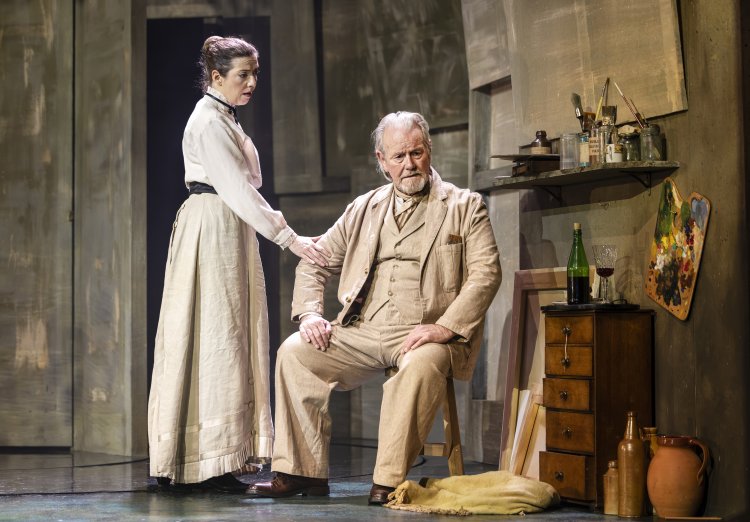
I asked the director, the composer and the writer: when the curtain comes down, what do you want the audience to think of Monet? They said the audience should make up its own mind. Of course he was inconsistent. But perhaps he mistook tenderness for distance, I don’t know. He was distant from them and could not get close — because he was a man who understood light and colour better than he understood himself. In this story we see a man who did not understand himself until it was too late — until he had lost Camille. He was Catholic, so he could not use contraception — and she died after the second birth. She was frail and would probably have died young in any case, but there are moments when I stand up there and think: “You killed her. You drove her to death because you made her model even when she was sick. But you needed that painting for the Salon. And that took precedence.” And within the fiction of the play, she dies during that modelling, and he is completely wiped out as a human being.
The atmosphere of the performance, with the light and the colours, is absolutely astonishing. Does that light help you?
So much. Oh, it is so emotional! And one of the things I learned is that colour is not just colour. Colour is an event. It is not simply blue, green, red. Green, for instance, argues with itself — there is a conflict in it. And when you introduce light, the colour changes. It is that fleetingness Monet was trying to paint — it may look as though it is the same subject again and again, but it is not the same thing. In the same way, an actor cannot give the same performance every night. It is impossible. Your fellow actor will throw you a line differently because they had a row that day or some trouble, and you must respond to that — otherwise the audience will feel the staleness, the falseness. You cannot perform in isolation. You have to act through the other actor and — absolutely — include the audience.
Do you think the audience has changed since the days of the Andrew Lloyd Webber musicals, for instance in Jesus Christ Superstar or Cats?
Absolutely. It is a completely different animal. And every night changes as well — it depends on the audience. Sometimes there are a lot of elderly people in, and they live with their memories. But when you are standing in front of two and a half thousand people in an Andrew Lloyd Webber show, it is powerful, but it is a different thing entirely, a spectacle. In musicals, too, the song becomes the psychology — and I always look for the reason why it cannot be spoken, why it has to be sung. With age that becomes harder — I am not the baritone I was at thirty. In musicals I learned to imply more than is written, because every line there has to be loaded with subtext. And something has just come to mind — my first real observation of this. I was very fortunate: the first play I did in the West End was an original play by John Osborne called West of Suez, and Ralph Richardson played the lead.
Watching this great actor work on stage left me completely spellbound. He always gave the impression that, when he arrived at a word in a sentence, he was searching for something better — and only when he couldn’t find it would he reluctantly say what the author had written. I loved that sense of searching within the line. It kept the performance fresh, real, honest, and truthful, and it drew you in tremendously.
Rather than constantly driving toward the full stop — which, of course, is sometimes necessary — he allowed the thought to live and breathe. Actors can occasionally be a little indulgent; they like to stretch a sentence in order to hold it. But sometimes you simply have to pass the line on. If it’s a feed, it’s a feed — don’t cloud it, keep it clean.
Do you use the same principle in drama, for example in Shakespeare?
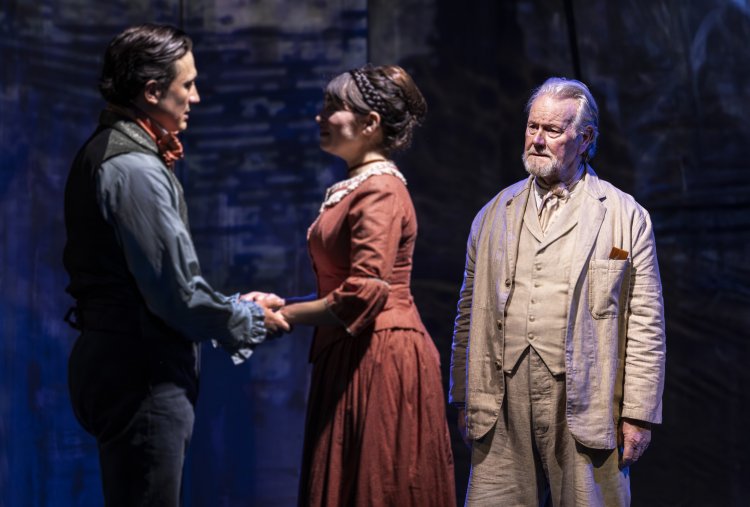
Yes. I think the first thing one has to do is strip away the sense of reverence — that “holy” quality. The idea that you are dealing with this extraordinary genius can be overwhelming. But it’s a play. It’s a play. And we are, essentially, in the bedtime story business: we tell stories.
You have to understand the story. And if you have a good director — someone who is almost a dramaturg as well, like Christian Durham here — then you must trust them to shape it. He’s a wonderful director, probably the best I’ve worked with, because he brought something out of me that I didn’t even know existed.
With Shakespeare, you need that guidance, because many of the lines meant something very specific in the sixteenth century, and today that meaning can easily go over people’s heads. Or you get a few very knowledgeable audience members who sit there rather smugly, because they understand it — while everyone else is left out. And that’s not fair.
Do you have a favourite Shakespeare role?
Probably Puck in A Midsummer Night’s Dream. I played him when I was twelve. And I realised: I can learn this, I can understand this, but I cannot do mathematics. So this must be mine. If a child finds his magnetic centre, that is for life. And everything that never interested me at school became necessary in acting: history, politics, religion, science, clothes, food — everything. You are not wearing a costume, you are wearing the clothes of that time. It has been an extraordinary career, really. Even though Puck was a turning point for me as a young actor, I do think Claude Monet will be a favourite role. Many things came together for me while creating him. I will remember it as a wonderful and challenging experience.
Do you remember the atmosphere during rehearsals for Jesus Christ Superstar and Cats? Was it like a rock concert, or… what did it look like?
Well… I never thought of it as a rock concert. I thought of it as a story in which I was playing Pontius Pilate — and it is a wonderful part, because it develops. It was fascinating. We take radio mics for granted now, but then we had handheld microphones with cables. And I used that cable to whip Christ thirty-nine times. I have to say it was easier for me than it was for the stage manager, who was sitting offstage and every time I lashed him had to pull the cable back and let it go again — thirty-nine times. But it was exhausting for me too, because the intensity had to build, and the last nine lashes became Pilate screaming in hysteria because the man in front of him will not speak and the whole burden is falling on his shoulders. So the distress Pilate feels gives the role an arc. Working on a role, I always ask myself: what does the audience know at the end that it did not know at the beginning? And if they have made the journey with me, then I hope I have been the conduit for that discovery.
Was Superstar your first musical?
Yes, I had not done musicals before that. I was a serious actor at the time, I did not dance and I did not sing. But my agent said, “Do you want to audition for Pilate in Superstar?” and I thought, “Oh, music… right, all right then.” I had never had a singing lesson in my life — I work on instinct and energy, for me it is the character that sings, not the technique. Now there are moments, when I am composing, when I think, “Oh, that is an A — forget it. No, I am not going to get that.” But back then I knew nothing at all, and in Pilate’s part, right at the end, there are eight B flats that are outside a baritone’s range. But Andrew Lloyd Webber very cleverly put them there because he wanted the distress of a man singing beyond his range — and that sharpened the drama. I do not know how I survived those eighteen months. But I did. And they were an extraordinary eighteen months.
And Cats?
With Cats, it was slightly different. I was much older. I’d gone along to audition because Trevor Nunn was auditioning and I wanted to go to the Royal Shakespeare Company. I was sitting in the corridor waiting for my turn and watching people sing their ballads… and I had just come back from Berlin, where I was playing Frank-N-Furter in The Rocky Horror Show — in fishnet tights and heels, which was pretty outrageous, but liberating, I can tell you. And I thought: “God, it just feels just a bit dull to me to sing the ballad I’ve got. And I know Sweet Transvestite, so hell, I’m just going to sing it.” And I did. Trevor sat there with his mouth open and then said, “I feel as though I’ve seen the entire show. Why have I never met you before?” And it was that first time as an actor where I could genuinely say: “Because I’ve been working.”
Trevor said, “If Cats doesn’t work out, I’ll take you into the Royal Shakespeare Company.” I floated out of that room. I was on cloud nine. But Cats did work out — and it changed my whole life.
In the third week of rehearsals I tore the cartilage in my leg — I had knee surgery, but they didn’t get rid of me. I went through rehabilitation in a ehabilitation clinic on Harley Street — it was a good thing there were beautiful women working there, because otherwise it was like Dachau: they literally made me work like buggery to get back into the show. And I went in the six weeks – I had to be back for the previews. But I couldn’t bend my leg, so I invented a cat’s walk with the leg stuck out to the side. And that became Munkustrap’s stance — it came out of the injury.
What a dramatic turn!
And in Starlight Express, a twenty-two-ton bridge knocked my teeth out — they call it the Jeff Shankly Memorial Bridge now. It nearly blinded me! Yes, I have given blood and bone to this profession.
You said the director is very important to you.
Yes. The director matters from the very beginning to the very end. And the assistant director too. Usually we have about six weeks of rehearsal, and from the first day the director sets out his concept of the piece and guides the actors through it, especially if it is a good director like Christian Durham — he does not leap on you when you do something wrong. He understands the actor’s process, and so he lets you run with it. I remember we were rehearsing a scene with bread and wine, and for me it became a symbol of communion, of the transformation of wine and bread into the blood and flesh of Christ. But it didn’t last long because it held up the action, but it was a necessary process of discovery to go through, and I’m very glad that Christian let me do that because eventually I said, you know, there’s so many food references here. And I thought: is not my character doing the same thing — transforming light into painting, and colour into time?
Some people say that time does not exist, that we only perceive it as linear.
The first thing that comes to mind is: do the past, present and future really exist? The only reality is a succession of present moments. Have you ever visited the past? No. Nor has anyone else. So does it exist? It is simply a memory. And memory is not reliable: it thins, it conditions, it changes. It gives you, in a way, the best version of yourself, because the truth of your memory is sometimes a bit too painful to take. And the future — is that not an illusion too?

What do you think about time travel?
Well, I suppose we all have a time machine so far as we’ve got this wealth of past memories and life experiences. No matter what age we are. It’s just that when we are younger we do not draw on it as much as when we are older, when this feeling appears that it is all over. You know, for me, it’s all in front of me. Like, I’ve got so much more to discover, so much more to learn, you know. The important thing is not to limit your own possibilities. We often have a fixed idea of who we are and what we are capable of — a kind of sum total of everything anybody has ever said about us. “Oh, you can’t dance, darling. You’re hopeless. You’ve got two left feet.” Or: “Don’t ever try to be a model — you walk like an elephant.” All those things sink into the subconscious and shape our personality — our doubts, our vulnerabilities — and they are a pain in the ass to get rid of. But the only way forward is to put them aside. What we really are is limitless.
And fear is one of the greatest barriers?
It can be. It can be the fear of failure. Fear in general — phobos, as the Greeks called it. Overcoming fear is, in many respects, the first hurdle an actor has to get over. It is the fear of the audience, the fear of not being liked. So many actors need to be loved. But the question is: are you up there for therapy, or are you there to show the truth of the character? Why do very beautiful actresses so often love to play ugly women — women with rough hands, women with hard lives? Because they themselves are beautiful, and they enjoy laying that beauty aside. And conversely, those who are not blessed with conventional beauty often love to put beauty on stage: there are actresses who can play beauty in such a way that you forget to breathe, because they have the ability to make you believe. Theatre is the bedtime story business — we make people believe the fairy tale.