The Keys to Hogwarts: Galina Yuzefovich Presents Her New Book in London

Harry Potter fans are a loyal crowd—especially those who grew up with the seven-book series and had to wait for each new installment. It was largely people like this who came on January 29 to Galina Yuzefovich’s lecture at the Idiot Books bookstore—along with her regular listeners and readers, of whom there are so many in London that tickets for the evening sold out within minutes.
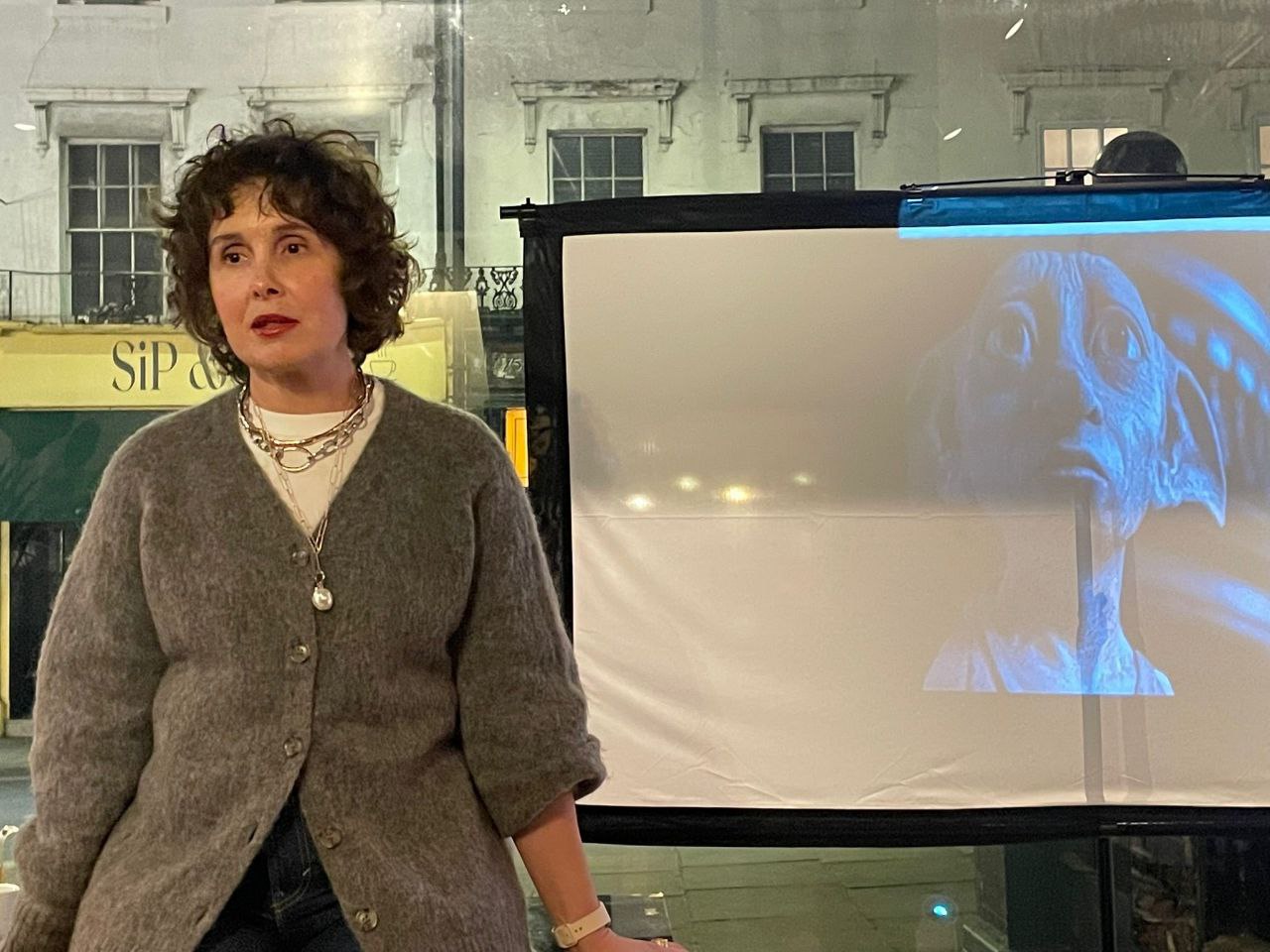
The lecture, titled “Something About Good and Evil: English Traditions and the Value System in Harry Potter,” served as a presentation of Yuzefovich’s new book, “The Keys to Hogwarts: Cultural Codes of the Harry Potter Universe”.
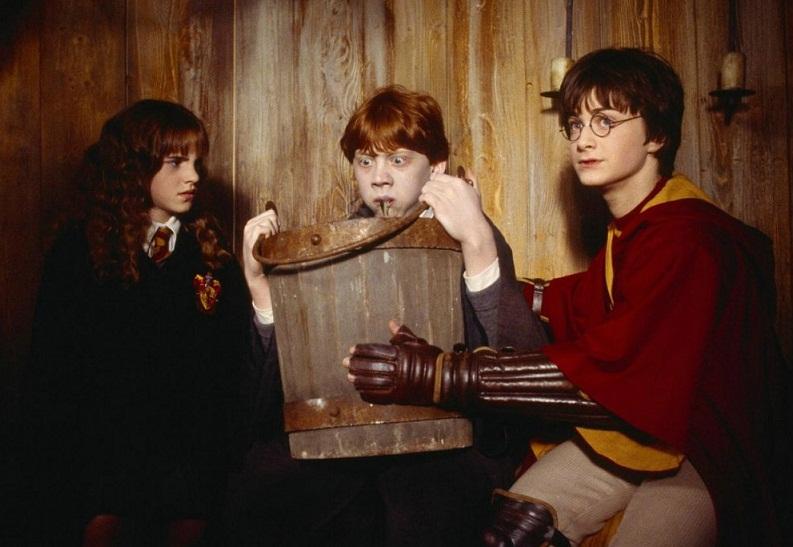
Introducing the audience to her subject, Yuzefovich drew attention to elements of J. K. Rowling’s universe that not only fail to irritate the reader but even lend it a certain charm—despite being, in fact, rather strange.
What exactly are students taught at the famous school? Is Hogwarts education really so remarkable? Why do wizards treat house-elves like outright slave owners, while the Weasley family laments that they cannot afford to have such a servant? Why do followers of Grindelwald and Voldemort consider Muggles inferior and seek to enslave them altogether? And so on and so forth. And yet the seven-book series clearly stands on firmly humanistic principles—how can this be?
Speaking about the image of the dark wizard Grindelwald, Yuzefovich mentioned the British politician Oswald Mosley, founder of the British Union of Fascists, who rose to prominence in the 1930s:
«After returning from the First World War, Mosley felt an acute need to help his country, to somehow bring it to justice. His imagination was not particularly rich, so after wavering between the Liberal and Conservative parties, he realized that the English political map did not suit him at all—he wanted something different. In search of that ‘something else,’ he went to negotiate with Mussolini, who then quite literally became a role model for him. Mosley returned to England with a firm belief that all the mistakes of the previous era could be corrected by establishing fascist rule in Britain. He founded the British Union of Fascists, whose members immediately donned black shirts and took to the streets».
Delving deeply into the historical background, Yuzefovich also mentioned the Mitford sisters—Diana Mitford, who became Mosley’s wife; Unity, a fervent fascist who nearly married Hitler; and, of course, Jessica, an anti-fascist who fought darkness by every means available to her.
«Interestingly, the real-life ridiculus spell cast against Mosley turned out to be a novel by P. G. Wodehouse, in which Mosley was mocked so mercilessly that his popularity plummeted rapidly—whether, as Yuzefovich clarified, the novel coincided with the collapse of his political career, or whether satire and laughter truly had such a powerful effect on public opinion».
Drawing numerous parallels between historical figures, classic works that form the golden canon of both British and world literature, and the characters and actions of Harry Potter, Yuzefovich meticulously constructed a clear interpretive framework for her audience—explaining where the seven-book saga came from and why these are profoundly British books. In a sense, they might even serve as a kind of guidebook to the British educational system.
Galina Yuzefovich also recalled classic and much-loved books and long-running television series—from the Jeeves and Wooster stories to Downton Abbey, which focuses on aristocratic high society:
«If we try to project everything I’ve just described onto reality, we end up with a community that is very similar in its rules, customs, habits, and outlook on life to the British upper classes. In other words, the wizarding community is constructed according to the same model by which the British upper classes have lived for centuries».
To this day, Yuzefovich noted, audiences continue to watch shows like Bridgerton, which depict—albeit somewhat grotesquely—the life of high society, and the literary tradition devoted to this world remains very much alive:
«There is a vast, rich, and in fact enduring tradition of literature about the lives of the upper classes. These include Wodehouse’s books about the idle aristocrat Bertie Wooster; Nancy Mitford’s novels The Pursuit of Love and Love in a Cold Climate; and the novels of Evelyn Waugh».
Edward St Aubyn’s tetralogy was also mentioned:
«If the characters of Nancy Mitford and Evelyn Waugh endured their traumas with restraint, then Patrick Melrose, for one thing, has a far more severe addiction—and everything that happens to him is much more horrifying: family violence, drug abuse, recovery from addiction, and painfully difficult relationships with people from his own social milieu».
At the beginning of the evening, Galina joked that people kept asking whether her new book was fan fiction. No, not fan fiction—although fan fiction did, of course, come up, both as a general phenomenon and specifically in relation to Harry Potter.
Some attendees shared stories of parents who, if not sharing their child’s passion for Harry Potter, at least understood it—and took them to an all-night bookstore when the next volume was released.
Yuzefovich herself recalled how she became a philologist: when she was very young, she had to wait for the translation of the next volume of The Lord of the Rings, and while waiting, she reread the entire canon of epic literature—and after that, her path was decided.
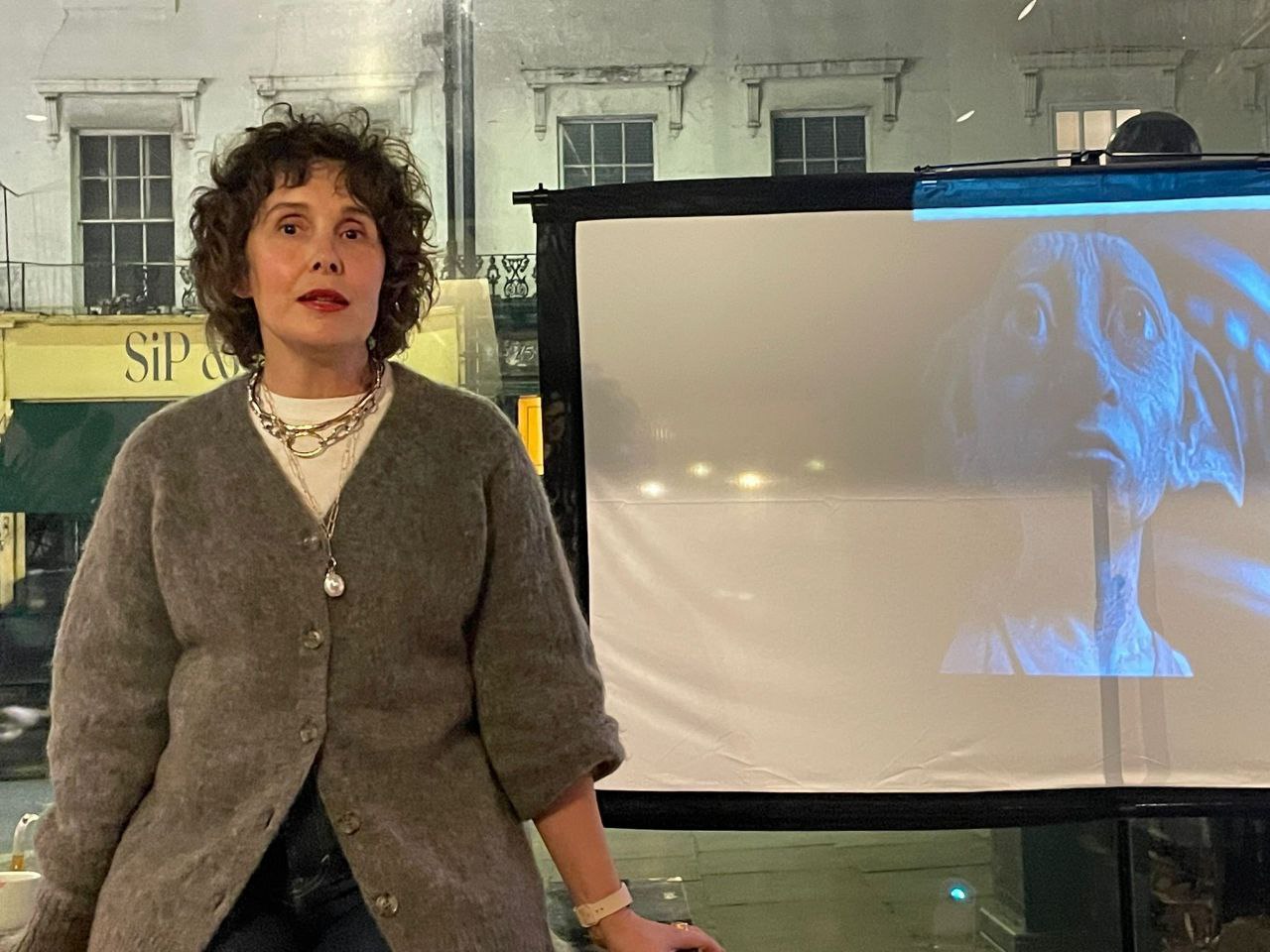
From the outside, the large illuminated window of Idiot Books looked like a series of living paintings. Inside, the hall was packed with listeners whose faces expressed not just interest, but genuine pleasure. Speaking of fan fiction, both the audience and Yuzefovich mentioned Harry Potter and the Methods of Rationality by rationalist Eliezer Yudkowsky, in which Harry approaches the world from a scientific perspective, critically evaluating everything that happens.
By the end, the lecture seemed to turn into an exchange of impressions and memories, resembling a reunion of Hogwarts classmates. Toward the conclusion, Yuzefovich quoted Laura Thompson from her book about the Mitford sisters:
«And yet, for the most part, we do not want that world—the world of aristocrats—to disappear. What would we do without the upper classes? So long as their representative behaves in accordance with his status, laughing mischievously at his own eccentricity, egalitarian Britain will forgive him».
That is to say, we are, in fact, favourably disposed toward the British aristocracy. An aristocrat must live up to certain expectations. And if we assume that the characters created by J. K. Rowling are essentially aristocrats—albeit somewhat disguised—we see that they fully meet those expectations and demands.