
From Mary Bennet to Hobbits: Six Christmas Shows in London

In London, Christmas begins long before December. Perhaps this centuries-old, tried-and-tested tradition helps us withstand the early darkness, icy winds, and rain that occasionally turns to snow. We’ve chosen six very different productions, ranging from traditional British pantomime to an American comedy.
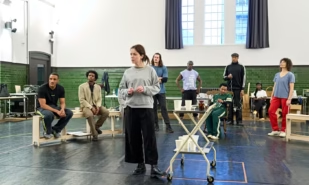
Miss Bennet: Christmas at Pemberley
Park Theatre
13 Clifton Terrace, Finsbury Park, London N4 3JP
Mary Bennet, the least conspicuous of the five sisters in Pride and Prejudice, has somehow gone from being a minor character to almost a leading lady. Austen’s Mary is all dull piano-playing, books, and moralising pronouncements that nobody wants to listen to. But about ten years ago, American playwrights Lauren Gunderson and Margot Melcon decided to put things right and wrote a story of her own. Their play, Miss Bennet: Christmas at Pemberley, first staged in the United States in 2016, has finally reached the British stage. Interestingly, this is happening amid renewed interest in Mary, sparked by the BBC series The Other Bennet Sister. It is worth noting, however, that the play has no narrative connection with the series.
The action takes place at Pemberley, where the Bennet family gathers for Christmas. Elizabeth is happily married to Mr. Darcy, Jane to Bingley, while Mary remains the same odd sister, plain and rather dry. The arrival of Arthur de Bourgh changes the usual order of things: perhaps Mary will discover that a love of books and independent thinking need not stand in the way of personal happiness, and that refusing to conform to society’s expectations might even turn out to be an undeniable virtue.
The production at Park Theatre is directed by Sarah Meadows, who works extensively with contemporary drama, women’s stories, and characters trying to break free from the roles imposed upon them.
The title role is played by Chloe Wade, known for the television series Emmerdale and Doctors, as well as the film Upgraded. Her work in independent theatre is particularly interesting: she wrote As SHE Likes It, a play devoted to women’s voices and stories in the film industry, which toured England a couple of years ago. Arthur de Bourgh is played by Keaton Guimarães-Tolley (Mother Courage and Her Children at Shakespeare’s Globe). Elizabeth Darcy is played by Nadi Kemp-Sayfi, familiar from EastEnders, and Mr. Darcy by Jack Michael Stacey (Queen Charlotte: A Bridgerton Story).
Perhaps the most interesting thing about this Christmas comedy is not how Mary fights for her happiness, but how she moves from being a supporting character in somebody else’s story to becoming the protagonist of her own. Besides, it’s a wonderful excuse to meet the Bennet family again, beloved by readers and audiences for many decades.
The Snowman
Peacock Theatre
Portugal St, London WC2A 2HT
On 26 December 1982, Channel 4 broadcast the animated film The Snowman. A wonderful song, hardly a word spoken, and a heart-wrenching story. It was directed by Dianne Jackson, and ever since then Christmas has acquired a new… symbol? Tradition? Channel 4 has shown the film every Christmas since, for more than forty years. It all began in 1978 with Raymond Briggs’s picture book about a boy who builds a snowman that comes to life. Four years later, director Dianne Jackson turned it into an animated film, while composer Howard Blake wrote the music, including the famous Walking in the Air. Two years later, none other than David Bowie introduced the film on screen.
There are sweet Christmas stories, with little presents and cosy fireplaces. And then there’s The Snowman — a story about flight, dreams, and freedom, with a handful of melted snow at the end. As luminous as it is heartbreaking.
The boy and the Snowman explore the house, discovering wonders in familiar, everyday things, before rising into the sky above the snow-covered countryside — and Brighton. In the theatrical version, their journey also takes them beneath the Northern Lights and among the reindeer; they meet other snowmen and Father Christmas. It’s easy to see why this story hardly needs words: the music carries the narrative, guiding the characters and their movements in a way that has become familiar to several generations of British audiences.
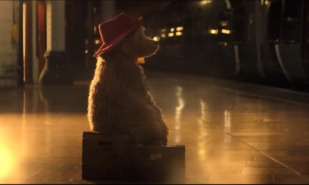
But this year, The Snowman is entirely new, replacing the stage version that ran for more than thirty years. The production is directed and choreographed by Olivier Award winner Will Tuckett, whose credits include Into the Woods at the Royal Opera House and The Nutcracker for the National Ballet of Japan. The new Snowman has been created by puppet designer Tahra Zafar — yes, the very artist who made the brilliant puppet of that touching little bear Paddington, which won the hearts of audiences and theatre professionals alike. Four young performers share the role of the boy: Felix Anderson, Jake Durant, Tristan Marwa, and Tate Masuku.
This is quite a challenge: bringing to the stage a story whose magic is so deeply connected to the tenderness of hand-drawn animation and to each audience member’s childhood. One can’t help feeling a little possessive, perhaps even grumbling under one’s breath. But London theatre knows how to overcome such difficulties — just think of Paddington or Totoro. Can stage illusions, puppets, video projections, and flying machinery preserve the same fragility, tenderness, and intimacy of the memories that live in the book and the animated film? Perhaps adults need to see it just as much as children do: to remember once again what it feels like to believe that you can fly!
A Christmas Carol
The Old Vic
103 The Cut, London SE1 8NB
In 1843, Dickens wrote a short novella, something of a social sermon, about an elderly miser named Ebenezer Scrooge. Interestingly, readers might never have seen A Christmas Carol in Prose: Being a Ghost Story of Christmas at all. Dickens’s previous novel had been a financial disappointment, and his publishers tried to turn down the new book. Dickens announced that he would pay for its publication himself. Then the printers made mistakes, and the writer himself was unhappy with the book’s appearance. Eventually, A Christmas Carol was published and sold well, but printing expenses swallowed up part of the profits, leaving Dickens deeply disappointed by the modest income from his story about a grumpy old miser.
Just in case, let’s remind ourselves of the plot. Scrooge despises the festive fuss, cannot understand other people’s joy, and considers kindness both pointless and harmful. But then he is visited by the ghost of his dead business partner, Marley, followed by three spirits who show him his past, present, and possible future. Scrooge is so shaken that he begins to wonder: can he change before it’s too late?
The stage adaptation of Dickens’s best-known story, which The Old Vic has been performing for several seasons now, was created by playwright Jack Thorne and director Matthew Warchus. Thorne is one of Britain’s best-known contemporary screenwriters and playwrights, whose credits include Harry Potter and the Cursed Child, His Dark Materials, and Adolescence. Warchus directed the celebrated Matilda and also served as artistic director of The Old Vic, so he knows the theatre and its audience very well. Almost immediately after its premiere in 2017, A Christmas Carol became one of London’s Christmas traditions. There is music, magical little bells, treats, and a festive atmosphere, and the audience becomes part of the shared experience.
This year, Scrooge is played by Giles Terera, who won an Olivier Award for his portrayal of Aaron Burr in the original London production of Hamilton. The cast also includes Carly Bawden as Belle, Ewan Black as Fred, Edward Harrison as Marley, and Jack North as Bob Cratchit. Rob Howell is responsible for the set and costume design, while Christopher Nightingale composed the music. Both received Tony Awards when the production transferred to Broadway in 2019.
The production is mesmerisingly beautiful: mysterious and festive, it transforms a classic story into a living, shared experience. And although almost everyone knows the plot, its central question remains the same: what can we still do for others while we have time? There is always hope that even the coldest hearts can thaw. Especially at Christmas!
The Nutcracker
The Royal Ballet
The London ColiseumSt Martin’s Ln, London WC2N 4ES
If there is one production that contains all the beauty and enchanting tenderness of Christmas, it must surely be The Nutcracker. An enormous Christmas tree, elegantly dressed guests, antique toys, wonderful sweets, falling snow, beautiful dresses, and Tchaikovsky’s music — it seems that all our most secret childhood ideas of a magical Christmas have come to life here. Of course, we all know that the story goes back to E. T. A. Hoffmann’s The Nutcracker and the Mouse King, published in 1816. In 1892, the ballet The Nutcracker, set to music by Pyotr Ilyich Tchaikovsky, had its premiere. The libretto, developed by Marius Petipa, was based on Hoffmann’s tale as adapted by Alexandre Dumas, while the choreography for the original production was created by Lev Ivanov.
Tchaikovsky worked on the ballet in several stages, even interrupting its composition to travel to the United States, although he had intended to write music aboard the ship. The ballet was first performed at the Mariinsky Theatre in St Petersburg and has since gradually become one of the great symbols of Christmas in the theatre. Yet the birth of this masterpiece was far from trouble-free. Hard as it is to believe, the premiere was no triumph. Critics attacked the ballet for its weak, loose plot, its excessive spectacle, and its shortage of dancing, although they had fewer complaints about Tchaikovsky’s music itself.
One of the music’s particular charms was the celesta — an unusual instrument with a transparent, almost fairy-tale chime, which the composer had discovered in France and entrusted with the famous Dance of the Sugar Plum Fairy. The instrument was secretly brought to Russia with every possible precaution, partly so that its sound would surprise audiences and partly to prevent Tchaikovsky’s rivals, the composers Rimsky-Korsakov and Glazunov, from getting their hands on a celesta and using it before he did.
At the centre of the story is a little girl named Clara, who receives an unusual gift from her mysterious godfather, Drosselmeyer: a wooden Nutcracker. When the guests leave, the familiar house is transformed. The Christmas tree grows to an incredible size, toys come alive, nasty mice appear, and the Nutcracker turns into a handsome prince. Together, Clara and the prince travel to a magical kingdom, where dances, sweets, and the Dance of the Sugar Plum Fairy await them. It’s a story about that moment in childhood when imagination proves stronger than the laws of the real world — just as it does in The Snowman later on, isn’t it? And how remarkably persistent the longing for fairy tales remains, even in adults; how we yearn to escape the gloomy routine.
The Royal Ballet’s current London production is Peter Wright’s 1984 version, which draws on the tradition of the original ballet without reproducing its choreography word for word. Its particular treasure is the set and costume design by Julia Trevelyan Oman, who recreated the festive atmosphere of nineteenth-century Germany with extraordinary attention to detail and tenderness towards every element. This season’s Nutcracker celebrates Peter Wright’s centenary. Leading dancers of The Royal Ballet appear in the production, while the announced cinema cast features Mayara Magri and Reece Clarke as the Sugar Plum Fairy and her Prince, and Marianna Tsembenhoi and Taisuke Nakao as Clara and the Nutcracker.
Fly, You Fools!
Southwark Playhouse Borough
77–85 Newington Causeway, London SE1 6BD
Do you reread Tolkien over the Christmas holidays? If so, this one’s for you. Is it possible to retell the three-hour film The Lord of the Rings: The Fellowship of the Ring in sixty minutes? Let’s make things harder: no Hollywood special effects, no multimillion-dollar budget, and no orc make-up. American theatre company Recent Cutbacks is convinced it can be done. Its production, Fly, You Fools!, is a madcap yet affectionate parody of the first instalment of Peter Jackson’s famous film trilogy, based on the novel by J. R. R. Tolkien. Following successful performances at the Edinburgh Festival, the show is coming to London and is already attracting considerable audience interest.
Where does the title come from? Why, it’s the famous cry of the wizard Gandalf to his companions during a dangerous episode in their long journey.
Frodo must leave the Shire and travel across Middle-earth to destroy the One Ring. Along the way, he encounters elves, dwarves, orcs, wizards, and countless other inhabitants of Tolkien’s world. But instead of expensive sets and computer graphics, we’ll see acting at its most inventive, mime, hilarious and remarkably precise sound effects created live on stage, and, of course, lightning-fast character changes. The main thing is not to get distracted! Recognisable scenes from the famous film appear on stage, suddenly transforming a grand cinematic epic into a comedy in which the lack of technical resources becomes not only the principal source of humour but also, strangely enough, a way of expressing enormous love and respect for the story.
Director Kristin McCarthy Parker works with Recent Cutbacks on theatrical parodies of well-known films. The same team created Hold On To Your Butts, a comic reconstruction of Jurassic Park. Blair Busbee is responsible for the sound effects, and Kelsey Didion for the vocal arrangements. The announced London cast includes Jack Baldwin, Charlie Burt, David Hoskin, Charlie Ives, and Laurence Pears. Three of them have already worked with Recent Cutbacks on Hold On To Your Butts. So what we have here is not simply a group of actors who have decided to make fun of a popular film, but a company that has turned the theatrical retelling of cinema into a genre of its own.
Let’s repeat something important: Fly, You Fools! does not ridicule Tolkien or Jackson — it is a declaration of love for them. The company knows the source material inside out, adores it, and invites the audience to share that affection. This is a production born out of the power of imagination, a production about the love of cinema and about how theatre can create an entire universe out of practically nothing. And although the story has no direct connection to Christmas, it’s difficult to imagine a more entertaining winter adventure for fans of Middle-earth.
Jack and the Beanstalk
Hackney Empire
291 Mare St, London E8 1EJ
There is an English theatrical genre without which Christmas is almost impossible to imagine. Yes, yes, panto. Sometimes people turn up their noses: ‘Oh, how vulgar! This is supposed to be theatre — where’s the intelligence?’ But panto isn’t just silly jokes. It’s much more complicated than that. It’s a genre, an aesthetic, and a fascinating chapter in the history of theatre.
Panto wasn’t born in England and originally had nothing whatsoever to do with Christmas. Its roots lie partly in the comic characters and theatrical conventions of the Italian commedia dell’arte, which influenced popular entertainment across Europe. In eighteenth-century London, the form gradually developed into something distinctly British. John Rich, who opened the Theatre Royal, Covent Garden, in 1732, was among those who helped popularise it.
The actor and impresario John Rich turned Harlequin’s adventures into such a profitable spectacle that, in 1732, he was able to open the Covent Garden Theatre, the ‘great-grandfather’ of today’s Royal Opera House. One of the world’s most famous opera and ballet theatres owes its origins, in part, to a man in a colourful costume who clowned around, made audiences laugh, and whacked everyone with a stick.
The next turn in the genre’s history is associated with the great David Garrick, the celebrated eighteenth-century actor, intellectual, reformer of the English stage, and passionate admirer of Shakespeare. Taking charge of the Theatre Royal, Drury Lane, in 1747, Garrick believed it was his duty to educate the audience. He successfully staged serious productions, but discovered that the public was still enthusiastically buying tickets to Harlequin’s antics. Whatever his personal reservations about this kind of entertainment, he had no intention of turning down the substantial box-office receipts. The Christmas pantomime tradition continued to develop, and the Garrick Theatre would later become associated with the festive season, reserving its Christmas programme for pantomime. Garrick himself may not have created this tradition, but his era helped shape the theatrical world from which it emerged.
By the Victorian era, the genre had taken on many of the features we recognise today: a Christmas extravaganza with fairy-tale plots, songs, elaborate costumes, and obligatory shouting from the audience. This was also when some of its most distinctive conventions became firmly established: the young hero was often played by a woman, and the comic mother by a man. Even today, audiences yell and roar with laughter, shout advice to the actors, argue with them, laugh at ridiculous falls and grimaces, and enjoy cheeky, suggestive double entendres. In short, this is real, living history!
Today, one of the principal guardians of this noisy tradition — the very sort that might once have horrified Garrick — is Clive Rowe. An Olivier Award winner, also familiar to British audiences from the television series The Story of Tracy Beaker, he has been appearing in Hackney Empire’s Christmas pantomimes for more than fifteen years. His signature role is the pantomime Dame: an extravagant fairy-tale mother in impossible dresses, with an enormous wig and a razor-sharp tongue. This requires real comic mastery: singing, dancing, improvising, joking, and, at the same time, keeping a riotous audience firmly under control. This season, Rowe will not only play Dame Trott (a name that leads us into a whole world of English folklore), but also direct the production. The show is particularly important for Hackney Empire, which is celebrating its 125th anniversary.
The plot will be familiar to anyone who has ever heard the fairy tale about magic beans. Carefree Jack sells the family cow for a bean, from which an enormous stalk grows, reaching all the way up to the clouds and a giant’s castle. Here, the fairy tale is merely an excuse for music, dancing, jokes, and the most incredible adventures. Jack will be played by Marina Lawrence-Mahrra, while his simple-minded relative Simon will be played by audience favourite Kat B, appearing in her twenty-first Hackney Empire pantomime.
So, if you want to experience the living history of theatre, this is where you should go: to a real panto, a popular comedy in which the louder the audience screams and laughs, the closer the performance comes to its ideal. After all, that’s why the British have been going to pantomimes for generations.