
Honest Materials: how the «green» market is actually evolving

Over the past few years, «sustainability» has moved from a trend to a structural shift in the material market. What was once a question of preference — do I want to use ecomaterials or not — is becoming part of a broader system of expectations, policies, and measurable change.
The sector is growing rapidly. Estimates suggest around 14% annual growth, which is roughly twice the pace of the overall apparel market. This is not just expansion — it is a redistribution of importance. Sustainable materials are gradually taking share and influencing how decisions are made across the industry.
At the same time, the conversation itself is changing. It is no longer centred only around “better materials” or isolated innovations. Instead, it is shifting towards systems: life cycles, traceability, certification, and long-term impact. Roadmaps, targets, and reporting frameworks are becoming as important as the materials themselves. This marks a transition from narrative to metrics.

For brands, this means that sustainability is no longer only a matter of positioning. It is becoming operational. Design decisions now extend beyond aesthetics and function into areas such as disassembly, recyclability, or biodegradation. Supply chains are expected to be transparent. Materials are evaluated not only by what they are, but by what happens to them over time.
Another important shift is the growing connection between industries. Fashion is no longer a closed system. Production waste and material outputs increasingly move into other sectors — construction, insulation, composites, and more. In this model, the end of one product becomes the beginning of another process. This «infinite loop» logic changes how we think about materials. End-of-life is no longer an afterthought. It becomes part of the design process from the beginning.
Alongside these systemic changes, there is also a visible shift in material culture. Surfaces are becoming more complex, more constructed, more tactile. Instead of flat finishes, we see layered compositions, structural textiles, and combinations of fibres and techniques. This complexity is not only aesthetic. It slows down consumption. It creates objects that are harder to treat as disposable and easier to value, maintain, and keep.
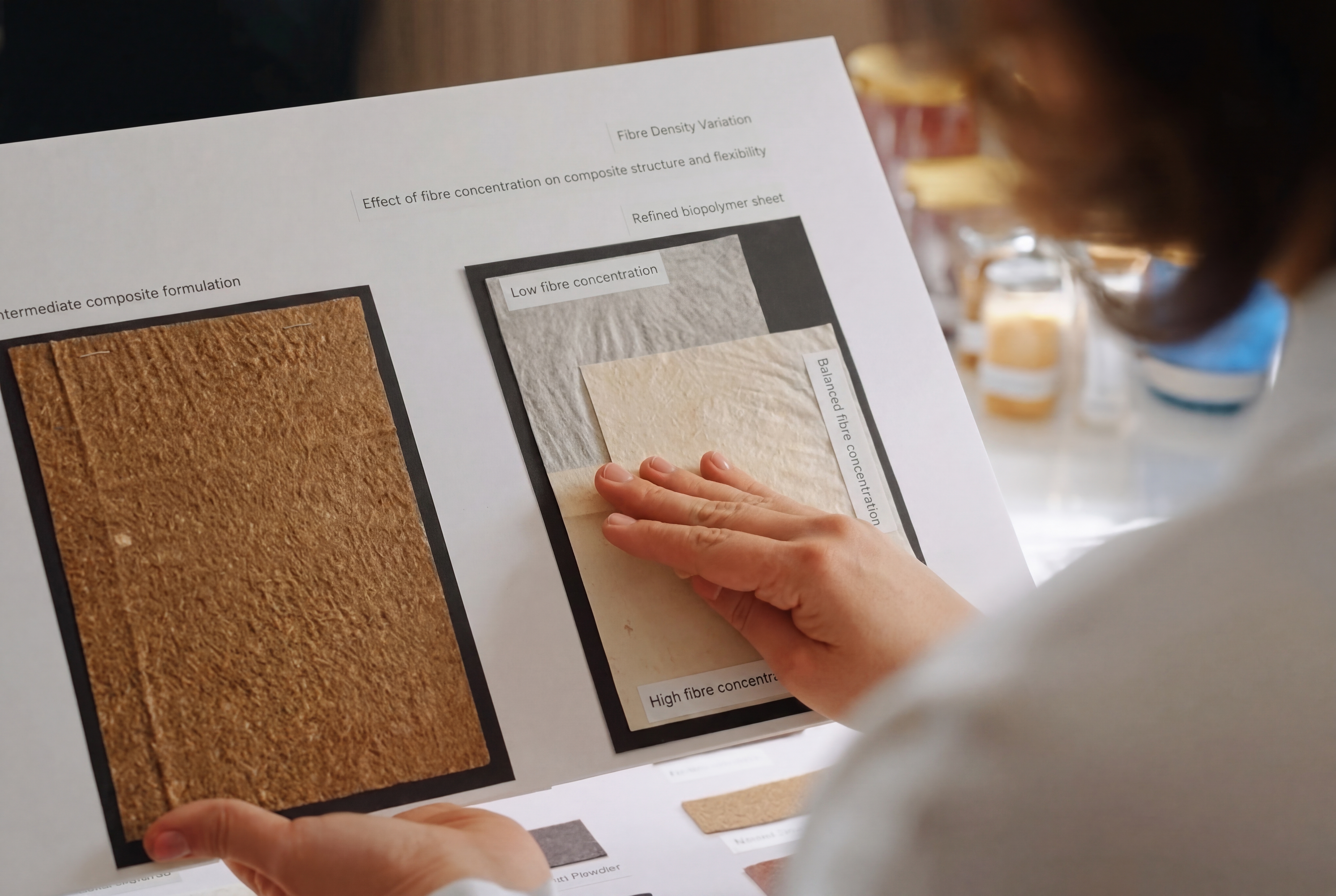
Within this evolving landscape, the term «green materials» is often used as a universal label. But in reality, it covers very different approaches and this is where clarity becomes essential.
- Sustainable materials are generally defined by reduced environmental impact. They may involve recycled content, organic raw materials, or cleaner production methods. Their focus is optimisation – doing less harm within an existing system. However, they are not necessarily designed to decompose.
- Biodegradable materials represent a different logic. They are designed from the beginning to return to natural cycles — to break down under the influence of microorganisms, moisture, temperature, and time, without leaving harmful residues. Here, the end of the life cycle is not a problem to solve later, but a condition embedded in the material itself.
These materials are often grouped under the broader term «biomaterials», but even this category is not homogeneous. Within the bio-approach, we can distinguish three main directions.
Bio-inspired-materials take principles from nature (structure, geometry, efficiency) without necessarily using biological substances. They operate on the level of form and logic.
Bio-design materials involve biological processes directly. These include grown structures such as bacterial cellulose or mycelium. In this case, design is not only about shaping, but about managing growth.
Biodegradable materials form a separate category. Their defining feature is the intentional design of disappearance. They exist not only as objects, but as processes extended in time.
This is perhaps the most complex and underestimated area of the current material landscape. Because at this point, materials are no longer just about performance or sustainability. They are about defining their own role within a system — from creation to transformation to disappearance. And this is where a more precise understanding becomes critical.
Not every «green» material is the same. And not every solution operates within the same logic. The future of the market depends on recognising these differences and working with them, rather than smoothing them into a single narrative.