Kostya Benkovich: «Art does not kill, but it can wound»

Artist Kostya Benkovich works with metal as if it were the nervous system of the modern world: rebar and pipes, under welding, turn into rigid structures that speak about power, violence, brands, and society pressing down on the individual. His exhibition Fight the Power at Arc.Space was dedicated to young hip-hop performers whom the industry and major brands turned into symbols, and then left alone with violence, addictions, and death. We spoke with Benkovich about street art, welding, metal, the politics of material, and his future exhibition at the museum in Chișinău.
Fight the Power is not a new project, but one shown to the public for the first time?
I created this project in London in 2021. We were planning to show it in 2022, but together with my producer Sasha Markvo we decided that, in the changed context, it would be inappropriate. Nevertheless, the series turned out to be successful: most of the works went into private collections. Now, exhibiting at Arc Space, I got an excellent opportunity to bring everything together and to look critically at what began five years ago. And I am very grateful to Vasya Zorky for the proposal to make this project at Arc Space.
What was your first impression?
At the exhibition I finally evaluated the objects with a fresh, detached eye. I like these works very much. I have always tried to make sure that my objects were of high quality and carried within them a strong, meaningful statement — here, this succeeded. But time has changed: I managed to change several countries, to look at the world, and today the focus of my interests has shifted. Now there are completely different challenges around, although I still consider the theme of the project itself relevant.
The theme is connected with social media stars, trademarks, social media, social division. Not a Russian theme!
I had a choice, and I decided to do what really seemed important to me: to move away from local themes and speak about a global problem. I wanted to create an international project and address universal human challenges — and I believe that this succeeded.
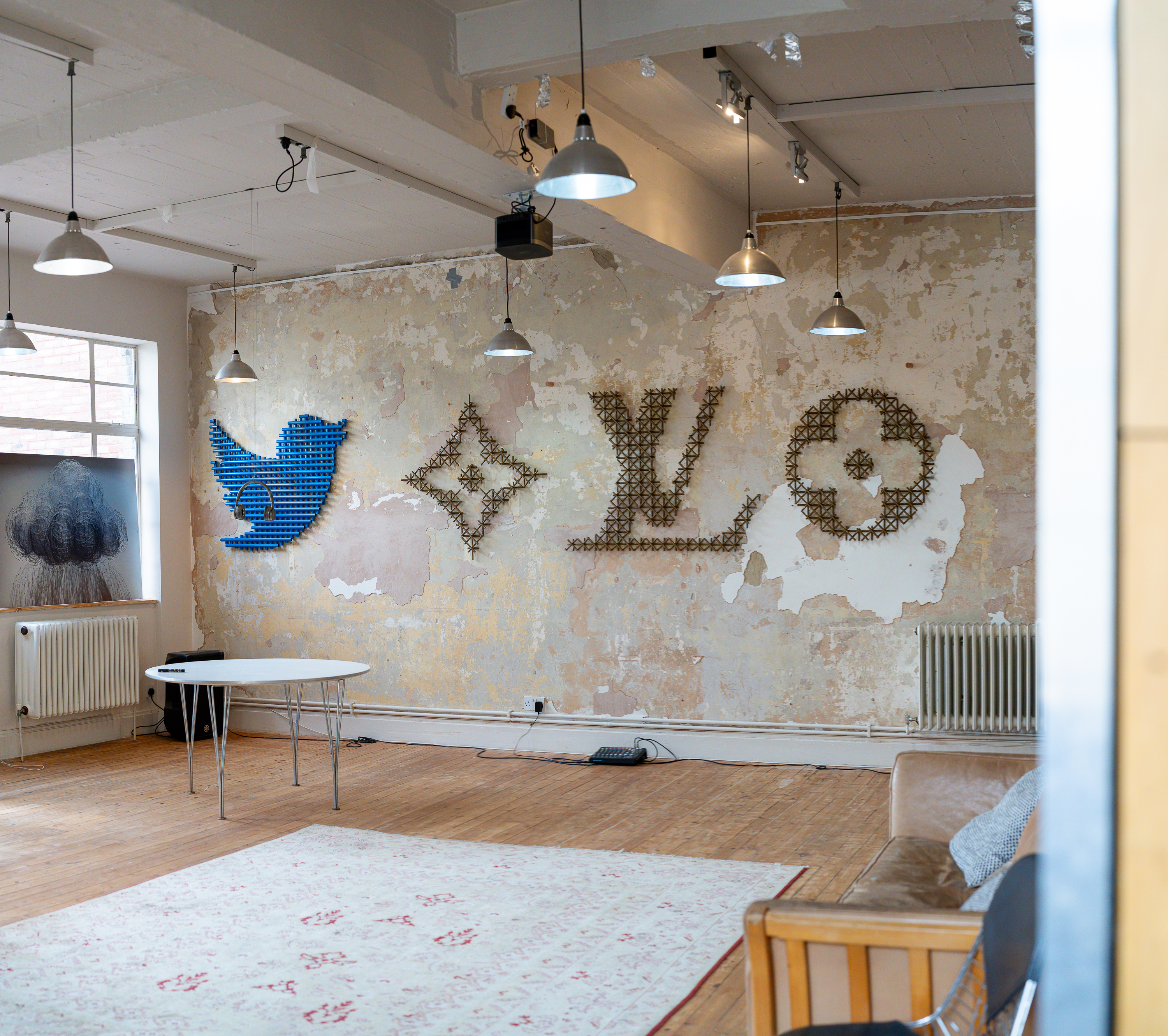
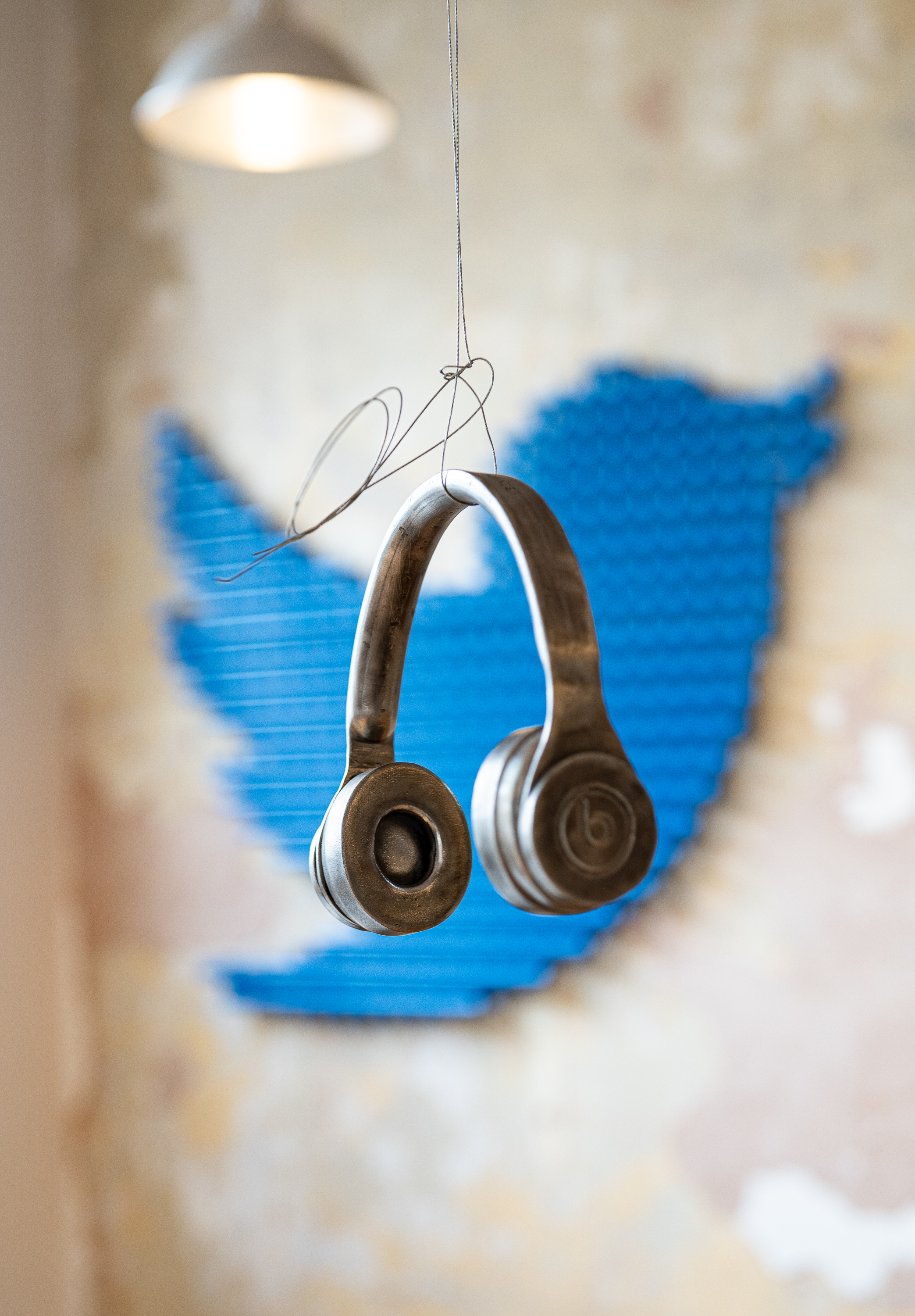
Can the image of a specific person be used in social networks for advertising — can that person be objectified? This exhibition is dedicated to the tragic fate of young American hip-hop performers whose lives ended too early, exactly at the age of twenty to twenty-one. Many people know the “27 Club,” but I called this project “20:21” precisely because of the age at which they died. It is the story of musicians such as Lil Peep, XXXTentacion, Pop Smoke, Juice WRLD, and Jimmy Wopo. They read emotionally charged poetry, shared their personal dramas with their listeners, broadcast views on socially significant events, and in fact became the voice of their time.
An entire generation of people grew up in social networks under the influence of advertising and algorithms, and this forms the consciousness of the modern person. We all become buyers, ultimately — victims of marketing, victims of advertising. Their images were used by major fashion brands, while they themselves ultimately faced street violence, depression, and loneliness. This happened against the background of events that later led to the emergence of the BLM movement, and for these artists everything turned into a real tragedy.
In this series I mix, in one cocktail, fashion brands, social media, hip-hop, and these deaths. Perhaps I will return to this project again, and in that case I would like to show it in the United States at a large, serious venue. The United States is the place where this really needs to be done. But for now I am concerned with new challenges and new projects.
The project in Chișinău and new horizons… You mean the exhibition in Chișinău?
Among other things. For about a year I have been preparing a project for the National Art Museum of Moldova. I first visited Chișinău at the invitation of the ALT Cultural Initiatives Foundation of the Republic of Moldova. My task was to immerse myself in the local context and to look, through the eyes of an artist, at the processes taking place there. Moldova is a young, dynamic country with wonderful European prospects, but also with its own internal problems.
An important event for me was meeting the museum director, Tudor Zbârnea. He is a true museum director — an incredibly educated, modern-thinking person. We quickly found common ground, and he proposed that I make a project for the museum. The foundation supported this initiative. For me this is a great honor: a serious institution, a magnificent nineteenth-century building in the very center of the city, with a wonderful collection of world art.
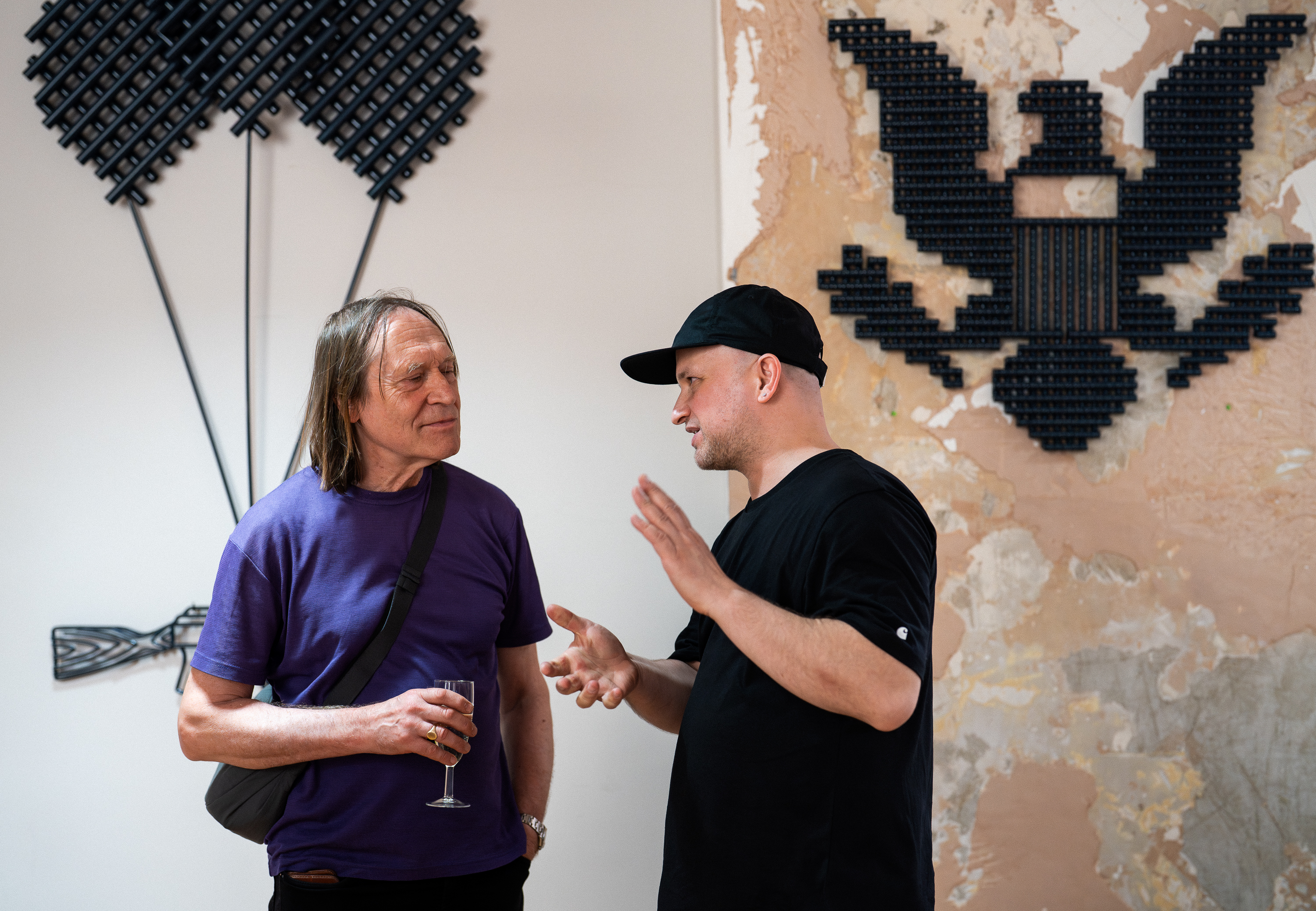
For the past year I have been working on this exhibition, trying to find a balance between my previous series and completely new works in which I use new techniques and materials. From past projects, The Scream will be presented. At the same time, the exhibition will contain many conceptual references to other authors — I often build a dialogue with the history of art. For example, there will be references to Kazimir Malevich, Jean-Michel Basquiat, Jeff Koons, On Kawara, and others. These will be works that use formal references but carry an absolutely new meaning. This is an important, landmark exhibition for me, which I hope will become programmatic. I want to work on the international scene: for example, we are now in talks with Kirill Serebrennikov in order to show this project later in European capitals.
And will your works be in Chișinău itself?
The question is open, and there are ideas. A project is now being carried out in the city to redesign the memorial at the site of the mass execution of Jews. In my art I regularly turn to the theme of the Holocaust; for me this is a very personal subject. And I hope I will have the opportunity to make a significant project dedicated to the catastrophe, one that will be organically included in the memorial complex.
Did you deliberately go to study metalworking at the Stieglitz Academy?
The exhibition space of our department impressed me so much that I immediately understood: this is mine. We studied architectural metal design, drew façades, went through powerful production practice, and created objects with our own hands. All of this laid a serious foundation for my current work.
To the craft I added a conceptual vision. We were taught to draw grilles at full scale on paper — it produced large-scale graphics, where metal obeyed the drawing. I still use this graphic method now, which is rather unusual for contemporary art.
Why?
At the institute they did not teach us to engage in contemporary art at all; it was a classical, academic education. When, after the war, in the late forties, our department was created, it had different tasks: graduates were supposed to make monumental projects — for example, to design metro stations and palaces. Then, when Perestroika happened, demand created a market for private mansions, commercial architecture and restoration appeared. But all of this had nothing to do with current art. I am very grateful to the Stieglitz Academy: already in Europe I saw what a competitive education we had. We were taught to work with materials, and we were taught to draw very professionally. But the big problem is that many talented young people finished their studies simply as craftsmen — the system produced precisely them.
For a very long time after the academy — about eight years — I myself was rebuilding myself in order to find my path. Imagine: in the whole country there were only eight graduates a year! A huge amount of knowledge was invested in us, and one needs to use it, but exactly how — you do not understand immediately. I often say in interviews that the discovery with rebar came through graphics and the experience of working with architecture. I understood that this material is conceptual in itself and carries a multitude of additional meanings. It turned out that in this way I developed my own independent and strong language.
Did you begin with political symbols?
My start happened ten years ago, in 2016. My career developed rapidly: half a year until my first museum exhibition at the Russian Museum, a year until an exhibition at Saatchi Gallery, and three years from the start to the best gallery in Russia — Triumph Gallery. I worked at the intersection of gallery art and street art, I had an excellent team and colossal experience working in my own workshop, where we dealt with complex commissions, including those involving major state museums and restoration.
And you went into pure art, abandoning a successful business?
In 2015 I understood that the business was developing, but I was not developing as an artist. All my life I had the feeling that I had to do something, that art and the creation of new meanings were the goal, the meaning of my life. And therefore in 2016 I sharply changed my life: I stopped my previous activity and fully went into creativity. I was lucky: I had the financial possibility and I had a workshop.
Why did politics become the theme of your statements?
I am a very politicized person; from childhood I loved watching the news. I caught the end of the Soviet era: I was among the last Pioneers, I was accepted in the city party committee of the town of Volkhov in 1991. I remember the August Coup very well — I was ten years old then. I wore a Pioneer badge, a red necktie, and a blue school uniform. Later I made several street-art works about the failed hopes for freedom.
In the 1990s my family lived in the small town of Volkhov in the Leningrad region. It was a harsh time of struggle for survival. Children were left to themselves, and many of my peers died, went into crime or drug addiction. In fact, from that generation only those who got their heads together in time survived. The town was small, and there were plenty of criminal stories. Despite coming from a well-off family, I grew up on the street, with friends.
How did you avoid the very worst?
A sense of self-preservation worked. I understood already then that there are things one must not do. When teenagers from my circle crossed the line and, during a robbery, took a person’s life, I clearly realized that this path leads to a dead end. I completely broke with that environment. Thanks to my leadership qualities, I was able to influence my circle and pull out close friends — we entered different universities and became established in life. But that period left a deep mark.
I think my work with rebar, all this aesthetic, comes from there. It was the main, universally used material at that time: metal rods were carried in car trunks, fences were built from them, bars on windows, barriers, and cemetery railings. For a person who lived in the post-Soviet space, this material transmits very understandable, basic meanings.
I remember your work The Hand of God. What role does color play in working with rebar?
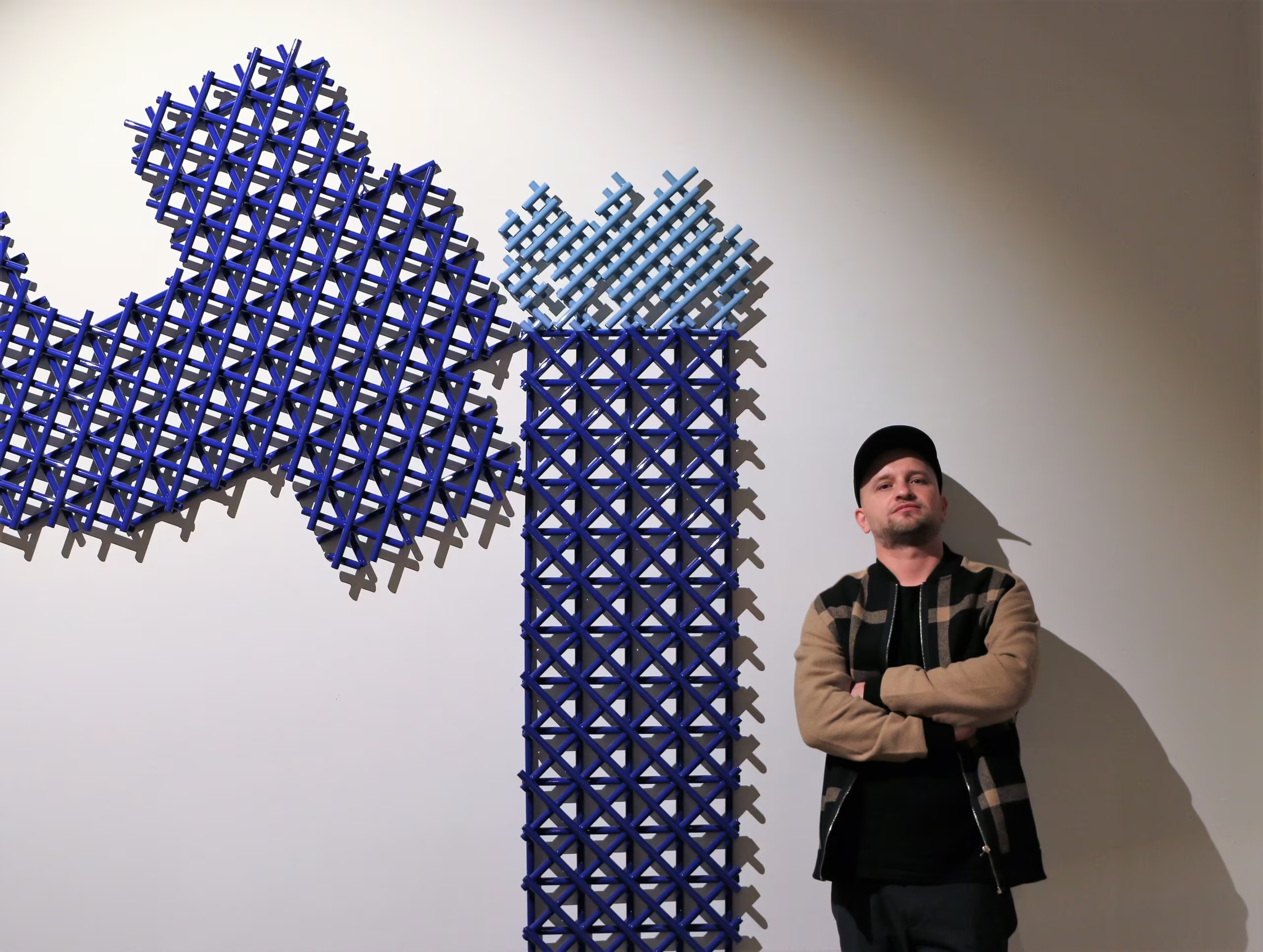
I work with symbols, therefore I use pure, signal colors, as in road signs. Color is a function. The red flow from The Right Hand of God down to the earth is the color of blood, a symbol of catastrophe. The blue cloud above it is sacred, divine azure.
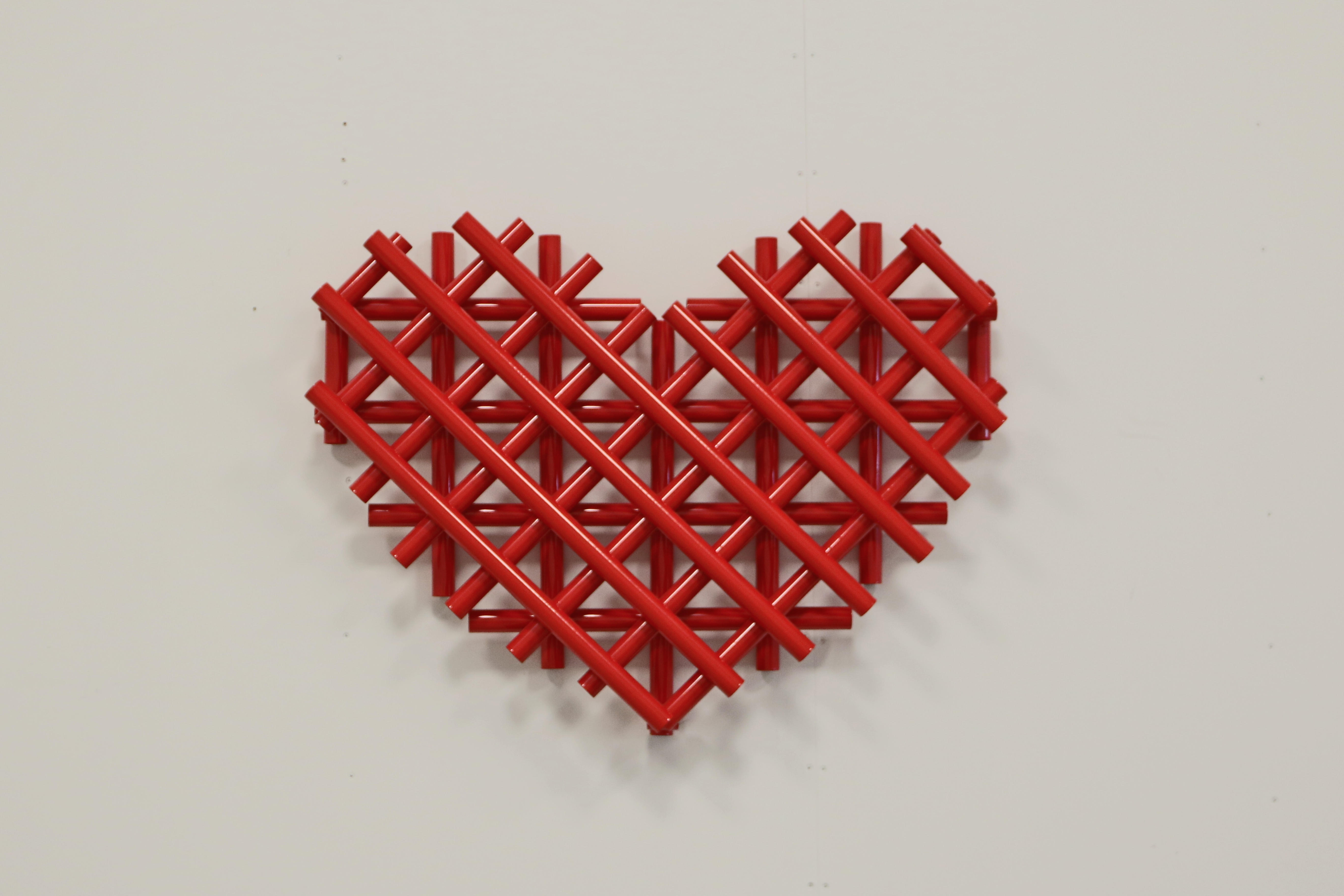
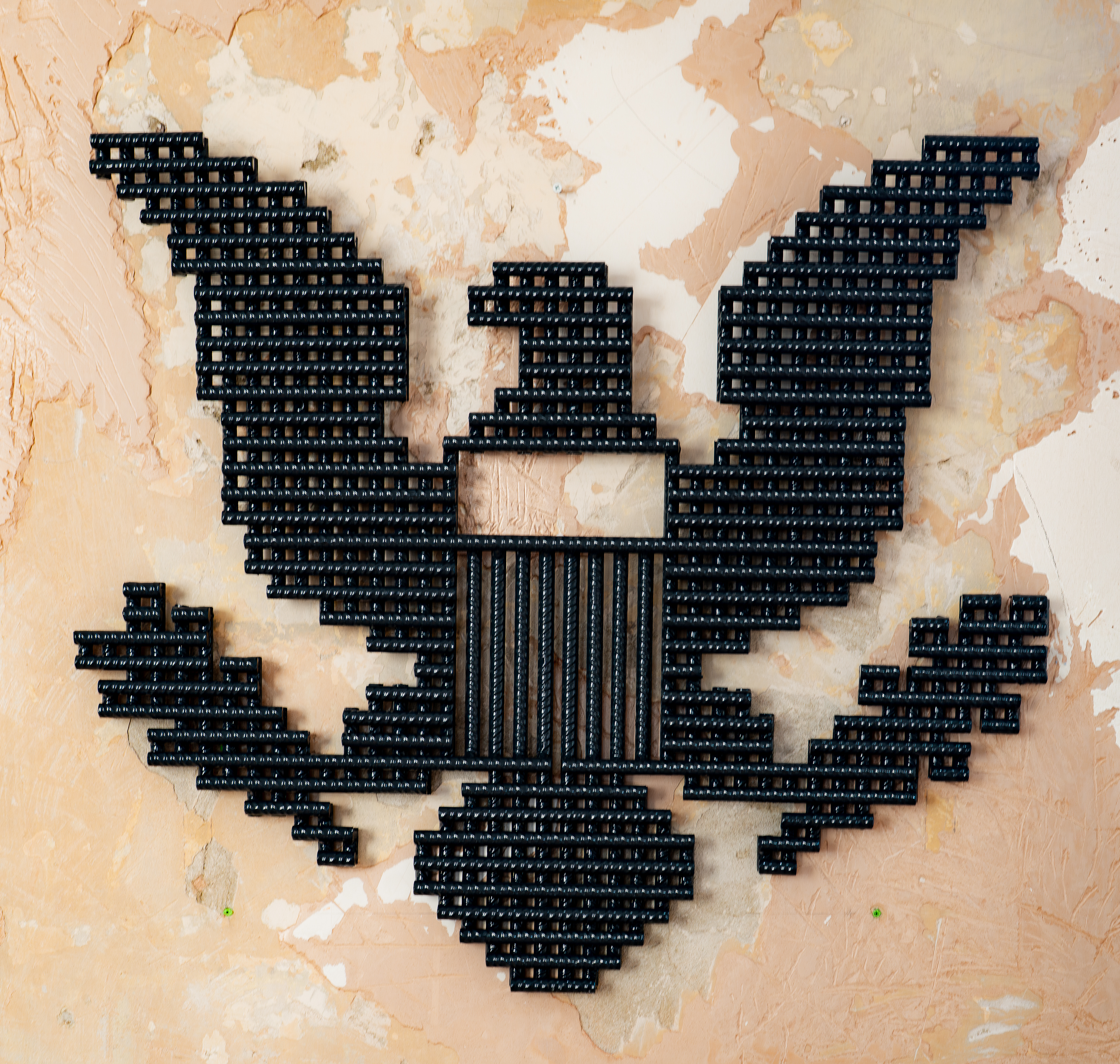
Everything is important in the object: scale, color, cell size, form, structure, the diameter of the rod. Sometimes I replace rebar with pipe in order to lighten the construction. But when the metal is assembled densely, it creates powerful psychological pressure. The American coat of arms, for example, which is presented at the Fight the Power exhibition, despite its small size is perceived by viewers as the heaviest work — not only in weight, but also in content. There, precisely, everything is assembled very densely, which causes strong tension in people. When examining my works, Antony Gormley said to me: «You must understand what a colossal impact your works have on a person. But it is important to dose it: in your art a very strong psychological effect on people is concentrated.»
Does the artist have a responsibility to the viewer? I remember the deafening impression from the work Suitcase. One must understand what a strong impact this work has on the viewer.
One colleague once noticed that this suitcase is, as it were, all of us, displaced persons; it is like a prison that we carry with us, and the image I created conveys this state very precisely. We, those who have left, although we live in different European countries, are still not internally free. And I am not free. Suitcase hit this universal human nerve of emigration.
It is a reflection of the spring of 2022, of an atmosphere of complete despair. I remember women from Ukraine whom I met in Israel, at the Ministry of Absorption. One of them, sobbing, shouted: “I have nothing, this suitcase is my whole life, nothing else remains!” This is a story about a difficult choice: what to take with you, packing that single suitcase — family relics or simply things necessary for survival. I myself spent several years on the road, for two years I did not live anywhere permanently, working on projects in different countries. This is an enormous stress for my wife and me. Even without having a permanent home, we bought cups and plates that there was nowhere really to put during moves — simply for the sake of a feeling of normality.
As for responsibility: people periodically appeal to my conscience. They asked how I could make a statement on the subject of the death of so many people in a project about September 11. There were two towers in reverse perspective — God’s view of the catastrophe. It was an exhibition about religion, about the fact that it can not only unite but also divide. They asked about The Scream on the Nemtsov Bridge. But the volunteers accepted and preserved this work.
This is about the power of impact. But responsibility?
Art does not kill, but it can wound — that is what I said in my first interview for London Cult a year ago. There are themes that I treat very delicately. For example, everything connected with religion: I understand that here it is easy to hurt people, and I approach this carefully.
In general, I am against any bans and artificial restrictions. Sometimes the life of an artist is very short, like that of the heroes of my exhibition. How can one not embody ideas? Otherwise you risk never realizing them. In general, the attitude toward art is the main indicator for any state. It immediately shows whether there is democracy and freedom in the country. Living in Finland, I can say that it is an absolutely free country. In Britain, I can also openly do what concerns me, and this is a very important criterion.
But I will add: now I have less desire to analyze the past. I have begun a new life. I like Finland very much; a new project about it and for it is now ripening. I have begun a major partnership: I became an ambassador for the company Kemppi — a world leader in the field of welding technologies. They provided my studio with the most modern equipment. In the same way, another Finnish company supported me — Umetalli, a manufacturer of tables for assembling welded structures. In Finland I can be who I am. I joined an artists’ association; there are amazing programs here, public-art projects and competitions for authors. This is the kind of future I want to think and speak about.
It seems that welding, on the one hand, is a kind of medieval magic connected with blacksmithing, and on the other hand, a completely technological thing…
Well yes, there is magic in welding and forging. In fact, blacksmiths in all myths were always gods — Hephaestus, Svarog, Seppo Ilmarinen in the Finnish epic. Of course, it is a miracle: fire, from which an everyday object or a weapon is born. The blacksmith was always one of the main, respected people, but at the same time he was associated with something mystical, and his house often stood on the outskirts — of course, for reasons of fire safety, but nevertheless! People avoided him because they did not understand how he worked; there was even an opinion about connections with evil forces.
Fire in general, and everything born from it, has delighted me since childhood. Of course, after so many years of practice this feeling becomes somewhat dulled, but nevertheless. Now, for example, I have begun to master aluminum welding — it is amazing. Modern welding is a subtle, controlled process that can be used as a full-fledged artistic instrument, literally like a brush. And, looking at the result, sometimes you think: did I make this myself, or was I simply a conductor?
Image courtesy of the artist.