

Dream on, Monet, dream on: the musical A Mirrored Monet explores the artist’s impossible choices

Carmel Owen’s musical was first performed at the Edinburgh Fringe three years ago. Since then, it has travelled a long way — and has now finally reached the stage of Charing Cross Theatre. This is, of course, a show not only about Claude Monet. It is the story of any artist — and, more broadly, of any person wholly devoted to their calling. How does one find the necessary balance between work and loved ones? How can one possibly keep up with both? Or perhaps it matters more to keep up with one than with the other?

In Christian Durham’s production, the story is told by an older, celebrated Claude Monet, who remains on stage throughout — both as narrator and participant, because this is his life, his memories, his love, and his art. He is played by Jeff Shankley — a legend of the British musical stage, a baritone, a major theatre and television performer who has appeared in Jesus Christ Superstar, Cats, and Starlight Express (yes, he has worked with Lloyd Webber extensively), and who, for instance, played Pop in We Will Rock You in 2016. His current work at Charing Cross Theatre is very much a Shankley benefit — in the finest theatrical sense of the word.
This Monet has his own place on stage: an attic studio bathed in greenish-golden light, with a stool, a palette, and a chest-like table full of drawers. Yet neither time nor space can hold him back — he moves into the past, wanders among his friends, and looks into the eyes of his younger self.
Only his daughter from his second marriage is constantly hovering nearby, pulling him out of his memories as she tries to put the necessary drops into his eyes. Her father snaps, brushes her away, growls like the dominant lion in the pride. Blanche’s drama (Natalie Day), beside the story of her great father, may seem secondary, and yet how vividly it is acted and sung. Her white apron, stiff and starched like a servant’s, robs her movements of all softness; her constant anxiety over her father, her irritation with him, her awareness of life passing her by, of youth stolen from her, of her jealousy toward his first wife — all of this turns her at times into a nervous mechanical puppet. Only once does she suddenly spring upright, like the spring inside a clock: flexible, desperate, fresh, crying out at her father with her tender pink palms thrust forward. But the outburst inevitably gives way to submission. And Father Monet goes on muttering, sharply brushing her aside, speaking harshly…
And of course this grumbling father in a white suit is exactly like his own father — as we are made to see when the young Claude (played by Dean John-Wilson) comes to speak to his father about marriage. Here Shankley slips for a moment out of the older Monet and into the role of Monet’s tyrannical father.
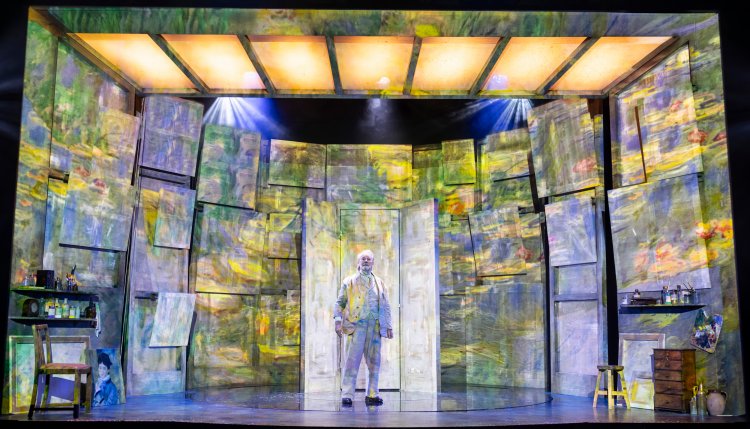
John-Wilson plays an artist possessed by art. His beautiful clear voice sounds like the rising sun itself (soleil levant, just like in Monet’s most famous painting): it lifts over the auditorium like morning light, equally pure and detached. Young Claude looks at the world with wide-open dark eyes, but he does not see domesticity, bread, or practical problems — he sees the shifting, mysterious, elusive light that he longs to transfer onto canvas with the tip of his brush.
And here is the crucial detail: in Monet, light and colour are protagonists in their own right, no less important than the actors and their characters. Once again, the small stage of Charing Cross Theatre magically unfolds into a surprisingly expansive space. At one moment it is a forest, at another an art gallery — and this is very much the result of the remarkable combined work of lighting designer Jodie Underwood, set designer Libby Todd, and video designer Matt Powell. On that little patch of stage, a pair of lovers somehow manage to dance as though carried by the wind, their skirts and hands gliding between screens, easels, painters and picnic baskets, while around them the forest murmurs, the pond rustles — and then suddenly the walls of an art gallery slide into place, airless, slightly oppressive, gilded and burgundy-dark.
It must be said that the musical does not particularly fuss over the audience, nor does it spoon-feed them the details of Impressionism’s emergence. If you have not, in the course of your life so far, managed to get to grips with the movement — or at least read a Wikipedia article — then that is your problem. Watch as best you can. Yet you may well fall in love with all of them and begin going to museums. In that sense, Monet also carries a certain educational function, while turning painters bronzed by time into living human beings. There, for instance, is Renoir (in a precise and delightful performance by Sam Peggs): alive, in love, gifted — not a black-and-white photograph on the page of an encyclopaedia.
There is in Monet a certain vulnerable innocence that marks all works made out of great love. Paintings flare up magically within gilded frames — and suddenly Édouard Manet’s scandalous Olympia gazes out into the auditorium, innocent and shameless all at once, with that defiantly dark ribbon at her throat. The whole of Parisian Montmartre seems to mingle here before the audience: not only Monet and Renoir appear, but also Manet (Aaron Pryce-Lewis), the artistic bohemia of the second half of the nineteenth century, critics, patrons.
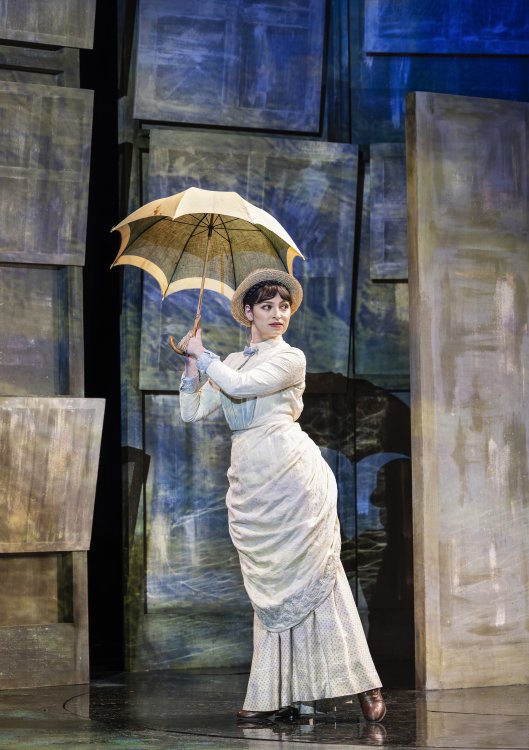
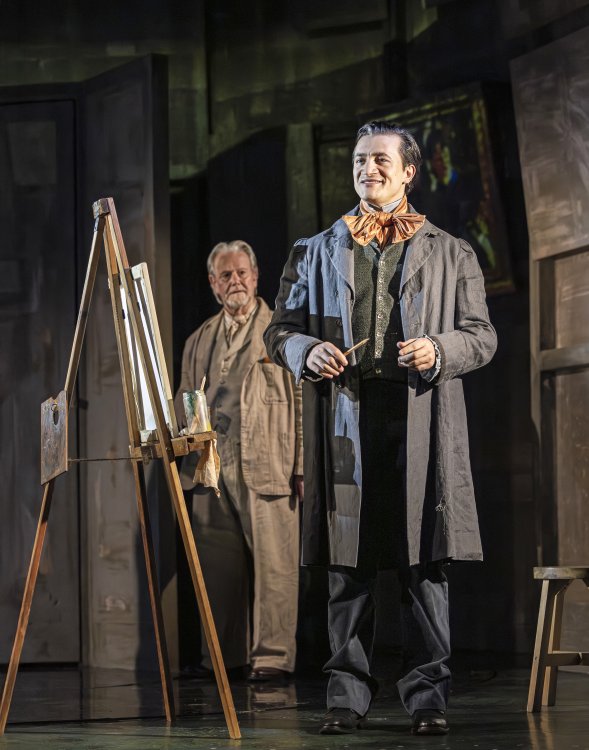
Do you remember Guy de Maupassant’s tiny story The Model — about how a famous French painter was forced into marriage? In it, a vividly drawn atmosphere of marvellous nature contains human relationships that are twisted and wild; the narrator is impossibly cynical, and the other characters remain deeply ambiguous. In the world of Monet, the marvellous atmosphere is there, but cynicism is absent altogether — as though it had never been invented. Everyone is crystal-clear in their feelings, everyone loves, and every conflict grows out of the impossibility of reconciling these loves. “I was selfish!” the older Claude cries in despair as he looks at his younger self, entranced by the play of colour and light, while his Camille — beloved, wife, mother of his children, the great woman of his life — desperately tries to wrest at least a drop of his attention from him.
And so the eternal question emerges: where does work end and indulgence of one’s talent begin? What sufferings must this Penelope endure in her endless waiting for an Odysseus with a palette in his hand? And what if she and her child have nothing to eat? Claude flies after his dream — a pure, unadulterated visionary, and though he may reach his goal a thousand times over without ever losing faith in himself, what is to become of her?.. “Dream on, Claude, dream on!” the painter Frédéric Bazille exclaims mockingly (Ritesh Manugula), and Claude is delighted to dream and race after that dream, heedless of hostile critics and of an art world still devoted to classicism. But where is the line beyond which the passionate artist becomes a cold narcissist?
Camille is played by Brooke Bazarian, who makes her astonishingly like the model from Monet’s own paintings — the same bearing, the same lightness, the same airiness. Within the framework of a musical there are not many opportunities for dramatic acting, but Bazarian uses every one of them. In counterpoint to her within the world of the production stands Suzanne (also played by Natalie Day — unquestionably an acting triumph, since both of her characters, Blanche and Suzanne alike, are fascinating to watch). Suzanne is almost comic, and laughter repeatedly ripples through the audience. She plays her lines with a turn of the head, with her eyes, even with her fashionable bustle dress trailing behind her.
The production glides over Monet’s biography and the lives of the artists around him, selecting those details and events that matter most to its central theme. How much neglect and poverty can one endure in the name of a higher purpose?

When the Royal Academy refused Monet a place in its exhibition, he left England with his wife and child and returned to France. In the musical, this detail too is viewed through the prism of family: a young mother with a small child in her arms longs to go home, while Monet, in something close to a church recitative, sings to his wife of the beauty of this brick city wrapped in mist, with its great river flowing through it. Thus reality and fantasy, inspiration and daily life, dream and duty collide.
His relationship with Camille lies on Monet’s soul like a heavy stone; remembering her, he hopelessly searches for some possibility of reconciliation — with her, wounded by his neglect, and with himself, the young and passionate artist he once was. Forgiveness will be granted. Reconciliation will descend upon him — and at last he takes up his brush and paints freely, broadly, across the canvas. But could it ever have been otherwise?






![Sometimes You Need a Complete Vacuum to Hear Yourself: Performance [RETREAT] in Space | London Cult.](https://londoncult.co.uk/wp-content/uploads/2026/06/banner_retreat-1-309x185.jpg)