Glyndebourne’s First Tosca: Some Impressions After The Dress Rehearsal

Glyndebourne’s first-ever Tosca is not a museum piece, nor simply an elegant staging of Puccini’s Roman thriller. It is a severe, sharply contemporary reflection on power, fear and the banality of evil.
Ted Huffman’s new production, conducted by Robin Ticciati with the London Philharmonic Orchestra, has an almost cinematic tension. Under Ticciati, the orchestra created a striking fusion of musical and theatrical dramaturgy. At its best, it had the force of a great film score: not illustrating the action, but exposing the machinery beneath it. The tempi were taut, the balance precise, and the dramatic nerve never slackened for a moment.
Huffman, known among other things for Eugene Onegin at the Royal Opera House and the FEDORA Prize-winning Denis & Katya, works here without directorial self-indulgence. His Tosca is built on concentration: on text, music, the physical presence of the performers, and the precision of their interaction on stage. Political violence is not illustrated bluntly. It gradually emerges through behaviour, space and rhythm.
The associations come quickly: Mikhail Romm’s Ordinary Fascism, Hannah Arendt’s Banality of Evil, Inglourious Basterds, Life Is Beautiful, and a Remarque-like love story caught in the machinery of history. Yet the production never feels like a collage of references. Its force lies in the recognisability of its world: a world in which violence becomes procedure, cruelty becomes administration, and terror is made all the more chilling by the absurd routines of bureaucracy.
Caitlin Gotimer’s Floria Tosca is compelling both vocally and dramatically. Her beautiful, fresh voice meets the demands of the role with confidence, while her stage presence gives the character immediacy and emotional clarity. Matteo Lippi’s Cavaradossi offers the rare pleasure of a tenor equally secure in piano and forte, and technically immaculate in the upper register. The evening is sharply supported by Kristian Lindroos as Angelotti, Federico De Michelis as the Sacristan, Didier Pieri as Spoletta, Michael Ronan as Sciarrone, and the Glyndebourne Chorus under Aidan Oliver.
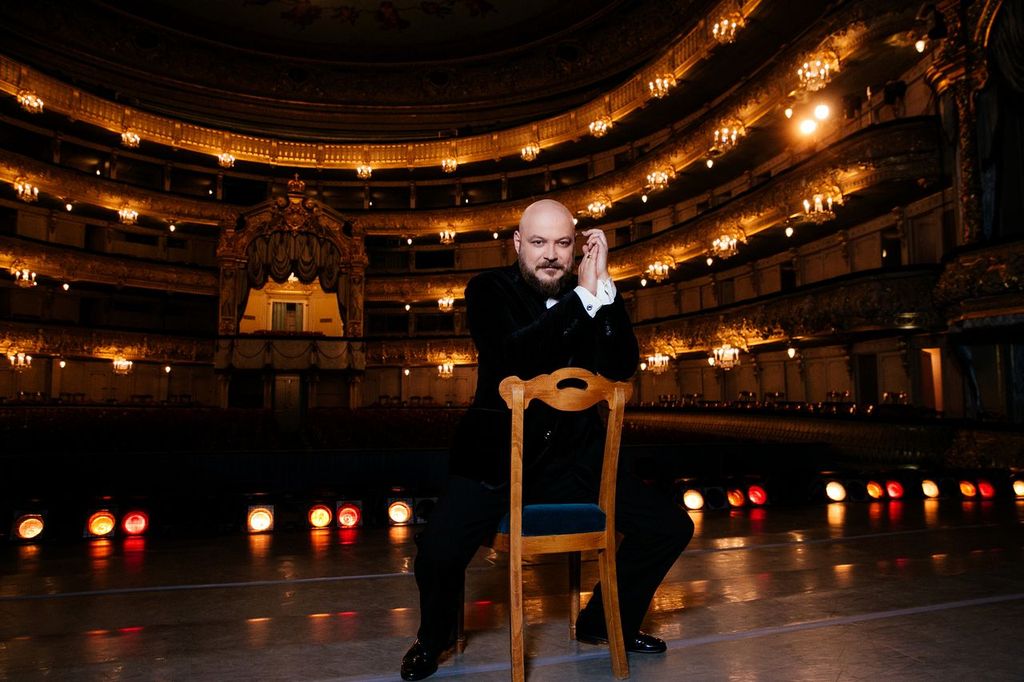
But, from my point of view, the evening belongs to Vladislav Sulimsky’s Scarpia.
In this production, it is hard to imagine a more exact interpreter of the role. Sulimsky, who grew up inside the Soviet system, seems to understand this kind of power not as abstract operatic villainy, but as something historically and psychologically recognisable. His Scarpia is neither a cartoon sadist nor a grand villain from Romantic literature. He is more frightening than that: controlled, bureaucratic, intelligent, almost ordinary. His evil is not theatrical. It is institutional.
When I worked at the Mariinsky Theatre, Craig Rutenberg — the former Head of Music at the Metropolitan Opera and a long-time vocal advisor at the Mariinsky — used to reserve his highest praise for a singer: “a true singing actor.”
Sulimsky is not merely a singer with a beautiful voice and life-giving technique. He is a true singing actor, turning every phrase into dramatic action and allowing every emotional impulse to pass through the voice. There is not a single empty note. A role I know almost by heart suddenly sounded as if it had been written anew.
Nadja Sofie Eller’s set design and Astrid Klein’s costumes support the concept without over-explaining it. They are beautiful in their exact minimalism. D M Wood’s lighting works in the same logic: it does not overload the production with symbols, but creates a space in which image, rhythm and atmosphere speak more strongly than any declaration. This becomes especially powerful in the third act.
I must admit that I have often left Tosca after Act II, but here the third act may be the strongest part of the evening. Without giving too much away, its opening lands like a shot to the heart. What Huffman reveals in Tosca and Cavaradossi is not the romantic aura of “the artist”, but the vulnerability of two ordinary people caught in history: by the end, they are frightened, crushed and infinitely alone. Their “Trionfar!” is no longer a gesture of a triumph, but a solitary human voice in a cold, impersonal space, beside the ditch that will become their common grave. For the first time in my life, I found myself moved to tears — not because of operatic grandeur, but because the moment suddenly seemed to contain the total helplessness of an ordinary person facing a cynical state machine.
This is a Tosca about what power does to human beings: to those who wield it, those who serve it, and those it crushes.
I very much hope this production is filmed. It deserves to be seen far beyond Glyndebourne.
21 мая — 22 июня; 4 — 30 августа
Glyndebourne Opera House
New Rd, Lewes BN8 5UU
East Sussex