Steven Kavuma: «Open your doors. And you’ll be surprised!»

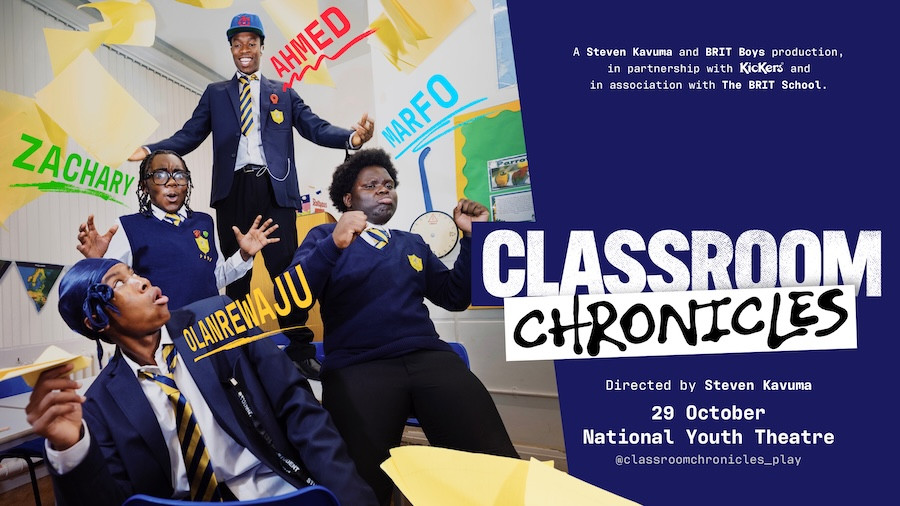
Four boys find themselves in school isolation — a place where they are supposed to sit quietly, feel ashamed and think about their bad behaviour. Instead, they laugh, argue, dream and become friends. On 29 October, Classroom Chronicles premieres at the National Youth Theatre — a new play created by four BRIT School students, the Brit Boys, whose short student piece has been developed into a full-length production with director and playwright Steven Kavuma. We spoke to Kavuma ahead of the premiere about why children need the freedom to play, what it was like growing up between Uganda, Wales and London — and why British theatre, as he puts it, needs to “just open the doors”.
When you were a child, were you ever put in isolation at school?
Yeah. I wasn’t a particularly naughty student, but I did get into a few fights, a few arguments. I went to school in North London, in Tottenham, and our isolation room was run almost like an army or a prison. It was incredibly strict. You felt like you were a prisoner, not a student. I guess the whole point was to make you think, “I never want to come back here again.” We even had a different lunch break from the other students. If you wanted to walk around, they would take you around the school and then bring you back into the classroom. It was very much like that. And, of course, I hated being there. There was a lot of shame attached to it. But there were always the same kids coming back into isolation. And looking back now, I don’t think the school ever really tried to work out why they were there again and again. It was more like: you’re a bad student, you need to be disciplined. Now I think they needed more support. They needed somebody to listen to them, to understand what they needed, rather than just saying, “You’re a bad student, so this is how we’re going to punish you.” It wasn’t right. Even thinking about the separate lunch, being walked around the school under supervision — it was terrible.
I think the whole tradition of isolation is quite strange, isn’t it?
Absolutely. It is a very strange thing. I don’t know why we still do it.
How did you meet the boys who created Classroom Chronicles?
My partner, Moesha, who is the footwear designer for Kickers, and I went to a showcase at BRIT School. I’d already been doing some work with the school, and we were invited to this evening celebrating the global majority community there. And we saw this piece by four Black boys. It was set in an isolation room, and it completely resonated with me — with my world, with where I was as a kid and who I am now. They transformed that space into everything. It was loud, it was beautiful, it was joyous, it was funny. It was amazing. I felt incredibly seen by them. And Moesha and I came out going, “We need to do something with this.” Then the boys got in touch and said, “Would you want to direct it?” And I was like, “Funny enough, we were already thinking about trying to do something with you.” I still don’t think they fully understand how powerful that piece was. Just seeing Black boys allowed to be — not criminalised, not put down, not written off — was incredibly important to me. Because that was my experience of isolation at school. It felt like: you’ve been written off. You’re another number, another “problem” kid. As opposed to someone saying, “You are somebody. You can be somebody. And we can support you in that development.”
You’ve worked with a lot of young people.
Yeah. I’ve worked with National Youth Theatre, where we’re doing the play now, I’ve taught at different drama schools, and I’ve worked with other groups of young people as well. Most of the young people I’ve worked with are actors, or they want to be actors. And it’s completely different when you meet kids who are just doing drama for the fun of it, for the joy of it. And there are challenges in that as well. As a teacher, sometimes you look at a young person and you can see there is a lot going on in their life. But there is only so much you can do, and sometimes there is only so much the system can do to actually support them.
Is theatre, is drama important for children at school?
Absolutely. It’s important to have freedom. It’s important to play. Even if you’re never going to take it seriously as a profession, the idea of becoming somebody else, escaping your reality, being transported somewhere else — that’s what we do as kids, right? Every child should be allowed to imagine. Every child should be allowed to play. And that’s what drama gives you. What worries me is seeing drama GCSE become less and less accessible as an option. Because what that says to young people is that there are only certain “real” jobs, and theatre isn’t a viable career. But it isn’t only about having a career. When I was a kid, drama was where I really flourished. Then I’d go into English and we’d be doing Romeo and Juliet, and I’d be like, “Well, we’ve already done this in drama. I understand what’s going on.” I could understand the text in a way some of the other kids couldn’t because they weren’t doing drama. I was really good at English because of drama.
I wasn’t particularly good at anything else, looking back.
The destiny of theatre people.
Absolutely. So, yeah, drama in schools is incredibly important.
Do you feel there’s a difference between you as a child and young people today?
Yeah, absolutely. They have access to things we didn’t have access to. And that’s a great thing, but it’s also a scary thing. They’ve got AI, they’ve got TikTok, they’ve got social media in a way we just didn’t have. I think it’s a scary time to be a young person. We’re seeing so many more mental-health issues and crises, and part of that is just the rapid growth of the internet and technology. When I was a kid, you also had spaces. You had youth clubs, youth centres, free activities you could sign up for. Young people don’t really have that now. Or there are very few, and you have to know about them, you have to be in the know. There’s a lot more pressure and not a lot of opportunities. So it’s harder for a young person now to escape, or to find their way out of wherever they are. When we were growing up, I think there were more opportunities to dream. There was this sense that you could do something, that you could achieve something, and that could take you somewhere. I grew up in Tottenham in North London, and the fact that I went on to one of the best drama schools in the UK is still insane to me. I don’t know how many young people today can see themselves in places like that — or even see themselves beyond the world they’re growing up in.
Did you already know as a child that you wanted to act?
Yeah. I loved acting. I loved transforming. And I took it really seriously because I really enjoyed it. But it was difficult trying to communicate to my parents that acting could be a viable career, that it could actually be a possibility. And I think you get that in different cultural backgrounds, where your parents have grown up knowing one particular way of building a life. And also, at that time, there weren’t many Black or brown people on television. So not only could I not see the journey — my parents couldn’t see it either. There weren’t those people you could point to and say, “Look, they did it. So maybe you can do it too.”
What was the first show you ever saw?
It wasn’t in London. I was born in Uganda, and then we lived in Swansea in Wales. The school took us to our local theatre to see a pantomime. There was a big Welsh singer in it, and that was my first real experience of theatre. It was so joyous and so funny. And in primary school I was basically the class clown all the time. Then suddenly I saw people on stage who were being paid to be funny, and I was like, “Oh wow. You can do that?” We also had a family friend who was an actress, and she appeared in Doctor Who. I loved Doctor Who as a kid. So I saw her on television, and then I saw her in person the next day, and I was just like, “You were on my TV yesterday. How are you here?” I loved the magic of that. I think that was when I went, “I want to do what you do.” And I’d always been writing as well. As a kid I was constantly writing things without really understanding that what I was writing were basically scripts. I’d watch EastEnders, it would end on a cliffhanger, and I’d write the next episode. Or I’d write my own Doctor Who story. Writing was probably my first love, actually. Because it allowed me to escape. It allowed me to create characters and places and whole worlds. And my parents celebrated that. I could see that they liked me doing it, and I thought, “Oh, this is actually a thing. This is something I can do.”
How old were you when you moved to Wales?
Seven.
How did you feel when you moved to another country? I’m asking because so many families from Ukraine, Russia, Belarus and elsewhere are living in another country now. And parents are particularly worried about their children.
It was difficult. First of all, I couldn’t wrap my head around the cold. Then there was the cultural change. And suddenly I wasn’t seeing people who looked like me on any kind of mass level. I had no friends in primary school, and I was getting a lot of racist abuse. It was a very difficult time. And I don’t want to say, “Oh, it was a good thing.” It wasn’t a good thing. It was painful. But it made me ask myself questions. Who am I? Why do I want to be accepted so badly? Who am I trying to become in order to be accepted? And eventually I got to a place where I went, “No. This is who I am.” I had to really own myself, probably much earlier and much more forcefully than I would have done otherwise. Then, when I was twelve, we moved to London. Wales had been difficult, and London was difficult in a completely different way. I arrived with a thick Welsh accent and kids would say, “You speak funny. Don’t speak like that.” And some of the other Black kids barely knew Wales existed. A lot of them had lived in Tottenham their whole lives. Tottenham was their world. They hadn’t travelled, and they didn’t really have a sense of what existed beyond that. So there were cultural clashes at certain points. But the more you grow, the more you start to learn who you really are. And the boys in Classroom Chronicles talk about that as well — questions of identity. One of the characters is born in Nigeria, moves to London and talks about shortening his name instead of saying his full name. It’s all those questions: who are you really? Who are you trying to be? Who do you want to accept you?
Tell me more about Classroom Chronicles.
It’s about four Black boys who are in isolation at school. And while they’re there, they suddenly get to know each other. They start to understand who each of them is, why they’re there, and they become best friends. It’s a play about friendship, about boyhood, about growing up — and about Black boy joy. Because I don’t think we get to see enough stories where Black boys are just allowed to be. Allowed to imagine, allowed to play, allowed to be funny, as opposed to always seeing those stereotypical stories about Black boys. It’s a coming-of-age story. It’s about them discovering who they really are and who they want to be. There’s also that conflict between what their parents want them to be and what they want to be. It’s about courage, strength, culture, class and belonging.
The show is on 29 October at National Youth Theatre. And you’re only doing it for one day?
For now, yeah. But we want to bring it back. We want to keep developing it and hopefully bring it back in 2027, 2028, and create a real momentum around it. It’s in partnership with Kickers and with the support of BRIT School. The school has been amazing with us. The boys are all in their second year of the musical theatre course there, and the principal has been incredibly supportive of them as well.
Do you like British theatre today, generally?
Yeah, I do. But I think it needs to change, and I’ve always been very vocal about that. First of all, it needs to be much more accessible. Tickets are way too expensive. There are a lot of people who actually need to go and see theatre who simply cannot afford to go. The industry has become an echo chamber. A lot of it is theatre people talking to theatre people. And a lot of the work being put on is about those people, as opposed to real people and real stories. Secondly, there are very few development opportunities for new writers and artists — and even fewer meaningful development opportunities. Too often it works like this: if you happen to be friends with the person who runs a certain theatre, then suddenly you get an opportunity. What theatres should be doing is opening their doors. Bring people in. Develop new work. Develop new talent. And that’s what I’ve really enjoyed about working with Kickers. You’re outside that bubble of how theatre usually works. Sometimes we’re so deep in that bubble that we forget there is a whole other audience out there. That was genuinely eye-opening for me. There is an audience we haven’t tapped into as an industry, and those people do want to go to the theatre. There are people who are dying for stories like Classroom Chronicles. There are people who are dying to be developed. And for me as an artist, working like this has allowed me to take some of that power back. I don’t want to be beholden to institutions. I don’t want to be kneeling to them and waiting twenty years for permission to put something on that I think should be on and should be seen. And what I’ve realised is that there are organisations outside the theatre industry that are ready to support that work. National Youth Theatre has also been amazing. It genuinely cares about the development of young people and young talent.
National Youth Theatre has been around for a very long time.
Yeah, around seventy years now. It was the first youth theatre of its kind in the world, and they take what they do seriously. They genuinely care about developing young actors, writers, directors, producers, stage managers. And that brings us back to the state of British theatre. It’s quite dire. Theatre is in desperate need of government support, but it’s also in desperate need of changing itself. If everything becomes commercial and everything has to have a celebrity in it — who cares? People want to go to the theatre and see stories where they feel represented, where they feel seen. Not just a show because some big actor is in it. Who are theatres accountable to now? Their boards? And what does the board care about? Money?
I’ve lived here for four years, and the British system is completely different from the Russian one. In Russia, a lot of theatres receive state funding, so a production can stay in repertory for ten or twelve years. Here, a show might live for two or three months — or, in your case, one day. How does that feel as an artist?
But that’s the infrastructure, isn’t it? Of course I’d love to do Classroom Chronicles for a month. Three months. But the infrastructure we have in this country doesn’t allow for that. Otherwise I’d be bankrupt as an artist. All my money would go. There just isn’t the funding to do it. Outside of Arts Council England, what other serious funding avenues are there for artists to support the work we need to do? Not many. And it isn’t right. It also isn’t right that the big musicals and the big commercial productions get to live for years and years and years. God, I think we’re a bit sick of The Lion King at this point. We’ve seen it. I’ve seen so many productions that I think should have gone to the West End, or should have transferred somewhere else. And they haven’t, because the infrastructure in this country just isn’t there to support that work having a longer life. Everything is very quick. It’s here, and then it’s done.
There is also a dangerous side to state funding. In Russia, if a theatre receives money from the state, it can be expected to support the state’s position. It can become propaganda.
Absolutely. I don’t think we have that here to the same extreme that you see in some other countries. But there is a version of it here — through boards, through arts foundations, through funding structures. Certain kinds of work get supported. Certain kinds of work get programmed. Look at the National Theatre, for example. That organisation should represent the heart of the whole country. But when you look at the programming year after year, you start to see a pattern. The same kinds of plays, the same kinds of work. And you go, “Yeah. Expected that. Expected that. Expected that.”
But they do bring in work from other cities.
Of course. But it’s not enough. For me, a genuinely radical idea would be to have a separate artistic or creative director for each of the spaces at the National Theatre. Then you could build an artistic team that actually represents the whole nation. I know they’re trying. But it isn’t enough, especially considering the resources they have. And that speaks to the sector generally. It isn’t groundbreaking. It isn’t thinking radically. It’s safe. There’s nothing really pushing what theatre should be, or what theatre has the opportunity to be. And I’m not talking about commercial theatre. I’m not talking about the West End. I’m talking about theatre at an institutional level. Theatre that should be challenging ideas. It should make us question things. It should make us see things we’ve never heard of or thought about before. And we’re already seeing the result. Artists can’t sustain being in the sector. Some people go, “Well, I can’t do this anymore, I’m going to work in TV and film.” Some people go, “I don’t want to be an artist at all anymore, because there are no jobs for me.” I’ve seen that happen to friends of mine. Brilliant artists just disappear from the industry because they haven’t been given the opportunities to develop.
But theatres do have to balance artistic ideas with financial realities.
Yeah, but I don’t think it’s quite that simple. Think about a football club that you really love. You’d go to the games. You’d buy a season ticket. You’d do all of that stuff because that is your team, right?
Of course.
Theatre doesn’t have that same buy-in from the wider community. And it should. This is your neighbourhood. This is your local theatre. You should want to be there because it feels like it belongs to you. If more theatres had a proper identity — the way football clubs have an identity — and they had that buy-in from their people, they wouldn’t constantly have to sell their soul. A theatre says, “Well, we have to put this play on.” No, you don’t. There is nothing telling you that you have to do that play again. There is nothing telling you that you have to get that star again. Open your doors. Just open them. And you’ll be surprised.
You said British theatre is losing artists. Do you feel that yourself?
Yeah. I’m at a certain stage in my career now, and sometimes I do feel like I’ve been ghosted by my own industry. Actually, neglected is probably the better word.
Really? But you’re a very visible figure in British theatre.
Yeah, I know. But the commercialisation of theatre has moved in this very weird way where there are fewer and fewer opportunities for new talent and new work to be developed. I had a play that had been going around different organisations, and one theatre said to me, “If you can get that star in the play, we can put it on. No question.” And I remember thinking, “Hang on. So you’re not actually interested in reading it? You’re not interested in its artistic merit? But if I bring you that star, you’ll put it on automatically?” That, for me, rings alarm bells. And that’s also why this project has been so important. It’s given me back some autonomy as an artist. We’ve been able to do things I probably wouldn’t have been able to do with a conventional theatre producer. We’re thinking completely differently about the audience experience. About marketing. About how we talk about the show. Who are the influencers, or who are the people we bring on board? Do they genuinely get the piece? Can they talk about it within their own communities? It’s been a breath of fresh air for me. It’s allowed me to think differently about making theatre accessible.
I’d never really thought about it in that way.
Yeah. And people are leaving. Some people are moving to other countries. So I keep coming back to the same thing: open your doors. A ticket shouldn’t have to cost £25, £30, £50. Every young person should be able to go and see a play. That would actually be radical.
Have you ever thought about opening your own theatre? Then you could have your own programme — and your own open doors.
Absolutely. But systemically it’s incredibly difficult because the problems are so deeply rooted. It’s in the way the theatre press talks about work. It’s in the way work is marketed. It’s in the way theatres engage with audiences. I’ve thought about opening my own theatre. I’ve thought about being an artistic director. But it’s also a huge amount of work for not enough pay. And nobody is willing to wait. Everybody wants immediate success. Nobody wants to give you the time to build an identity, build a following. When I came into Seven Dials as Head of Programming, I said from the beginning: this isn’t going to become amazing overnight. Give it a couple of years. Once we’ve built an identity, it will come back. And I kept being told, “Well, we need a play that sells.” At a certain point I was programming a season that I wasn’t entirely proud of anymore. It became: this is the play that is going to make us money. There is so much caution now. So much safety. And what that tells emerging artists is: you need to be amazing immediately. My first play was shit. It was. The first play I ever wrote was shit. Shakespeare wasn’t writing masterpieces the first time he wrote a play. But now, as a writer, you send your play to a venue and it has to be absolutely amazing. As a director, you walk into a venue and you’re expected to already have all these credits. But where is the space to fail? Where is the space to develop new talent? There has to be risk. There has to be challenge. That’s where the opportunities come from.
So an artist should be bold even when they’re scared?
One hundred per cent. And that’s exactly what commercial theatre takes away. It becomes all about safety. All about numbers. All about the formula. And, you know, cinema has become more accessible than theatre. That’s the crazy thing. I can open Netflix and, for £6.99 or £10.99 a month or whatever, I can watch as much as I want. I can watch football. It’s accessible. Theatre isn’t.
So talent isn’t enough anymore?
I’d go even further. Sometimes I don’t think it’s even about talent anymore. When that producer said to me, “If you can get a star in it, we can do it,” I thought, “Well, where is the merit in my work?”
Sometimes you see work outside the West End and these small productions look incredibly “minimal” because you know most of the money has gone on hiring the venue. But at the same time, you can feel that people are making the work out of love.
Exactly. There’s heart in it. There’s soul. And that’s what I felt when I saw Classroom Chronicles. I sat there going, “This is beautiful. This is what theatre is and what theatre should be.” It isn’t about massive sets. Peter Brook said you can make a stage anywhere. The stage could be here. Theatre could happen on top of this table. That is the beauty of theatre. But theatre is slowly becoming less and less the people’s art. It’s becoming soulless and heartless and dire and predictable. And predictable is the important word. Why should I spend £45 – 50 and give up a whole evening to see something that I already know is probably going to be predictable? And when I think about young artists — particularly these boys from Classroom Chronicles — I feel a massive responsibility. How do we safeguard their ability to continue as artists? How do we help them find their people, find their community?
Years ago I read a line: do you know the difference between a real magician and an ordinary person? An ordinary person feels fear and stops. A magician feels fear too, but keeps going. I’ve always thought you could replace the word “magician” with “artist”.
I like that. I’ve never thought about it that way before, if I’m being honest. Yeah. I agree with that.