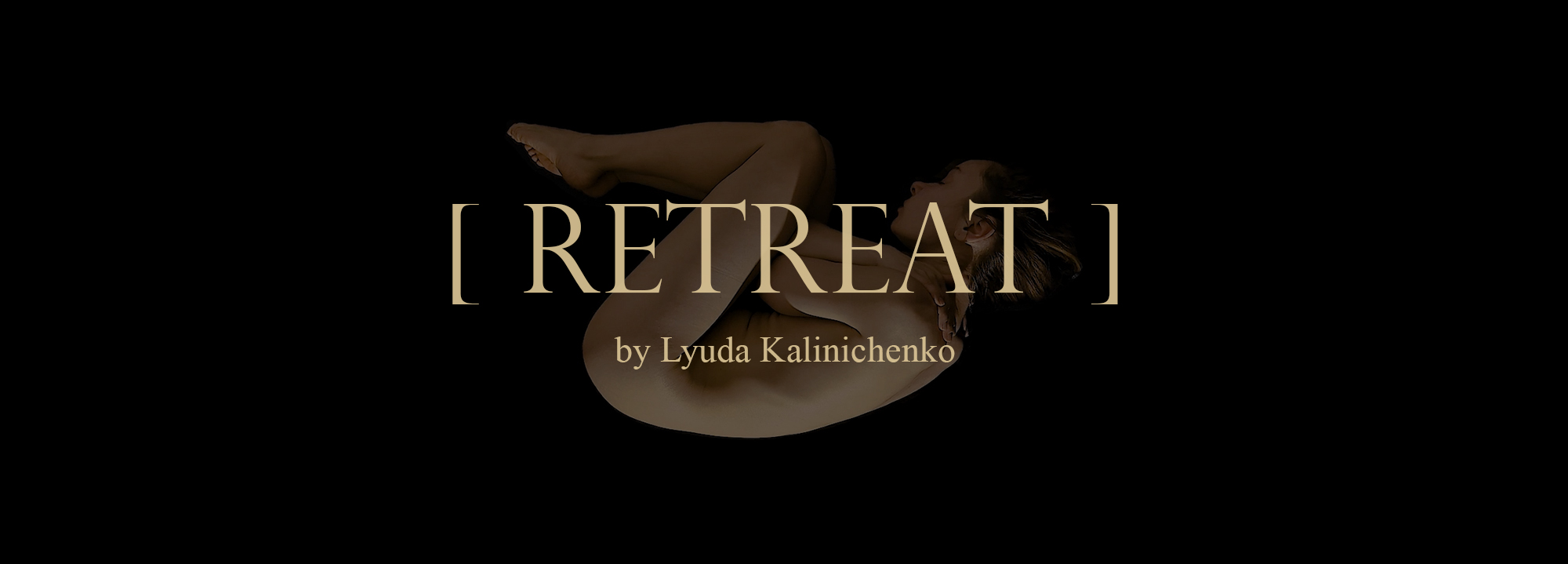
Sometimes You Need a Complete Vacuum to Hear Yourself: Performance [RETREAT] in Space

The video performance [RETREAT] by Lyuda Kalinichenko, created specifically for the international space art residency Xu Bing Space Art Residency, was shown in April on the screen of the SCA-2 Art Satellite. At the time of the presentation, the satellite was in low Earth orbit, approximately 400 kilometres above Earth. On 5 June, the documentation of the performance became available on the residency’s website.
The word [RETREAT] can be understood as withdrawal, departure, or temporary seclusion. In Kalinichenko’s work, however, it is not an escape, but a way of preserving oneself: a return to silence, to an inner state, and to a space before language, before social roles and time. Here, the metaphor “we are children born of the Universe” becomes almost literal.
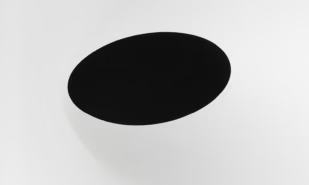
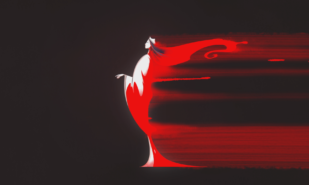
In the 90-second video, the artist lies against a black background in a foetal position, making almost imperceptible movements. The black background is perceived both as an inner space and as the cosmos extending beyond the satellite screen. In this way, a state of solitude, sleep, and vulnerability expands to a universal scale. DARIA PLAKSIEVA spoke with Lyuda Kalinichenko about the concept behind the work and its realisation.
![Sometimes You Need a Complete Vacuum to Hear Yourself: Performance [RETREAT] in Space | London Cult.](https://londoncult.co.uk/wp-content/uploads/2026/06/lk_sca_01-2.jpg)
It could be said that your video performance [RETREAT] is about preservation, withdrawal, and respite at the same time. Now that the work has taken place, could you describe in a few words what it is about? Has your understanding of it changed since you were preparing it, or did everything turn out exactly as you had imagined?
Yes, that is true: it is a work about preservation, withdrawal, and respite. But it is also about returning to oneself. About the idea that sometimes you need a complete vacuum in order to hear yourself. And there I am, in a fetal position — of course, not exactly me, but my digital copy — sleeping somewhere far away, in an endless black womb, in the place we came from and where, perhaps, we will one day return.
Interestingly, my last major work in the Urals was also connected to the image of infant sleep. At that time, I was looking at industrial quarries in satellite images. They looked like man-made crater-cradles. These cradles appeared to me as wounds in the earth that I wanted to fill with life. This is how the metal sculpture Industrial Baby appeared on the City Pond in Yekaterinburg, in the Urals.
Back then, I took on the role of a mother, feeling a great deal of energy, strength, and readiness to create. In [RETREAT], the roles have changed: now I have become the one who needs protection, that same infant sleep and a sense of safety — at least for 90 seconds.
![Sometimes You Need a Complete Vacuum to Hear Yourself: Performance [RETREAT] in Space | London Cult.](https://londoncult.co.uk/wp-content/uploads/2026/06/lk_sca_02-1.jpg)
Could you tell us how your work ended up in space?
About seven months passed between submitting the application to the Xu Bing Space Art Residency and the official release of the documentation. The idea did not come immediately. At first, many things felt too constructed, too insincere. And then something clicked — I simply curled up. That turned out to be the most precise gesture.
It was very unusual to receive emails from the organisers — almost like messages from the future. For example: We are very much looking forward to seeing [RETREAT] in space. At some point, all of this stopped sounding like fantasy and became a reality that was genuinely approaching.
By the way, the open call for artists is now open again, and the organisers recommend applying soon, as the project is planned to close in 2027.
![Sometimes You Need a Complete Vacuum to Hear Yourself: Performance [RETREAT] in Space | London Cult.](https://londoncult.co.uk/wp-content/uploads/2026/06/lk_sca_03-1.jpg)
Did you know in advance how the video performance would be presented, or was the form of representation unexpected for you? What feelings does this work and its unique location evoke in you?
Yes, I had a general idea of how it would look, because I had seen documentation of previous projects. The camera filming the screen of the SCA-2 Art Satellite is in a fixed position. The Earth moves, and the coordinates and time change.
Nevertheless, I was very nervous before watching the documentation for the first time. When I received the file, my whole family gathered together, we opened the video — and it felt almost like a sacred moment.
You see that it is not a montage. There is the Earth, there is space, there is the satellite screen with your work moving on it. And it feels as though you are flying there, moving synchronously with the Earth and the satellite. And all of it is real.
Who were the first viewers of your work? Did you receive any feedback from them? Will the work be presented to a wider audience?
If we are talking about the actual moment of transmission in space, then the first viewer was probably the camera. A kind of eye-lens — almost like in Kubrick’s 2001: A Space Odyssey.
After that, the video was received by the residency team and sent to me. Of course, I am not the first artist in space within this programme: several years ago, Joseph Kosuth and other wonderful artists took part in the first stage of the project. But for me, the very fact that my work was selected and shown on the satellite is already an enormous form of feedback.
![Sometimes You Need a Complete Vacuum to Hear Yourself: Performance [RETREAT] in Space | London Cult.](https://londoncult.co.uk/wp-content/uploads/2026/06/lk_sca_04-1.jpg)
Can your works from recent years be brought together under one common theme or experience? What stage of your artistic path do you feel you are in now? Is it even possible, or necessary, to divide the earlier stages of your practice into periods?
At the moment, I feel that I am once again at the beginning. It is difficult for me to divide my practice into clear themes or periods, although my works after moving are, of course, different from those I made in the Urals.
I am not one of those artists whose style is instantly recognisable. And that is both good and bad. It has always been important for me to experiment: with material, subject, place, and forms of presence. To be different. To be in several places at once. For me, making art is like rubbing Aladdin’s magic lamp. It often malfunctions, of course, but sometimes wishes do come true.
For example, I had always wanted to make music and perform on stage, but I did not have formal training or skills. Recently, I found a way: I combined drum machines, synthesisers, and a sewing machine.
I became interested not in sewing in order to produce an object, but in sewing as a process — in the same way that one can play music for the sake of sound or noise. Sewing and music have a lot in common: speed, rhythm, repetition, bodily movement. This image emerged: a seamstress-DJ. Stitch / sound / stitch.
And these processes have no natural end. They are like a Möbius strip, and only you decide when to stop.
![Sometimes You Need a Complete Vacuum to Hear Yourself: Performance [RETREAT] in Space | London Cult.](https://londoncult.co.uk/wp-content/uploads/2026/06/lk_sca_05-1.jpg)
Are there places on Earth, or beyond it, where you would like to show your art in the future? It seems impossible to go further than space — but perhaps the desire is not to go further, but deeper?
Indeed, after space it is difficult to think of a place that would be “further.” But when you reach the stars, what you want most is to return to Earth. Although I do still have a couple of ideas.
If you imagined that in one hundred years only one of your works would be found, which one would you want it to be?
I am not sure that I have one such work. But if we are speaking not about a work, but about a wish, I would want people in one hundred years to find a world where everyone lives happily, rather than dying for foolish ideas.
***
Lyuda Kalinichenko is a multimedia artist from the Urals, born in the USSR. She lives and works in London, UK. In her practice, she addresses personal and collective memory, loss, vulnerability, and ways of preserving the past. The starting point of her artistic path was a personal story: in 2016, her family photo archive was accidentally lost, after which the artist began to reconstruct her family memory through stories, photographs, archival research, and her own reconstructions. This process later formed the basis of her artist’s book.
Lyuda has been called the mother of Industrial Baby — a public art sculpture installed on the City Pond in Yekaterinburg, in the Urals. Her works have been presented in the main project of the 4th Ural Industrial Biennial of Contemporary Art and in the special programme of the 5th Ural Biennial. Her project Best Before: Unlimited was shortlisted for the Innovation Prize 2021 in the New Generation category. Her artist’s book projects include A Book About My Family and The Tale of How Zoya the Horse Learned to Fly.
Instagram: @lk_lyuda
Website: lkartist.art
The Xu Bing Space Art Residency Program is an international space art residency initiated by Chinese artist Xu Bing as part of the Star Chain of Arts project. On 3 February 2024, SCA-1, the project’s first satellite, was launched — effectively becoming one of the first artistic platforms of its kind in orbital space.
Xu Bing proposed the satellite not simply as a technical carrier, but as a new site for art and a new point of view. The project seeks to expand our understanding of space through art: to look at Earth from an unusual distance and to find new philosophical ways of reflecting on human experience, technology, and the vulnerable future of the planet. In its first stage, the project included internationally recognised artists, among them Joseph Kosuth, one of the key figures of conceptual art. The residency is currently holding another open call, but artists should act quickly, as the project is planned to close in 2027.